Live data from Hacker News

What it looks like when Google links to your website

raaw.se

41–50 of 68 posts

Re: What it looks like when Google links to your website

#41

Earlier quoted context omitted.

One thing that's bothered me almost every time I visited your awesome site over the last few years is that the link to the actual product is quite small and hard to see, in both places. For me personally a big "Go to site" button would make the site even nicer.

Thanks, we'll be sure to think about how we can make this better. The button/link is actually pretty big for all apps that don't have any additional links (like to app stores). See AOL Reader as an example. Is that reasonable or would you prefer something else? http://alternativeto.net/software/aol-reader/

I really like your site, it's the place I go when I look for an alternative to a specific app/webapp. I'm going to assume that most of your users are like me and come through your site by a google search. Some feedback:

- The main issue with your site is imho that it's trying to do two things at once. Next to giving alternatives to software, it also tries to be a categorized directory of applications. I would love for you to focus on only the former. Doing so would enable you to really declutter your site. There would be no more need for the grey navigation bar, nor for categories or tags.

- Give more prominence to: - The application searched for and to its external links. Don't be afraid to have users leave your site. - It's alternatives, on my laptop I can only see a single alternative above the fold. - User input, e.g. likes, comments and feedback. As you're a user input driven site, this is really important

- Give less prominence to or simply remove: - Questions, they look really empty and sites like http://webapps.stackexchange.com/ are better suited for this. - Forum, when looking for an alternative I simply want to take a look at a few options I don't much care for the forum - Recent user activities, I think it is simply clutter and no one but the person whose activity it shows cares.
Re: What it looks like when Google links to your website

#42

Earlier quoted context omitted.

On a slightly different tangent, why do people put the dollar sign in front of the numer?

Maybe because: $1 25¢

So that's like writing: Kg 19 300 g

I understand it's tradition, but the fact that people keep using it kills me. Especially when people start using kilo $, and in "$ 100K".

Re: What it looks like when Google links to your website

#43
post #2

We've also had a lot of traffic to https://starthq.com/apps/?q=reader as people look for Reader alternatives. Google should do this more often.

What a great idea. They should make a website so that when people search it gives them a suggestion of a site based on their query.

Re: What it looks like when Google links to your website

#44
post #10
post #4

"...AlternativeTo had about 217.000 visitors on that first day..." Why can't we all agree upon a universal, consistent notation for math and science?

s/217.000/217'000/ FIFY

Actually, no. The way he wrote it is (one of) the official way(s) to do it in Sweden.

Re: What it looks like when Google links to your website

#45
Congrats! I love alternativeTo. It's my way to train parents and friends to find the best free alternatives to whatever ad-bloated software SEO'd their way to the top of Google last time they decided they needed to convert a movie or download music.

This simple piece of advice (and a bookmark in their favorite browser) has greatly reduced the amount of PC rebuilding I've had to do for them over the years!

Re: What it looks like when Google links to your website

#46
post #22

Earlier quoted context omitted.

this is why I usually use spaces to separate thousands, so that I don't confuse people expecting either notation. The standard where I'm from is also a period for thousands, and a comma for the decimal fraction, but reading as much English scientific and computing literature, I am well aware that the period for decimal fraction is almost a de facto standard. So I tend to use spaces for the thousands and a period for…

This takes me back to 20 years ago when I was studying Japanese. Their traditional (pre-Arabic-numerals) system uses four-digit groupings instead of three: There are characters for ten, hundred, thousand, and ten-thousand. (I assume Chinese is similar.) Sometimes we use the number "1 million" to mean "a lot"; in that system it would be written as 100 ten-thousands. A more "natural" way to express "a lot" in that syst…

Or use the engineering notation: 217k users.

Re: What it looks like when Google links to your website

#47
post #22

Earlier quoted context omitted.

This takes me back to 20 years ago when I was studying Japanese. Their traditional (pre-Arabic-numerals) system uses four-digit groupings instead of three: There are characters for ten, hundred, thousand, and ten-thousand. (I assume Chinese is similar.) Sometimes we use the number "1 million" to mean "a lot"; in that system it would be written as 100 ten-thousands. A more "natural" way to express "a lot" in that syst…

Or use the engineering notation: 217k users.

> 2.17e5

FTFY

Re: What it looks like when Google links to your website

#48
post #12

Earlier quoted context omitted.

The 2006 CIA Factbook stated that the "US is the only industrialized nation that does not mainly use the metric system", (in addition to non-industrialised Burma/Myanmar and Liberia).

This particular case is not English vs. Metric, but rather lack of cohesion in the metric system. English: Use commas for separating thousands, use periods for decimals. Metric: Use spaces for separating thousands, use periods OR commas for decimals. In this instance, the English approach is obviously the superior one, as spaces are more confusing to use as a delimiter than commas, and there should only be one way to…

I´m european and the natural way for me is period for thousands and commas for decimals, although I´m aware of the imperial way, with commas for thousands and periods for decimals.

Another important difference is that in Europe we understand a billion as a million of millions (10^12), not a thousand of millions (10^9). For us, a 10^9 is a miliard. Luckily I´m also aware of the use of billions for 10^12 and whenever I read it on a US or UK text I understand correctly. Otherwise, saying that there are 7 billion people on Earth would be an extreme exageration...

Re: What it looks like when Google links to your website

#49
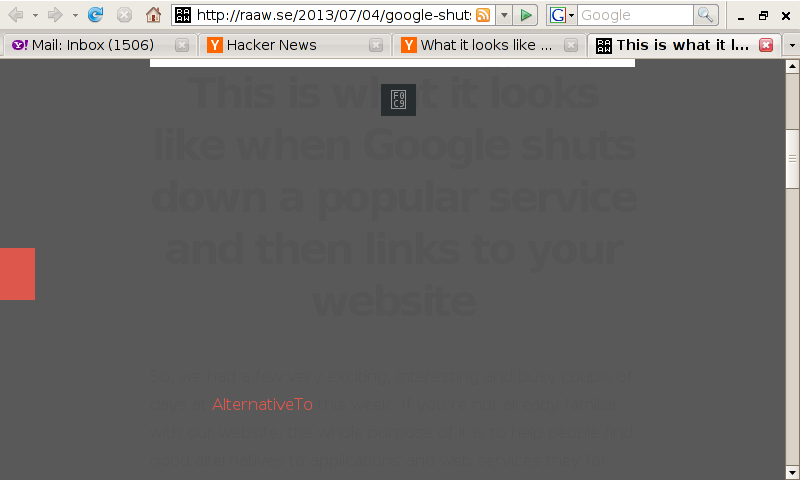
Not sure you'll see this, but this is what your page looks like on my browser:

http://www.livmathssoc.org.uk/images/AlternativeTo.png

I have, of course, scrolled down past the image. It took some considerable time before I realized there was any text there.

Just thought you'd like to know.

    Mozilla/5.0 (X11; U; Linux i686; en-US; rv:1.8.1.11) 
    Gecko/20071127 Firefox/2.0.0.11
(don't ask)

Re: What it looks like when Google links to your website

#50

Earlier quoted context omitted.

Maybe because: $1 25¢

So that's like writing: Kg 19 300 g I understand it's tradition, but the fact that people keep using it kills me. Especially when people start using kilo $, and in "$ 100K".

Tip: It's written with a lower-case k. Capital K in front of B means 1024 to some people (including me), but 1000 is always written as k.
Post reply on HN