Live data from Hacker News

San Diego photologs from the 1970s

beautifulpublicdata.com

41–50 of 55 posts

Re: San Diego photologs from the 1970s

#41
post #21

It is shocking how quickly California developed from agriculture to this, and how it basically stopped developing further after hitting this point. These photos could just as believably be van nuys in 2026. No wonder why we have a housing crisis. Progress and building to meet demand has been refused for almost 60 years.

> It is shocking how quickly California developed from agriculture to this

Check out Disneyland. There was nothing else there when it opened in 1955
https://www.youtube.com/watch?v=YtrVcOxVDls

Re: San Diego photologs from the 1970s

#43
post #27
post #25

Earlier quoted context omitted.

I think it's the only possible outcome if sprawl is allowed. New families with some money spend too much income buying house. Kids move out, parents get old and don't get out as much. Don't keep up the house, because they need to retire. Sell house that's only attractive to lower income. Low income statistics take over the area. Nearby businesses close from everything related to low income statistics. Repeat with new…

Infill development used to be allowed in California but it stopped in the early 70s when communities turned to zoning to exclude blacks and browns after redlining was made illegal. The many sundown towns did not go without a fight. There are still some pieces of what that infil looked like. The bog standard brick 5 story building you see all over east coast cities can be found in california in parts, often sticking o…

Communities did not turn to zoning in response to infill being disallowed. Zoning was around since at least 1917 and already for that purpose.

Zoning in the 70s was more a response to (1) homeownership property value protection (2) nimbys being given the power to block projects like they still do today, especially in highly "progressive" cities. The more progressive, the harder to build (3) people claiming expansion was bad for the environment.

Re: San Diego photologs from the 1970s

#44
post #21

It is shocking how quickly California developed from agriculture to this, and how it basically stopped developing further after hitting this point. These photos could just as believably be van nuys in 2026. No wonder why we have a housing crisis. Progress and building to meet demand has been refused for almost 60 years.

I work in commercial real estate, grew up in San Diego and work in the SoCal market. I am not joking that the MAIN problem is Prop 13, which came into effect 5 years after this video was made.

I deal with these owners EVERY DAY who would rather sit on crappy buildings and land because why not, it costs them nothing. They've owned forever. Literally TODAY I had an offer rejected from a Seller that would have yielded 80 units of affordable housing in an area with $150k median income, delivering completion in 2028-2029.

Re: San Diego photologs from the 1970s

#45
post #13
post #8

Earlier quoted context omitted.

I keep hearing that whole area is gonna be razed as part of the Midway/Sports Arena redevelopment, but I feel like as long as MCRD stays put, Les Girls will always have a home. LOL

The most recent draft of the Midway Rising Specific Plan ( https://www.sandiego.gov/sites/default/files/2025-09/dsd_app... ) says Les Girls stays; the development doesn't go north of Kurtz St. By my reading of the map, it means that that Midway Rising will cover the Salvation Army store and everything west of it between Sports Arena and Kurtz St (including the current parking lots). Of course, if/when Midway Rising d…

Oh no, they're going to knock down Soma? Such an iconic all-ages venue.

Re: San Diego photologs from the 1970s

#46
post #27

Earlier quoted context omitted.

Infill development used to be allowed in California but it stopped in the early 70s when communities turned to zoning to exclude blacks and browns after redlining was made illegal. The many sundown towns did not go without a fight. There are still some pieces of what that infil looked like. The bog standard brick 5 story building you see all over east coast cities can be found in california in parts, often sticking o…

Communities did not turn to zoning in response to infill being disallowed. Zoning was around since at least 1917 and already for that purpose. Zoning in the 70s was more a response to (1) homeownership property value protection (2) nimbys being given the power to block projects like they still do today, especially in highly "progressive" cities. The more progressive, the harder to build (3) people claiming expansion…

>Communities did not turn to zoning in response to infill being disallowed.

??? Zoning is the mechanism to disallow infill, it can't come in response to it. The book "The Color of Law" by Richard Rothstein covers how zoning as used as a new tool for racial exclusion in its third chapter. Indeed, modern socal remains a highly segregated area thanks to zoning decisions that ensure working class people, who are predominantly nonwhite, will find no suitable housing they might afford in the various lily white strongholds.

Re: San Diego photologs from the 1970s

#47
post #21

It is shocking how quickly California developed from agriculture to this, and how it basically stopped developing further after hitting this point. These photos could just as believably be van nuys in 2026. No wonder why we have a housing crisis. Progress and building to meet demand has been refused for almost 60 years.

I work in commercial real estate, grew up in San Diego and work in the SoCal market. I am not joking that the MAIN problem is Prop 13, which came into effect 5 years after this video was made. I deal with these owners EVERY DAY who would rather sit on crappy buildings and land because why not, it costs them nothing. They've owned forever. Literally TODAY I had an offer rejected from a Seller that would have yielded 8…

Prop 13 only sees statewide median homeownership period go up slightly in california compared to national average. The real issue is not these edge cases that prop 13 might bring about, but zoning.

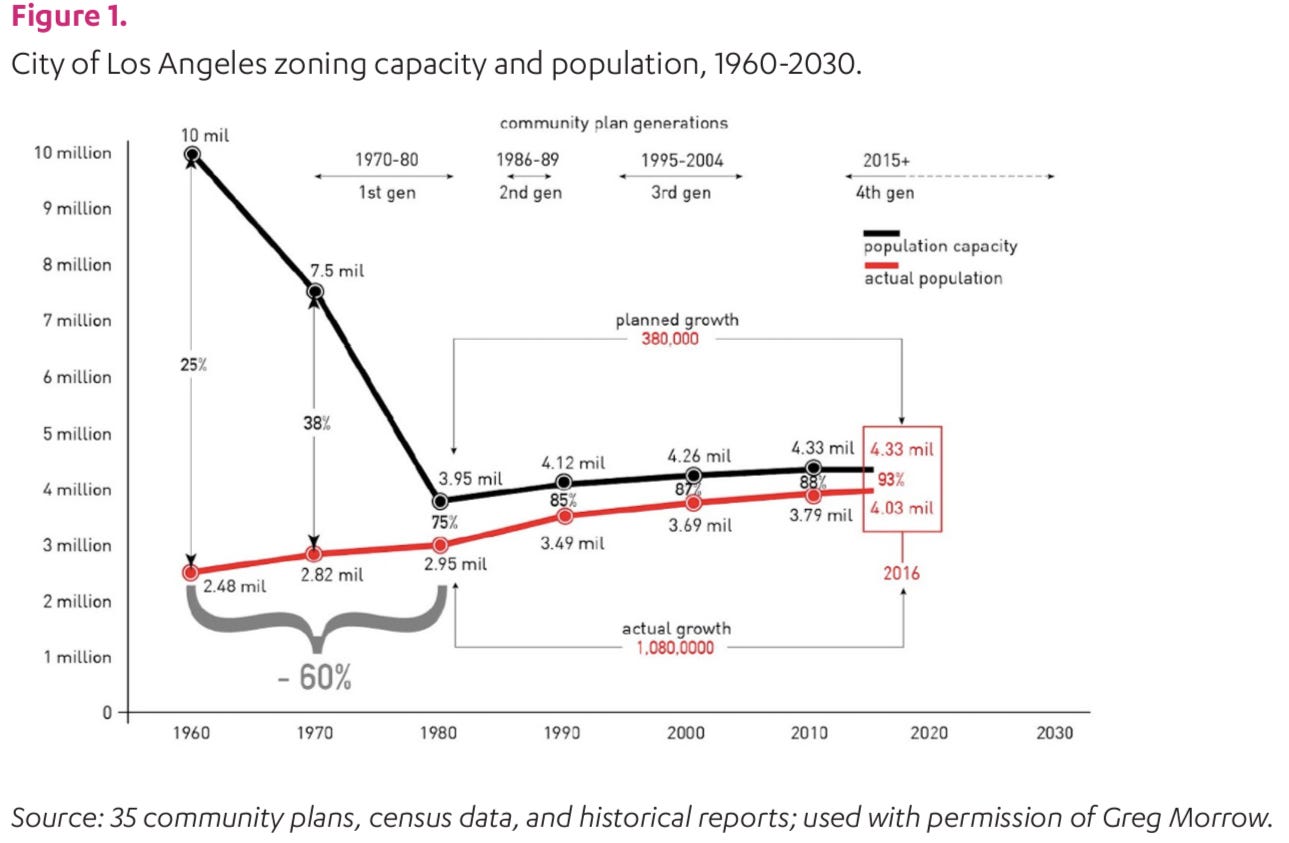
Have a look at this graph: https://substackcdn.com/image/fetch/https%3A%2F%2Fsubstack-p...

You can see how even with prop 13, even with various RSO ordinances, even with red tape, even with building code requirements, the demand for development has always been enough to build to the limits of what has been allowed through zoning, ever since cities like LA were widely downzoned in response to redlining being made illegal in the early 1970s and succeeding zoning plans.

Re: San Diego photologs from the 1970s

#48

Color is magnificent and I can't believe we've lost so much joy on our relentless march to hyper-optimized profit. I recently read another article about how everything has gotten more monochrome, will try to find it again. In scanning some slides from the 1970s, I was struck by the colors of the pants! Bright! Stripes! Fun! I sew shirts and gravitate towards bright prints, and everything tends to stand out because cl…

Excluding pantsuits, the 70's were a great time for clothes!

Re: San Diego photologs from the 1970s

#49
post #9

Nice you could choose if you would like your gasoline with or without service :-) (4:00). Why was the chain called "Der Wienerschnitzel" and not "Das Wienerschnitzel". It is (was) a proper noun, but why the wrong article? (5:02) A small part appears twice (from 8:51--9:06). more cyclists than I see in current streetview footage Coca-Cola delivery vans where yellow?

> Nice you could choose if you would like your gasoline with or without service :-) (4:00).

Yeah. Too bad you weren't able to choose if you would like your gasoline with or without lead yet.

Re: San Diego photologs from the 1970s

#50
post #47

Earlier quoted context omitted.

I work in commercial real estate, grew up in San Diego and work in the SoCal market. I am not joking that the MAIN problem is Prop 13, which came into effect 5 years after this video was made. I deal with these owners EVERY DAY who would rather sit on crappy buildings and land because why not, it costs them nothing. They've owned forever. Literally TODAY I had an offer rejected from a Seller that would have yielded 8…

Prop 13 only sees statewide median homeownership period go up slightly in california compared to national average. The real issue is not these edge cases that prop 13 might bring about, but zoning. Have a look at this graph: https://substackcdn.com/image/fetch/https%3A%2F%2Fsubstack-p... You can see how even with prop 13, even with various RSO ordinances, even with red tape, even with building code requirements, the…

Porque no los dos?

Zoning limits what and how much is permitted. Prop 13 changes the economics and greatly reduces churn and supply, both for redevelopment and migration.

Prop 13 takes the normal supply problems introduced by zoning and turbocharges them.

Post reply on HN