The existence of characters that need this much work to explain suggests to be that unicode is bloated. Not the only thing that suggests that, either.
The stated goal of Unicode is to support every past and present writing system in world world. Say what you will about that but I think just because a symbol's meaning might be obscure to us doesn't mean it isn't useful to someone else.
The existence of characters that need this much work to explain suggests to be that unicode is bloated. Not the only thing that suggests that, either.
That’s unavoidable given the goal: Unicode provides a unique number for every character, no matter what the platform, no matter what the program, no matter what the language. https://www.unicode.org/standard/WhatIsUnicode.html
What does "every character" mean? Did it really need to include emojis, for example? Domino tiles? Alchemical symbols? A much smaller number of characters would have been sufficient for all but a tiny number of cases.
Because that symbol was used as a notation symbol in those star charts and azimutal maps? The article quotes the Didot system, specifically, which focused on printing travel maps and is known not only in the French speaking world for its timely accuracy [1] as it was also using that very same map system. Maybe read the article next time? [1] https://en.wikipedia.org/wiki/Didot_family [2] https://fr.wikipedia.org/wiki…
I'm sorry, but I don't understand your comment at all. The linked article does not refer to Didot, nor does the Wikipedia page for the glyph in question. Neither the wikipedia page for the Didot family, nor for Histoire générale des voyages shows the Angzarr symbol, I've carefully checked on all the scans on these pages. In fact, any occurrence of the symbol would pre-date the current earliest known example (1963) by…
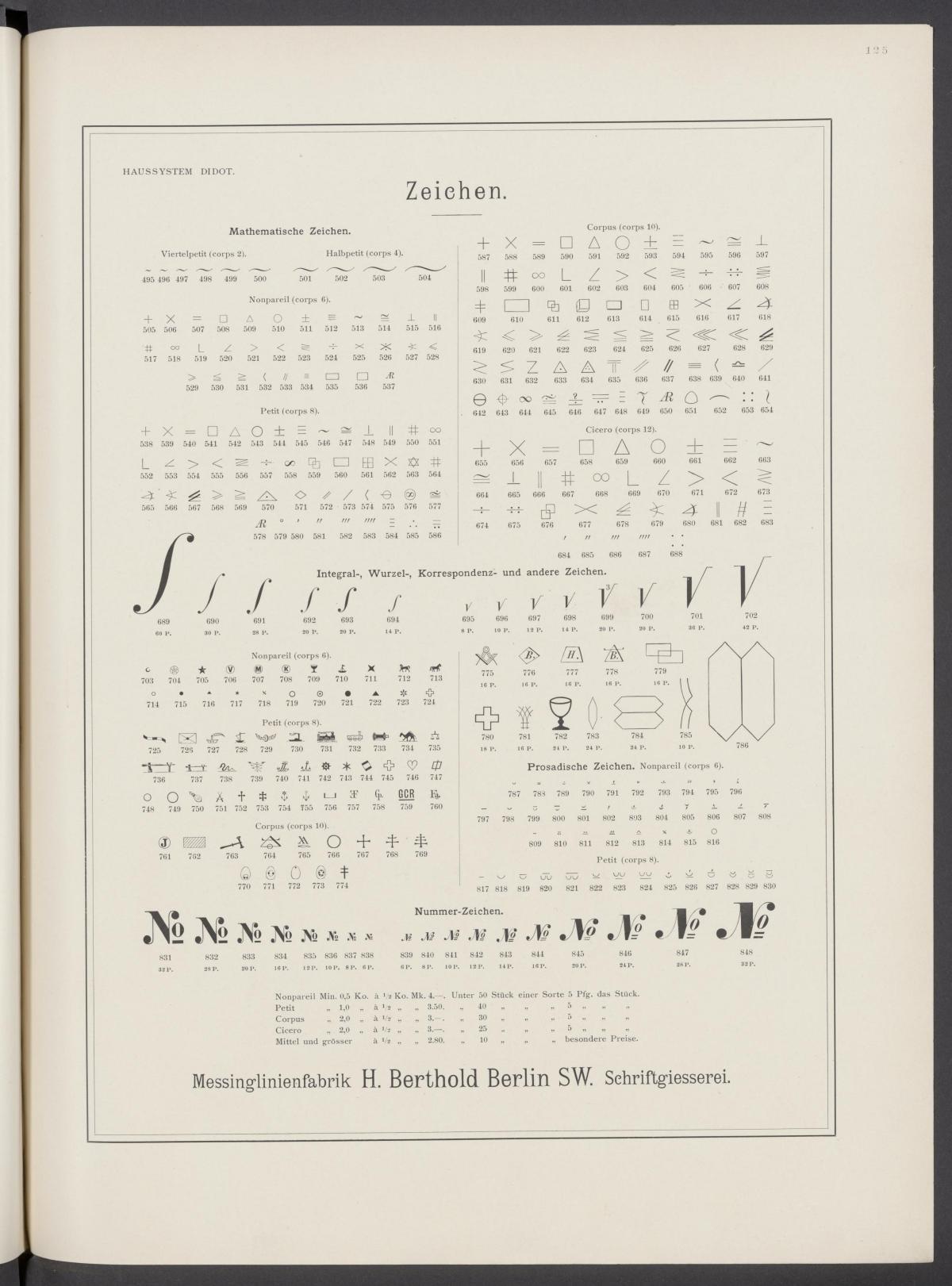
Check the photos in the article, specifically this one [1]
"Haussystem Didot", the title of the catalog, refers to a letter setting by the printing agency Didot, which is the one I linked on wikipedia.
The Gallica scans are linked in the wikipedia article. Each of those chapters has hundreds of pages.
I highly doubt that you eye scanned thousands of pages in French handwritten and mixed typesetted ... within less than a day. You definitely must be lying, they take months to read.
I am a bit surprised a unicode character could be a mistery at all. The unicode process is quite bureaucratic, so how comes there wasn't any justification given when the character was submitted for inclusion? After all, I know plenty of symbols that definitely are used routinely in some domains, but that are not a part of Unicode, and it appears that going through the process to actually get them included would be a bit of a chore.
One of the interesting things about Unicode is how many symbols exist that almost no one encounters in normal software. Every once in a while you run into something like this and realize the standard is not just for text encoding but also a kind of archive of specialized notation from different fields. It makes you wonder how many other symbols are sitting in the table that are still mostly unknown outside the niche…
> how many symbols exist that almost no one encounters in normal software. Unicode's entire point being to make "normal software" handle those symbols ;)
IMO the biggest omission in Unicode are game controller button and keyboard emojis, as very frequently arise in game tutorials.
I'm sorry, but I don't understand your comment at all. The linked article does not refer to Didot, nor does the Wikipedia page for the glyph in question. Neither the wikipedia page for the Didot family, nor for Histoire générale des voyages shows the Angzarr symbol, I've carefully checked on all the scans on these pages. In fact, any occurrence of the symbol would pre-date the current earliest known example (1963) by…
Check the photos in the article, specifically this one [1] "Haussystem Didot", the title of the catalog, refers to a letter setting by the printing agency Didot, which is the one I linked on wikipedia. The Gallica scans are linked in the wikipedia article. Each of those chapters has hundreds of pages. I highly doubt that you eye scanned thousands of pages in French handwritten and mixed typesetted ... within less tha…
That's great and all, but the point is that there still isn't a single known (to the community of people trying to find the origins of that symbol, so, safe to say, the vast majority of people in general) appearance of the character in the actual text (i.e. used for its purpose), so if you have an example of a map/book/anything where this character was used, providing the link/scan/photo would be very appreciated.
Check the photos in the article, specifically this one [1] "Haussystem Didot", the title of the catalog, refers to a letter setting by the printing agency Didot, which is the one I linked on wikipedia. The Gallica scans are linked in the wikipedia article. Each of those chapters has hundreds of pages. I highly doubt that you eye scanned thousands of pages in French handwritten and mixed typesetted ... within less tha…
That's great and all, but the point is that there still isn't a single known (to the community of people trying to find the origins of that symbol, so, safe to say, the vast majority of people in general) appearance of the character in the actual text (i.e. used for its purpose), so if you have an example of a map/book/anything where this character was used, providing the link/scan/photo would be very appreciated.
Great detective work re the azimuth finding for the glyph, but I believe the link to a sextant is tenuous at best. The author says it can, of course, be turned sideways to measure an azimuth with respect to an arbitrary meridian . That’s not correct. The tool for doing that is an azimuth ring sitting on a compass which allows the user to obtain the angle relative to north (the azimuth) between the user’s local meridi…
> Great detective work
"Haussystem Didot" in the article's referenced typesetting catalog refers to the typesetting of the Didot family's printing agency. And they used that symbol 1700 and onwards in their map navigation descriptions in these books:
I am gonna repeat myself, but search for the Gallica links in each of those books to find the scans. There you can see earlier usage and evidence that as I pointed out in other - downvoted comments - that this was commonly used for sextant navigation instructions.
> how many symbols exist that almost no one encounters in normal software. Unicode's entire point being to make "normal software" handle those symbols ;)
IMO the biggest omission in Unicode are game controller button and keyboard emojis, as very frequently arise in game tutorials.
Most games aren't shipping with full-fat unicode support or typefaces that could display those icons, though. Plus it'd start to break down with controllers that aren't simple A/B/X/Y.
Something got doubled six times in a row, big deal. In the case of the i-ching it's literally six bits of binary (expressed in yarrow stalks). In genetic codons there's four symbols instead of two, and three places instead of six, so the effect is the same. (Does base 4 have a name?)