Live data from Hacker News

How to Store Data on Paper?

monperrus.net

41–50 of 84 posts

Re: How to Store Data on Paper?

#43

Fun fact: magazines actually distributed software on paper briefly in the 1980s. https://youtu.be/mIGotStRCkA?si=toG5xeLMZzjIGTxC It's more like a long, linear barcode, but still. More often, they put the source code in the magazine and you'd just type it into your machine.

Oh yeah, I forgot all about those! The ZX spectrum was way before my time, but for some reason I still spent a lot of time typing code over from a magazine into a spectrum emulator as a kid.

Re: How to Store Data on Paper?

#44

Earlier quoted context omitted.

Adding 3 colors would make it base 5 (BW+rgb) and give log(5)/log(2) or about 2.3 times the information per dot.

2 dots at 5 possibilities each gives 25 (5^2) 2 dots at 2 possibilities each gives 4 (2^2) They only diverge from there. Or am I doing my math wrong?

[deleted]

Re: How to Store Data on Paper?

#45
Acid-free paper has a lot to recommend it: an archival lifespan of about 1000 years, low cost, and widespread equipment for printing it en masse very cheaply. Other media are superior in one or another way, but all are far more expensive.

It's probably worth mentioning https://github.com/za3k/qr-backup/ which is tested in practice rather than merely theoretical. It doesn't achieve very high density, though.

The theoretical information capacity of an uncoated 600dpi laser-printed page ought to be close to 600×600 bits per square inch, 23.6×23.6 bits per square millimeter in modern units. This is 33.7 megabits per US letter page or 34.8 megabits per A4 page. The bit error rate of a laser printer is quite low, under 1%, and the margins are maybe another 5% at most. So modest ECC ought to be able to deliver most of that channel capacity in practice. QR codes and OCR apparently don't come close.

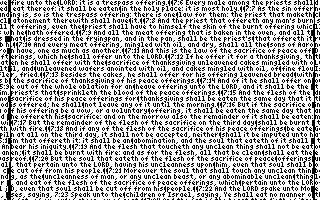
As an exercise, 13 years ago, I designed a proportional 1-bit-deep pixel font for printable ASCII, based on Janne Kujala's work, that averages about 3½×6 pixels. This is about 20 bits per character, so a letter-sized page should hold almost a megabyte of human-readable ASCII text. I generated the King James Bible in it at 600dpi. It comes to about four pages. Printed out in a half-assed way at double size (300dpi) on a 600dpi printer, you can read it pretty easily with a good magnifying glass. I have not yet been able to get an even partly readable printout at full resolution. If someone else tries it, I'm interested in hearing your results.

http://canonical.org/~kragen/bible-columns.png (warning, 93+-megapixel image, 4866×19254)

http://canonical.org/~kragen/bible-columns-320x200.png (small excerpt from the above)

http://canonical.org/~kragen/sw/netbook-misc-devel/6-pixel-1... (the font as a 374×7 image)

http://canonical.org/~kragen/sw/netbook-misc-devel/propfontr... (the image generation program I regret having written in Python because it won't run in current Python)

http://canonical.org/~kragen/sw/netbook-misc-devel/bible-pg1... (test input text, public domain everywhere except the UK)

Re: How to Store Data on Paper?

#47

Earlier quoted context omitted.

Adding 3 colors would make it base 5 (BW+rgb) and give log(5)/log(2) or about 2.3 times the information per dot.

2 dots at 5 possibilities each gives 25 (5^2) 2 dots at 2 possibilities each gives 4 (2^2) They only diverge from there. Or am I doing my math wrong?

Information is ~log(possible states) according to Shannon.

Log(25)/log(4) is 2.3. Among other things this definition has the nice property that two disks/pages/drives/bits together contain the sum of the capacities instead of their product.

Re: How to Store Data on Paper?

#48

Color Dot Encodings is interesting, you could encode data in a floor mozaic. And with my limited understanding the more colours the high the amount of data? You could encode data in monolithic structures this way. They'd last longer than paper and given future generations lots of confusion trying to figure out the meaning.

Except when the colors fade over time and people steal the purple ones to decorate their homes preferentially.

Re: How to Store Data on Paper?

#49

Fun fact: magazines actually distributed software on paper briefly in the 1980s. https://youtu.be/mIGotStRCkA?si=toG5xeLMZzjIGTxC It's more like a long, linear barcode, but still. More often, they put the source code in the magazine and you'd just type it into your machine.

I typed in a lot of Atari BASIC code from magazines but I never heard of this. Really cool!

Re: How to Store Data on Paper?

#50
I have this type of issue professionally too, even though we don't use paper. For regulatory reasons, the only approved format we are allowed to use for long term archiving is PDF/A. No attachments, only pages in a single PDF document.

It has shown to be an issue for including data, or spreadsheets. Most colleagues just print Excel files to a PDF that gets appended, but while it complies with the regulation it's basically unusable as-is.

Post reply on HN
