I've always wondered about the core of these gas giants. I assume it is some liquid form of light elements. What is puzzling is the presence of the gas giants in the middle of solar system's planetary line up: why are they in the middle and the ones closer or further away from the central star are not like them? Is it the temperature gradient?
Jupiter was formerly twice its current size, had a much stronger magnetic field
41–50 of 78 posts
Re: Jupiter was formerly twice its current size, had a much stronger magnetic field
#42 > Because Amalthea and Thebe have slightly tilted orbits, Batygin and Adams analyzed these small orbital discrepancies to calculate Jupiter's original size…
This seems like a non-sequitur. What do tilted orbits have to do with size?Re: Jupiter was formerly twice its current size, had a much stronger magnetic field
#43How is the size defined for a gas planet? The gas density just keeps dropping, where do you draw the line (isosurface, rather)? Earth's radius is always the one without earth's atmosphere.
It's a matter of definitions, so we skip them and just choose something that makes sense to humans.
Re: Jupiter was formerly twice its current size, had a much stronger magnetic field
#44I've always wondered about the core of these gas giants. I assume it is some liquid form of light elements. What is puzzling is the presence of the gas giants in the middle of solar system's planetary line up: why are they in the middle and the ones closer or further away from the central star are not like them? Is it the temperature gradient?
In an Arthur C Clarke story (I forget which one) the core of jupiter is a planet sized diamond.
Re: Jupiter was formerly twice its current size, had a much stronger magnetic field
#45How is the size defined for a gas planet? The gas density just keeps dropping, where do you draw the line (isosurface, rather)? Earth's radius is always the one without earth's atmosphere.
The density falls off pretty steeply at the “edge”, so the exact definition only makes little difference for the radius: https://www.researchgate.net/figure/Density-vs-radius-for-a-...
Re: Jupiter was formerly twice its current size, had a much stronger magnetic field
#46I've always wondered about the core of these gas giants. I assume it is some liquid form of light elements. What is puzzling is the presence of the gas giants in the middle of solar system's planetary line up: why are they in the middle and the ones closer or further away from the central star are not like them? Is it the temperature gradient?
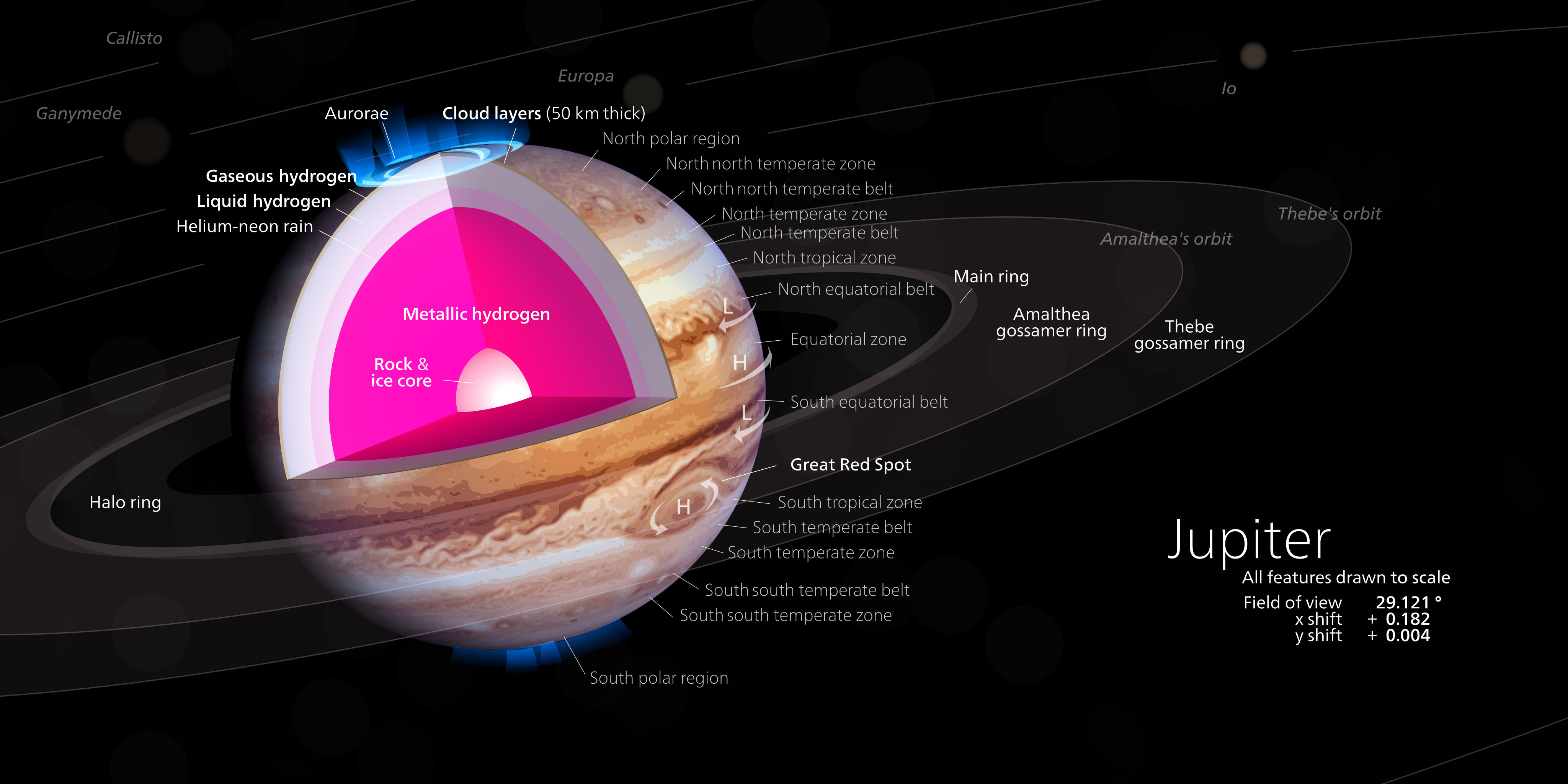
The core of Jupiter is thought to contain metallic hydrogen .
https://upload.wikimedia.org/wikipedia/commons/b/b5/Jupiter_...
Re: Jupiter was formerly twice its current size, had a much stronger magnetic field
#47Earlier quoted context omitted.
Like the interior of the planet, the atmosphere is overwhelmingly hydrogen and helium. And helium is liquid even at 0 temperature unless under pressure, so presumably (?) would be liquid on the surface. These materials are mechanically very different than the silcates and metals dominating the Earth’s crust, and I don’t think we even have well measured bulk properties? Not sure what erosion processes would look like.
That's wild to think about. My mind is struggling to picture 'liquids on the surface' of Jupiter. No idea what that would look like.
https://en.wikipedia.org/wiki/Dragonfly_(Titan_space_probe)
The single image from the surface by the Huygens probe leaves a lot to be desired.
https://en.wikipedia.org/wiki/Titan_(moon)#/media/File:Huyge...
Re: Jupiter was formerly twice its current size, had a much stronger magnetic field
#48I am deeply skeptical of any "research" that concludes something in the past. The scientific method relies on observation, experimentation, and replication, but these aren't possible with past events, so we can't directly test or falsify historical claims. Instead, researchers infer conclusions based on indirect evidence like documents, artifacts, or statistical patterns—often without being able to isolate variables…
Re: Jupiter was formerly twice its current size, had a much stronger magnetic field
#49Earlier quoted context omitted.
The density falls off pretty steeply at the “edge”, so the exact definition only makes little difference for the radius: https://www.researchgate.net/figure/Density-vs-radius-for-a-...
This is because of Newtonian gravity being inversely proportional to the square of the radius, right?
Re: Jupiter was formerly twice its current size, had a much stronger magnetic field
#50I am deeply skeptical of any "research" that concludes something in the past. The scientific method relies on observation, experimentation, and replication, but these aren't possible with past events, so we can't directly test or falsify historical claims. Instead, researchers infer conclusions based on indirect evidence like documents, artifacts, or statistical patterns—often without being able to isolate variables…
This is how young earth type misunderstandings begin. Thanks for bringing us inside the mind.