Why does the sun shrink and disappear just past the halfway point on the keogram?
Combining 15s interval whole-sky-camera photos to form a 4y spanning keogram
41–50 of 93 posts
Re: Combining 15s interval whole-sky-camera photos to form a 4y spanning keogram
#42Why does the sun shrink and disappear just past the halfway point on the keogram?
This post? https://astrodon.social/@cgbassa/113770444896606353
That's the moon, and it looks like it's increasing cloud cover + dawn causing camera to decrease overall exposure.
Re: Combining 15s interval whole-sky-camera photos to form a 4y spanning keogram
#43Incredibly cool. I love this so much, both artistically as well as how it demonstrate the equation of time [1] -- the fact that the changes in sunrise and sunset are not symmetrical. On the other hand, it's driving me absolutely crazy that he centers the image at 4:00 rather than midnight. Or maybe that's to show the shimmer of sunlight a little after noon on the right hand side? I can't figure out why it's "bluest"…
One of the commenters noticed this as well, the author says it is something automatic in the exposure. https://fediscience.org/@Birk_lab/113770845539931892
#1 rule of timelapse: manual white balance, manual shutter speed, manual aperture, manual agc/iso, manual focus.
Re: Combining 15s interval whole-sky-camera photos to form a 4y spanning keogram
#44This is fantastic, and like another commenter mentions, a beautiful continuation of an age old practice: measuring the sky.
Very cool that their hardware keept chugging along for years without hiccup, too.
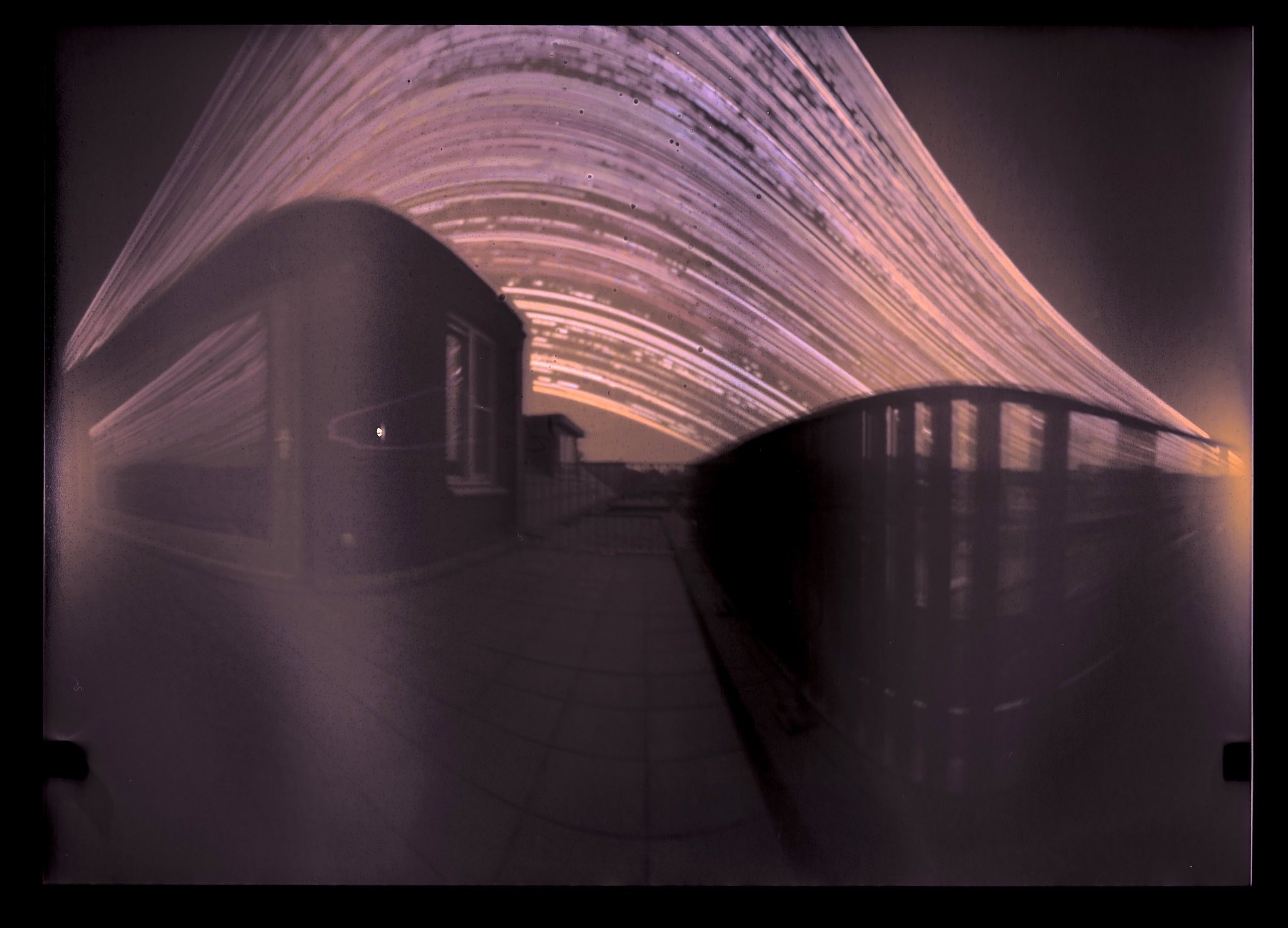
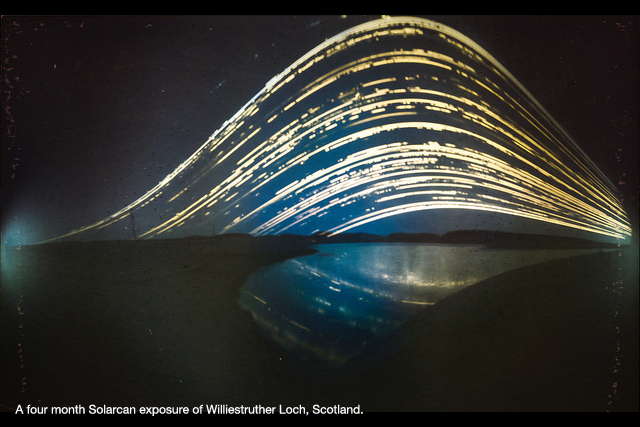
If you want to do something kinda similar but far less involved: a very lo-fi, no computer involved thing to do is an ultralong photographic exposure (months, a year, longer) with a pinhole camera.
The results are quite artistic IMO [1], the camera is fire-and-forget and you don't need any chemicals to develop the image. Just photograph/scan the photographic paper and invert the colors.
I'm not affiliated with them, but Solarcan sells ready made single-use pinhole cameras. An almost zero-regret purchase I'd say.
[1] You see the sun move through one year of skies, as seen from my balcony: https://files.rombouts.email/IMG_6500.jpeg
People have made wonderful, mildly spooky pictures with these: https://solarcan.co.uk/wp-content/uploads/2018/05/solarcan-p...
Re: Combining 15s interval whole-sky-camera photos to form a 4y spanning keogram
#45Annnd, this is exactly how humanity figured out astronomy before the telescopes: by taking multi-year observations and keeping detailed records! See Antikythera mechanism, Tycho Brahe, etc. Arguably the entire Greek epistemology was so solid because their astronomy turned out to be an early proving ground for the scientific method.
This is something I mention to the younger kids at start parties. Way back then, there was no internet, no devices, no tv, no radio, no movies, and more importantly no easily accessible calendars. You couldn't help but look up at the night sky. There was really nothing else to do, and when the only thing available to know when to plant and harvest was based on the constellations visible at the time. It helps put thin…
> There was really nothing else to do
Well, nothing to do except for storytelling, music, dancing, parties, games, plays, sports, eating, drinking, visiting, festivals, gossip...
People have been pretty good at keeping themselves entertained for a very long time.
Re: Combining 15s interval whole-sky-camera photos to form a 4y spanning keogram
#46Earlier quoted context omitted.
Oh that's a real shame then. The resulting composite images are certainly artistically interesting to look at, and you can see the big-picture effects like sunrise/sunset and moon, but that explains why you can't see the gradual brightening at dawn, or degrees of darkness at night. It seems like if you wanted to do this accurately, you'd need to lock exposure to handle a bright blue sky without blowing out -- both ap…
Yeah, I agree this should be using a fixed exposure (possibly on a schedule) with locked white balance. They are using an astro camera so the sensor is very sensitive, they can get away with extremely low exposure times.
> get away with extremely low exposure times
For night sky photography with an astro cam you’re still looking at exposure times of 20-60s at night (possibly also increasing the gain at night) and milliseconds during the day. The dynamic range is immense.
As someone who has struggled with this for my own allskycam, it’s extremly difficult to have white balance settings that perform well at all times of the cycle, especially with a camera designed to be more sensitive in the IR part of the spectrum (which will always look unrealistic). Settings that give you lovely white clouds and blue skies during the day tend to give you purple skies and green clouds at night. The quality of light is different so the white balance is different.
You can use autobalance or different white balance profiles for day and night but they each have issues.
Re: Combining 15s interval whole-sky-camera photos to form a 4y spanning keogram
#47I generate these type of charts [1] focused on the daylight hours so it was a surprise to see a concave shape instead of a convex one. Awesome way to validate these computer generated charts with captured physical data. [1] https://shademap.app/@52.39941,4.88468,11.49849z,17360064872...
This is really neat. I'm curious where the data for the tree shadows comes from though. I was surprised to see that the trees in my yard and my neighbor's yard were all mapped by your service, since I live in a small town in the middle of nowhere. I read the "how it works" FAQ section, which explained that building shadows come from the map services, but it didn't mention trees.
I built a similar shadow mapping tool for some commercial party that wanted to accurately estimate solar panel production in The Netherlands... In my specific case I could access very accurate LIDAR heightmaps gathered from planes.
This means you can ray-march the location of the sun throughout the year over the entire country to calculate exactly where and when a surface is occluded by shadows from nearby (or even faraway, sometimes) objects.
The LIDAR data can be as detailed as a shadow cast by antennas, a chimney or a tree... Which is more important than you'd think, because a little bit of shadow on a single panel means that all panels daisy-chained to that panel will see an efficiency drop! (So you either don't chain them but give each panel its own inverter, or you wreck your neighbors chimney)
Re: Combining 15s interval whole-sky-camera photos to form a 4y spanning keogram
#48Incredibly cool. I love this so much, both artistically as well as how it demonstrate the equation of time [1] -- the fact that the changes in sunrise and sunset are not symmetrical. On the other hand, it's driving me absolutely crazy that he centers the image at 4:00 rather than midnight. Or maybe that's to show the shimmer of sunlight a little after noon on the right hand side? I can't figure out why it's "bluest"…
I think the blueness is because clouds at dawn and dusk reflect atmospheric colors more, whereas midday the clouds light up as more of a white from diffusing sunlight. 100% made up theory on my part, but I think it makes sense? I asked o1 to estimate colors by hour and its reasoning and estimates seem fairly convincing[1], and also show more saturated blues dawn and dusk, though it did not model clouds. 1. https://ch…
Not sure about the accuracy of the results but the theory’s correct. The colour of sunlight changes as it passes through different thicknesses of the atmosphere and the proportion of direct light, refracted light and bounced light changes.
Re: Combining 15s interval whole-sky-camera photos to form a 4y spanning keogram
#49So cool that the shape resembles an hourglass!
Re: Combining 15s interval whole-sky-camera photos to form a 4y spanning keogram
#50You've got much better weather than we do. Here's mine from near Louisville KY (from Aug 2023 to Aug 2024) https://www.facebook.com/groups/101640086556073/posts/794426...