Live data from Hacker News

It's hard to write code for computers, but it's harder to write code for humans

erikbern.com

41–50 of 147 posts

Re: It's hard to write code for computers, but it's harder to write code for humans

#41
There was an article similar to this less than 2 weeks ago: https://news.ycombinator.com/item?id=41566097

This whole issue of writing for people really distills down to two skills:

1. Empathy

2. Writing

There is a world of difference between writing some code and writing an application, a product. That is all this article is about, though less explicitly. Empathy is a factor in this because its the difference between self-orientation and external-orientation. Self-orientated developers are primarily concerned with easiness, convenience, code vanity, and other subjectivity criteria. It comes down only to their effort of delivery.

Externally-oriented developers are primarily concerned with architecture and documentation because for them success is all about how other people receive their work product. Simplicity is more important than easiness because externally-oriented developers know they cannot read minds and have no idea what other people find easy, but they do know how to reduce steps and keep their code small.

In the brain writing an application, from a holistic product perspective, is no different than writing an essay, article, or book. Its all about organization and features. The code is something that comes later, like words on a page. For people who only write pieces of code they never develop the higher order organizational skills that brings it all together. It also works in the inverse in that if a person cannot write an essay with ease they cannot envision writing a new application.

Those are the reasons I super detest frameworks. Frameworks deprive developers the practice necessary to write original software which means they are not developing those organizational skills. Its a massive gap that the inflicted cannot see, but is so enormously apparent to those that can see it. From a behavior perspective its no different than a learning or neurological disorder in that the inflicted know something is missing, but have no means to see what that something is, and that drives massive emotional insecurity.
Re: It's hard to write code for computers, but it's harder to write code for humans

#42
Well, there is at least one effort at a solution:

http://literateprogramming.com/

and I've found that John Ousterhout's recent book, _A Philosophy of Software Design_ is one of the most notable programming books of the past decade and speaks to many of these difficulties so well that I added it my effort at a list of (mostly) Literate Programming books:

https://www.goodreads.com/review/list/21394355-william-adams...

The other issue here is the still unanswered question:

>What does an algorithm look like?

and by extension, the further question of:

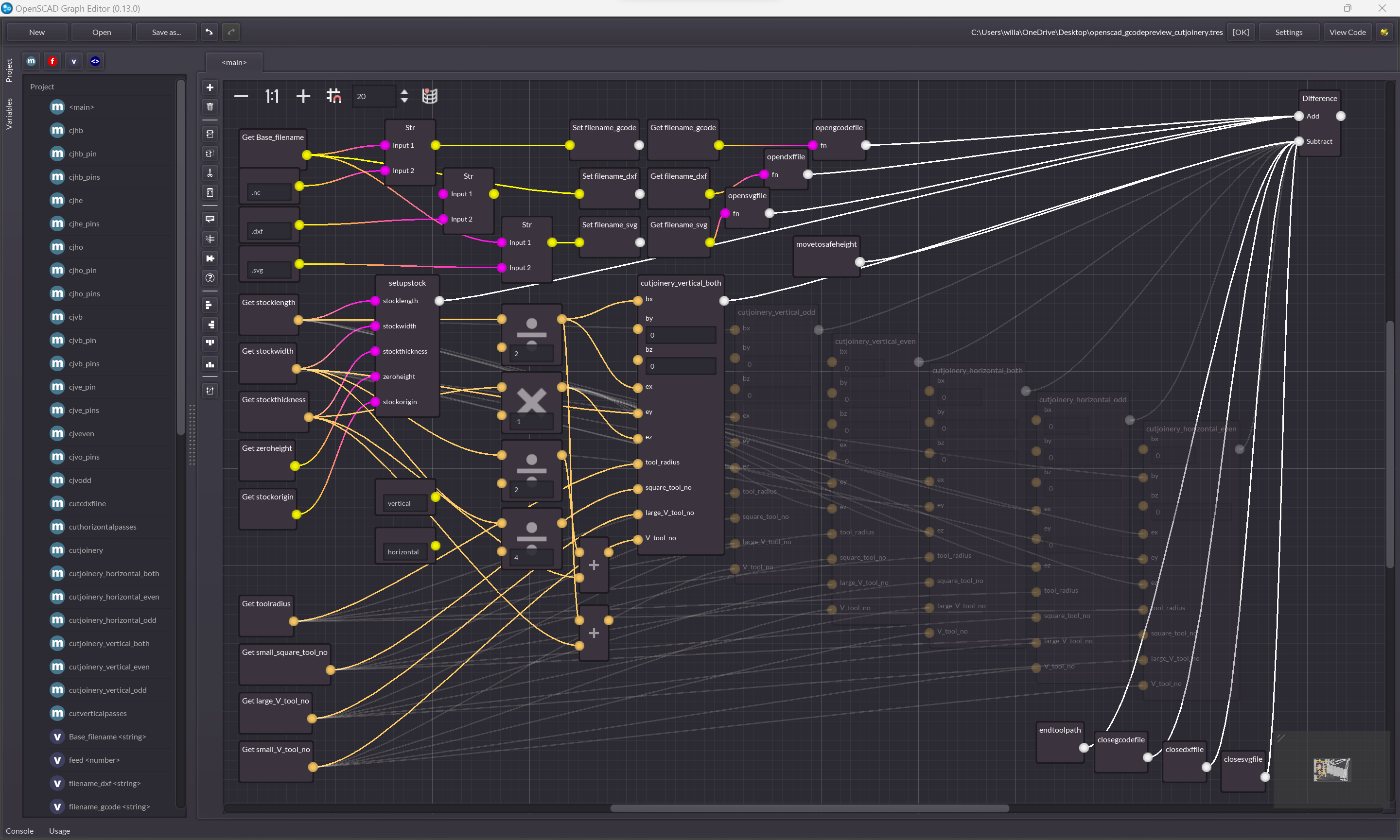
How does one manage a visual representation of a program when it gets beyond the size of one screen/window, or a page in a book, or for the largest ones, a poster?

With a bit of help of tex.stackexchange.com I was able to put together a Literate Programming system which allows me to use (La)TeX w/o the comment character which docstrip mandates:

https://github.com/WillAdams/gcodepreview/blob/main/literati...

(it's a little clunky, since that file has to be customized for the files in a given project)

but it allowed me to switch from having three files open in three different OpenPythonSCAD windows to a single .text file which makes a .pdf: https://github.com/WillAdams/gcodepreview/blob/main/gcodepre... which has a ToC, and multiple indices all nicely hyperlinked, and which makes a search/review of the code into a vertical scroll.

That said, I sympathize w/ the author quite a bit, and often work up snippets of code using either Blockly or BlockSCAD3D: https://www.blockscad3d.com/editor/ or https://github.com/derkork/openscad-graph-editor

https://raw.githubusercontent.com/WillAdams/gcodepreview/mai...

Re: It's hard to write code for computers, but it's harder to write code for humans

#44
> “Humans learn from examples, not from “core concepts”

Nitpicking maybe but I disagree with tfa on this point; not all humans work this way. Those of us who might actually prefer the general -> specific direction are already largely ignored in k12 and may only begin to thrive in higher education. Since we’re already kind of underserved, there’s no need to also deny that we exist!

Re: It's hard to write code for computers, but it's harder to write code for humans

#45
From Code Complete:

    “The smaller part of the job of programming is writing a program so that the computer can read it; the larger part is writing it so that other humans can read it.” (P.733)
Has stayed with me for ~20 years.

Re: It's hard to write code for computers, but it's harder to write code for humans

#46

> “Humans learn from examples, not from “core concepts” Nitpicking maybe but I disagree with tfa on this point; not all humans work this way. Those of us who might actually prefer the general -> specific direction are already largely ignored in k12 and may only begin to thrive in higher education. Since we’re already kind of underserved, there’s no need to also deny that we exist!

I need both. Truly learning for me is learning core concepts, but examples are “known correct” cases I can test that understanding against. If something in the example is surprising, I know my model isn’t complete yet (or the example is wrong lol)

Re: It's hard to write code for computers, but it's harder to write code for humans

#47
post #13

Earlier quoted context omitted.

I didn't find it contradictory. The first one is about how to start learning about something more easily and the second one about how to organize it all so that it's easier to use and understand as a whole. That may also help with getting started too. I personally agree that examples are a very efficient way to get started and you can learn the details incrementally in a top-down fashion. Some text books during my st…

There is even a headline saying "Getting started is the product". No, it is not. If your product doesn't have nice core concepts, then I don't even want to get started with it. Top-down is fine, as long as there is an actual bottom of core concepts.

again, not contradictory. have good core concepts, combine with good entry corridors. good concept with entry blocked by obtusity and esoterics is not a product ready for consumption.

i didn’t see the authors suggest that good concepts are unimportant.

Re: It's hard to write code for computers, but it's harder to write code for humans

#48

> “Humans learn from examples, not from “core concepts” Nitpicking maybe but I disagree with tfa on this point; not all humans work this way. Those of us who might actually prefer the general -> specific direction are already largely ignored in k12 and may only begin to thrive in higher education. Since we’re already kind of underserved, there’s no need to also deny that we exist!

I need both. Truly learning for me is learning core concepts, but examples are “known correct” cases I can test that understanding against. If something in the example is surprising, I know my model isn’t complete yet (or the example is wrong lol)

I also find “known incorrect” examples to be useful, for analogous reasons.

But the worst is when there is no good and thorough description of the conceptual model and of how the concrete examples relate to it, because then the system remains a black box you can’t properly reason about, regardless of how many hands-on tutorials and cookbook examples you’ve seen.

Re: It's hard to write code for computers, but it's harder to write code for humans

#49

> “Humans learn from examples, not from “core concepts” Nitpicking maybe but I disagree with tfa on this point; not all humans work this way. Those of us who might actually prefer the general -> specific direction are already largely ignored in k12 and may only begin to thrive in higher education. Since we’re already kind of underserved, there’s no need to also deny that we exist!

Yeah, it might be me. I learned microcontrollers by learning assembly, gdb, as, ld, then gradually switched to C, wrote my own "library", then slowly learned about vendor library and gradually replaced by code with proper approach.

Can't imagine learning this stuff from the vendor code examples. I wouldn't understand a thing.

This approach works for me, but only when documentation is extensive. When vendor suggests "copy this example and tinker with code until it works the way you want", this approach just throws me off and I absolutely lose any will to learn. Examples are very important, but not as starting point.

Re: It's hard to write code for computers, but it's harder to write code for humans

#50

> “Humans learn from examples, not from “core concepts” Nitpicking maybe but I disagree with tfa on this point; not all humans work this way. Those of us who might actually prefer the general -> specific direction are already largely ignored in k12 and may only begin to thrive in higher education. Since we’re already kind of underserved, there’s no need to also deny that we exist!

Maybe I'm dimmer than the average techie, but I need both. Much of my current job is frustrating because it's a big company and every new task I encounter is presented with only an example of how the previous person did it. Instead of, "This is what we're trying to achieve, this is how the thing works, this is how we do it," all that ever gets exposed to ICs is the "this is how we do it" part. This makes it impossible to reason about, adjust, and troubleshoot when even the slightest deviation is required. Yes, there is often SOME documentation tasks which are performed very often, but it's often outdated or incomplete. But it's not in a wiki, so not just anyone can updated at any time, there's a whole obnoxious process for updating the docs, which is why they never get updated.

Now that I think of it, this reminds me quite a bit of my time in the military...

Post reply on HN