Earlier quoted context omitted.
I remember reading/hearing somewhere that the bullet cluster actually fits MOND better than dark matter. I think it was a video by Sabine Hossenfelder but I can't find it right now and I'm not qualified to say whether it made sense or not.
Bullet cluster is inconsistent with LCDM on the grounds that given the apparent dark matter:matter ratio a collision between clusters of that size is something like unlikely to the tune of one in a trillion? IIRC universes. (Aka the collision should not have happened in the first place). The thing about lensing is that we don't have a solution in (GR would need to be tweaked if MOND is true -- the math is much harder…
The possibilities for dark matter have shrunk
41–50 of 82 posts
Re: The possibilities for dark matter have shrunk
#42Earlier quoted context omitted.
I think primordial black holes are the Occam's Razor solution too. No exotic new particles required, no modifications to gravity required, no new physics period. Observational results have ruled out certain masses of black holes but far from all.
AFAIK they are the only explanation that requires no new physics.
https://tritonstation.com/2024/06/18/rotation-curves-still-f...
Re: The possibilities for dark matter have shrunk
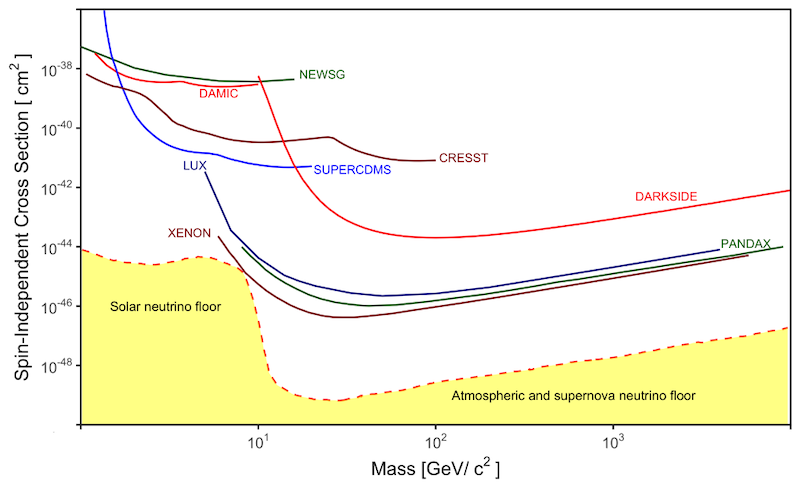
#43Notably, the possibilities are quasi-finite because of the solar neutrino noise floor. When we reach that, we stop needing to scale to 10x larger detectors for a 90% reduction in reaction cross section, and they start to need to be 100x larger, in my understanding. Even in a world with WIMPs, we aren't necessarily privileged to have them show up above the solar neutrino noise floor. It's going to be funny if the reas…
Maybe the justification for interstellar colonization will be so we can run a DM experiment on the near-relativistic ship during the trip. Boost those dark matter particles to some good fraction of c for easier detection.
Re: The possibilities for dark matter have shrunk
#44By the way, apart from the fact that dark matter predictions have been contradicted by increasingly sensitive experiments over and over and over, there is another inconvenient piece of observational evidence: An analysis of stellar velocities at the edge of the Milky Way, published last year [1] shows that they are "Keplerian", i.e. following classical behavior without the influence of any purported dark matter. So e…
> apart from the fact that dark matter predictions have been contradicted by increasingly sensitive experiments over and over and over My impression is that many physicists would disagree with this characterization entirely, and that they're eagerly working to constrain what it is or isn't. Ruling out big classes of phenomena that could be responsible for the things we observe isn't "contradicting" the predictions in…
Re: The possibilities for dark matter have shrunk
#45By the way, apart from the fact that dark matter predictions have been contradicted by increasingly sensitive experiments over and over and over, there is another inconvenient piece of observational evidence: An analysis of stellar velocities at the edge of the Milky Way, published last year [1] shows that they are "Keplerian", i.e. following classical behavior without the influence of any purported dark matter. So e…
Clearly you mean galactic rotation curves. However, your statement seems to ignore the numerous, independent probes of dark matter which we have seen since then, most of which are much stronger evidence, most notably the shape of the CMB angular powerspectrum.
https://en.m.wikipedia.org/wiki/Dark_matter#Observational_ev...
Re: The possibilities for dark matter have shrunk
#46By the way, apart from the fact that dark matter predictions have been contradicted by increasingly sensitive experiments over and over and over, there is another inconvenient piece of observational evidence: An analysis of stellar velocities at the edge of the Milky Way, published last year [1] shows that they are "Keplerian", i.e. following classical behavior without the influence of any purported dark matter. So e…
That link also claims that the results you're listing are not likely to hold up, including comments from an author of the paper used for the article. So if one of the paper;s own authors expects these claims to disappear once more data is gathered, then maybe it's too early to claim the end of dark matter. After all, DM has been measured in many different ways. One surprising finding doesn't negate hundreds of surpri…
Re: The possibilities for dark matter have shrunk
#47By the way, apart from the fact that dark matter predictions have been contradicted by increasingly sensitive experiments over and over and over, there is another inconvenient piece of observational evidence: An analysis of stellar velocities at the edge of the Milky Way, published last year [1] shows that they are "Keplerian", i.e. following classical behavior without the influence of any purported dark matter. So e…
> apart from the fact that dark matter predictions have been contradicted by increasingly sensitive experiments over and over and over My impression is that many physicists would disagree with this characterization entirely, and that they're eagerly working to constrain what it is or isn't. Ruling out big classes of phenomena that could be responsible for the things we observe isn't "contradicting" the predictions in…
Indeed, relevant to what an experiment like LZ might see, there really isn't much in the way of "predictions" which can be "contradicted." What we have at this point are mechanisms to calculate the interaction rate _given at least one free parameter_. If we were to detect a non-zero rate, then we would "know" the free parameter of a single-parameter theory underlying that calculation. If we were to continue to detect a non-zero rate, then we would try to do so using different materials, and look at the time dependence of the rate (or, really, the dependence of the rate on the Earth's direction of travel in our local galaxy). That would help us choose between different theories, pin down the free parameters, and confirm that what we're seeing is consistent with "heavy stuff just sitting out in the universe."
But, from a particle physics perspective, right now there are no predictions to contradict - just an opportunity to detect something.
Re: The possibilities for dark matter have shrunk
#48Notably, the possibilities are quasi-finite because of the solar neutrino noise floor. When we reach that, we stop needing to scale to 10x larger detectors for a 90% reduction in reaction cross section, and they start to need to be 100x larger, in my understanding. Even in a world with WIMPs, we aren't necessarily privileged to have them show up above the solar neutrino noise floor. It's going to be funny if the reas…
Is it the solar neutrino noise floor, or distant supernova neutrino noise floor? Maybe the justification for interstellar colonization will be so we can run a DM experiment on the near-relativistic ship during the trip. Boost those dark matter particles to some good fraction of c for easier detection.
Re: The possibilities for dark matter have shrunk
#49Earlier quoted context omitted.
Is it the solar neutrino noise floor, or distant supernova neutrino noise floor? Maybe the justification for interstellar colonization will be so we can run a DM experiment on the near-relativistic ship during the trip. Boost those dark matter particles to some good fraction of c for easier detection.
The "floor" is due to solar neutrinos - the sun is a continuous source of neutrinos and is located much closer to us than virtually every past supernova was. It is also a soft floor, as there are analysis tricks that can be played to distinguish between interactions from neutrinos and WIMPs at the statistical level. For this reason, the current fashion is to refer to a "neutrino fog," which can be entered into to som…
https://physics.aps.org/assets/0ce5ba95-0367-46ce-890b-de3a4...
(which is from https://physics.aps.org/articles/v14/96)
Re: The possibilities for dark matter have shrunk
#50Earlier quoted context omitted.
I think primordial black holes are the Occam's Razor solution too. No exotic new particles required, no modifications to gravity required, no new physics period. Observational results have ruled out certain masses of black holes but far from all.
AFAIK they are the only explanation that requires no new physics.
But, IMO, this is worthy of more study both theoretically and experimentally. An update to the evolution of the universe would be awesome!