Live data from Hacker News

It all began with a strange email

blogs.valvesoftware.com

41–50 of 128 posts

Re: It all began with a strange email

#41

Among virtual economies, EVE Online's economy is the real deal. The EVE game economy is I dare say more developed and complex than nearly any other games' - it has many kinds of input factors and stages of production, and many of the production facilities/resources are player-controlled and their fate determines on political maneuvering, war and sabotage between player corporations (guilds). The price of most items i…

Has anyone here played EVE online? I keep hearing about how intricate and rich it is, but I've never met anyone who played it. Is the complexity interesting? Or is it 'time-sink' complexity in the vein of Diablo 3 -- as in rather mindless optima-seeking?

I played it for a year or so, starting near the bottom of the complexity rung (flying around in ships with a USD value of something like 1 cent, shooting AI-driven space pirates) and moving up to piloting one of the largest available ships in the game (A 'Supercarrier', which essentially acts as a huge mobile support vessel with the ability to deploy fighters - with a real-world USD value of probably around $500). I was playing in one of the largest player-run alliances in the game at the time - we had a section of space carved out that we shared with various allies and fought regularly to defend.

The game is definitely full of time-sink complexity: Resources used for construction in EVE only come from a few sources, all of which are directly or indirectly player-driven - if you want to get raw materials to manufacture things, you have to either get them by mining asteroids (manually), killing AI-driven pirates and melting their wreckage down for scrap (manually) or by maintaining a setup of 'planetary interaction' stations that harvest resources from in-game planets.

On the other hand, the actual space combat - which is still a cornerstone of the game even if it's very abstract and strange to the casual observer - is often extremely engaging, has lots of room for high level tactics and coordination, and can actually handle groups of thousands of players all competing for control over a single star system. There's nothing else like it.

The best way to describe it is sort of like playing chess in outer space: Every action you decide on needs to try to anticipate your opponents' reactions and you need to apply that level of tactical thinking a few steps out. Likewise, in general fleets and vessels in EVE cannot move very quickly and battles can often become very drawn out, with much of the actual victories and losses occurring in a purely tactical sense (poor decisionmaking, incorrect information from your scouts, poorly chosen positions for your fleet, etc).

One of the other interesting things about EVE is that at a high level, the design team tries to make it a game full of balances and counterbalances. Even once you've 'made it' and acquired one of the biggest, most powerful vessels in the game, you have dramatic weaknesses - a pilot in a supercarrier worth $500 USD can, despite his mighty defenses and arsenal of fighters and point-defense weapons, be undone by a single opposing player in a ship that is literally worth nothing. The way it essentially works is that the smallest, weakest vessels are dramatically more agile, which (as an extension of the game's physics model) makes it impossible for huge, slow-moving, heavy-hitting vessels and weapons to cope with them. The end result is that a viable fleet for combat in EVE needs to contain a mix of cheap, disposable vessels (to confront and 'tackle' the opposing fleet's big supercarriers and other heavy-hitters) along with a mix of larger, more expensive vessels to do the work of actually dealing damage to opponents and providing logistics support (scanning, repairs, etc) to the rest of the fleet. It creates a really nice equilibrium where, when the game is working right, new players end up being just as important as veteran players.

On the other hand, arguably EVE's biggest problem is that it is 'appointment gaming' at its worst. As an active player, you will spend probably close to 95% of your in-game time waiting for something interesting to happen. There are lots of things to do to fill that time, but none of them are particularly interesting; they're all preludes to that huge, pitched space battle that (if you're lucky) might happen every few days, if you're awake and around to participate. For people with flexible schedules it ends up being a great fit, but for me, it was hard to fit into my schedule and I ended up with few opportunities to participate in the 'fun stuff', so I ended up giving my accounts and ships away to other people who would actively use them.
Re: It all began with a strange email

#42
post #22

an economy where we do not need statistics since we have all the data! I simultaneously feel his elation and am mystified. If you have such a quantity of data that you must relate to it via statistics, how is that better than only having the statistics? Is it because you can define and calculate your own creative statistics, or...?

Off the top of my head: you no longer need to sample to obtain your statistics, and you can obtain good statistics on virtually everything and every sub-component of the economy, sliced every which way, as many times as you like -- which is much harder in the real world. You can't just go out and gather information on sales of all red, oblong widgets in shops owned by couples aged 50-60 with one dog and one cat -- bu…

Even the real data should contain noise, compared to a true hypothesis. For example, you could predict that a certain (for the purpose of the example, small) percentage of all players will buy a certain ship. But many of them just stop playing by chance, then your prediction fails even if the underlying theory is correct. [1] I believe the main advantage is, that you can get rid of sampling bias. So you can look at the entire economy, not only on the part which is willing to answer a poll. For a nice real world example see [2].

[1] https://en.wikipedia.org/wiki/False_negatives#Type_I_error

[2] http://neuroanthropology.net/2010/07/10/we-agree-its-weird-b...

Re: It all began with a strange email

#43

Four years ago one of my first startup ideas I pursued was setting up an arbitrage between virtual economies. I believed then (and still believe) that it is a huge chunk of the future. Everything that is tangible now will become software and intangible in the future. That means the virtual economy is set to eclipse the current one. I spoke with some somewhat famous startup-type people; several I met on HN. None of th…

> arbitrage between virtual economies

Exchange between virtual currencies is discussed somewhat in the 2009 documentary "Another Perfect World"

http://www.youtube.com/watch?v=NxZP_ur_Tvo#t=25m

Near the end they interview the CEO of a South Korean company called ItemBay.com who says it's his dream to setup such a market.

Re: It all began with a strange email

#44

Among virtual economies, EVE Online's economy is the real deal. The EVE game economy is I dare say more developed and complex than nearly any other games' - it has many kinds of input factors and stages of production, and many of the production facilities/resources are player-controlled and their fate determines on political maneuvering, war and sabotage between player corporations (guilds). The price of most items i…

Has anyone here played EVE online? I keep hearing about how intricate and rich it is, but I've never met anyone who played it. Is the complexity interesting? Or is it 'time-sink' complexity in the vein of Diablo 3 -- as in rather mindless optima-seeking?

I've played off and on since 2003. The corporation I'm part of now has built an ERP and manages a trillion ISK (which at the legal rate is $35,000 USD in assets).

We have production facilities -- several of them. We have distribution facilities. Transportation units (local and long-haul). We have combat pilots to protect the transportation. And we have the final delivery points where we actually sell goods -- both retail (on the market) and bulk (contracts to buyers).

To manage all of this, we have built an ERP system. It tracks our inputs, outputs, and processes. It makes procurement decisions (build vs. buy) and submits orders to the various groups of people who actually make things happen -- the producers, researchers, haulers, marketers, etc. The game is very manual on that front, but we use an automated system to actually submit very small, easy to understand orders that people can do in a few minutes usually. In aggregate, it powers a rather complicated machine.

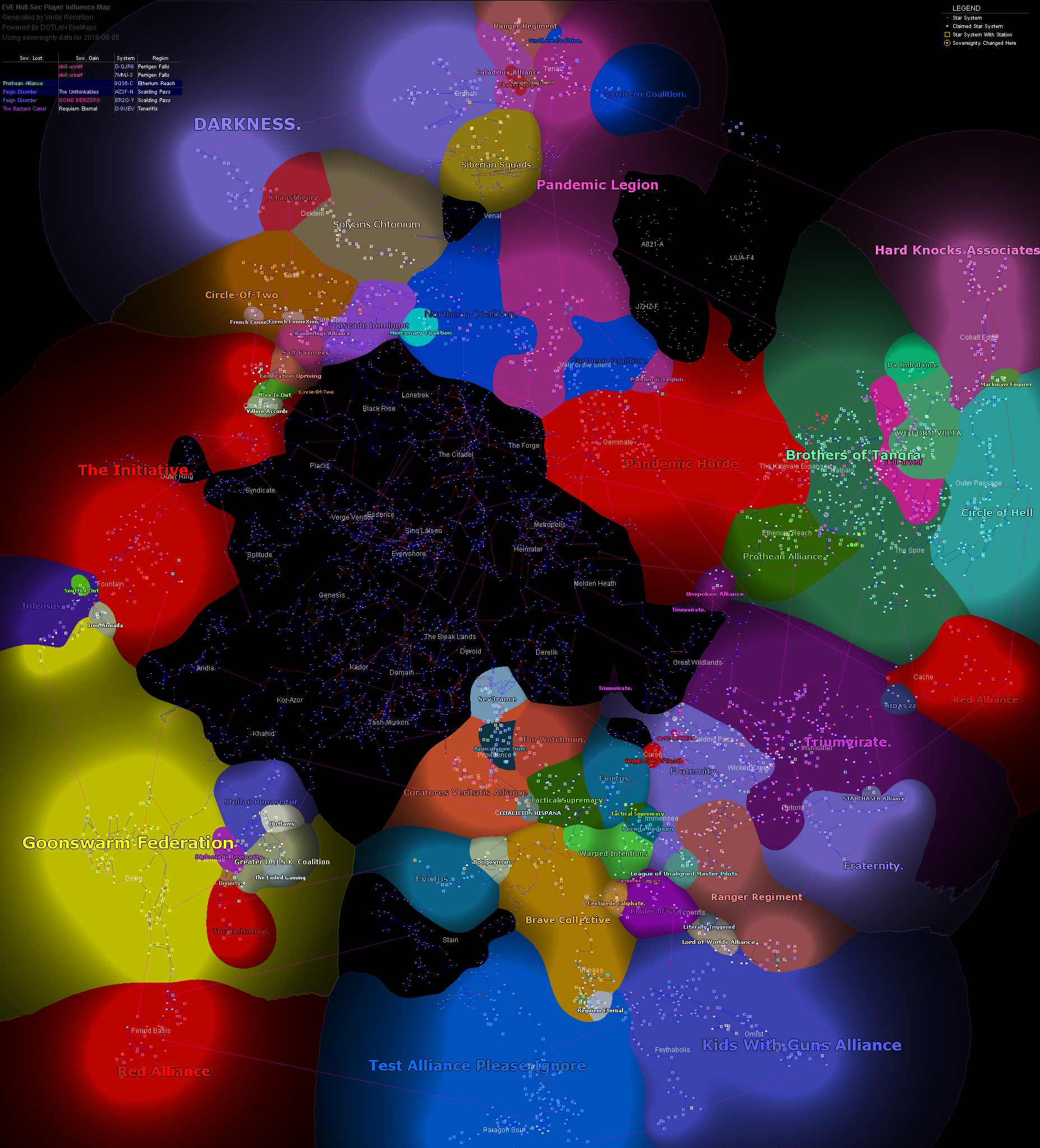
As an example... let's say somebody places an order for 10 Widgets out in the edge of space. We live out near the edge -- actually, look at this map:

http://go-dl1.eve-files.com/media/corp/Verite/influence.png

That's the sovereignty map. It's updated daily. My alliance is Intrepid Crossing in the top right in green. That's 0.0 space (null-security aka no police and lawless -- players own and control everything). Now, let's go through that example of a user ordering 10 widgets.

* Delivery order is submitted if we have it in stock. If so, someone will deliver it via contract. Done. * If not in stock, start the decision tree for this item. * Do we have this in stock in production/stock facilities? If so, submit a transportation order. When it gets transported, the system detects this and submits a delivery order. * If we don't have it in stock, check the market prices for the goods required to build this item as well as the cost to purchase it from a reseller. * If it's cheaper to buy, we submit an order to our procurement team. (Automatic, still.) Once they procure it, the order goes to transportation and then finally delivery. * If it needs building, we do another process of seeing if we have what we need -- or if we have to buy minerals, blueprints, etc. * If we had to buy things, those orders are submitted to procurement and transportation. * If we have it (or the minerals arrive), the production order is submitted. * When we finally have the good, then transportation and delivery happen.

The entire thing is mostly automatic. We carry out the whims of this machine and we supply (rather efficiently) a pretty large alliance. It's a really impressive system.

Yeah, it's a video game. Sort of.

I love it.

And I haven't even touched on the politics, wars, and everything else. It's a beautiful, wonderful, maddening thing.

Re: It all began with a strange email

#45
post #42

Earlier quoted context omitted.

Off the top of my head: you no longer need to sample to obtain your statistics, and you can obtain good statistics on virtually everything and every sub-component of the economy, sliced every which way, as many times as you like -- which is much harder in the real world. You can't just go out and gather information on sales of all red, oblong widgets in shops owned by couples aged 50-60 with one dog and one cat -- bu…

Even the real data should contain noise, compared to a true hypothesis. For example, you could predict that a certain (for the purpose of the example, small) percentage of all players will buy a certain ship. But many of them just stop playing by chance, then your prediction fails even if the underlying theory is correct. [1] I believe the main advantage is, that you can get rid of sampling bias. So you can look at t…

> "But many of them just stop playing by chance"

I suspect this will be one of the significant weaknesses in trying to translate anything learned in a game economy into real economies. You have much better data in a game economy, but people do grow bored or decide they're just not good enough, and move on. Or people decide they've taken a stupid path and reset their account, and build from scratch. In real life, most people try to keep living even if they're at the bottom end of the economy and don't have the means to change that. This strikes me as a fundamental difference between the virtual and the real.

Re: It all began with a strange email

#46
post #22

an economy where we do not need statistics since we have all the data! I simultaneously feel his elation and am mystified. If you have such a quantity of data that you must relate to it via statistics, how is that better than only having the statistics? Is it because you can define and calculate your own creative statistics, or...?

The discipline of statistics can be defined as the set of techniques used to draw inferences and conclusions from a sample--an incomplete set of data. When you have all of the data, playing with it ceases to be statistics and instead becomes data analysis.

Re: It all began with a strange email

#47
post #44

Earlier quoted context omitted.

Has anyone here played EVE online? I keep hearing about how intricate and rich it is, but I've never met anyone who played it. Is the complexity interesting? Or is it 'time-sink' complexity in the vein of Diablo 3 -- as in rather mindless optima-seeking?

I've played off and on since 2003. The corporation I'm part of now has built an ERP and manages a trillion ISK (which at the legal rate is $35,000 USD in assets). We have production facilities -- several of them. We have distribution facilities. Transportation units (local and long-haul). We have combat pilots to protect the transportation. And we have the final delivery points where we actually sell goods -- both re…

For those who find the map interesting, I recommend a time lapse from 2007.08.09 to 2012.04.12:

http://www.youtube.com/watch?v=to7CHVR-Mxk

There is an appeal for UNICEF donations in the beginning, so the video pauses long enough for you to read and close it.

And when you see drastic changes in color/influence? Serious crap just went down. Those are likely the events that even non-gamers read about on news sites.

Re: It all began with a strange email

#48

Fascinating read, just like many of the other Valve blogs. Though, I do wish this guy could explain why real-world money Steam games in the US are often half the price of those in Australia/Europe.

Pricing isn't about fairness, it's about maximising surplus for the seller. Businesses aren't a public service, they're in it to make money. Valve will have pricing analysts that have studied the demand curve and concluded the higher price point may reduce demand but is nonetheless the point where marginal revenue from that geographical segment approaches some notion of marginal cost, thus maximising returns. With su…

Thank you for your explanation.

I guess it just frustrates me because I can't get around it.

With physical goods, if I don't like the AU price, I can easily shop online on another countries website and get the goods shipped. No problems.

With digital goods, there's mostly no way to legitimately purchase them from overseas. You can use a VPN and a fake address, but that breaks the terms & conditions.

Re: It all began with a strange email

#49

Earlier quoted context omitted.

Blizzard sure could use someone like him right about now. Diablo 3 has crazy gold hyperinflation due to bots and the real money auction is causing further havoc. It is pretty obvious that this was not well thought out prior to release.

I disagree. I think it was well thought out, I just think it's hard to know what will happen until afterward. As for some of the values of items in Diablo III currently... I think there will be a settling period before prices reflect their true value. Supply will increase until some equilibrium is reached. When we hit some equilibrium we'll know if Blizz needs to tweak things. The gold AH, for instance, has had the o…

Isn't valve's store idea a pretty trivial way to anchor the price of items though? It seems blizzard chose the path of ambiguity, rather than using a proven off the shelf method for controlling price.

Re: It all began with a strange email

#50
>the notion that a computer game company has surreptitiously and quite spontaneously created virtual economies that it comprehends as ‘economies’ (which deserve study and regulation) was enough to write back instantly

Does this man believe we should have legal regulation of game economies? Oh wow.

Post reply on HN