Live data from Hacker News

But what is a GPT? Visual intro to Transformers [video]

youtube.com

41–50 of 56 posts

Re: But what is a GPT? Visual intro to Transformers [video]

#41
post #26

Earlier quoted context omitted.

The temperature setting is used to select how rare of a next token is possible. If set to 0 the. The top of the likely list is chosen, if set greater than 0 then some lower probability tokens may be chosen.

Can this be potentially dangerous -- e.g. if a user types "The answer to the expression 2 + 2 is", isn't there a chance it chooses an output beyond the most likely one?

That’s why we use top p and top k! They limit the probability space to a certain % or number of tokens ordered by likelihood

Re: But what is a GPT? Visual intro to Transformers [video]

#42
post #24
post #19

Earlier quoted context omitted.

As a reasonably experienced programmer that has watched Andrej's videos the one thing I would recommend is that they not be used as a starting point to learn neural networks but as a reinforcement or enhancement method once you know the fundamentals. I was ignorant enough to try and jump straight in to his videos and despite him recommending I watch his preceeding videos I incorrectly assumed I could figure it out as…

Could you please share what other learning materials you used?

For me 3brown1blue series: https://m.youtube.com/watch?v=aircAruvnKk was an excellent introduction that made Andrej's videos understandable. Then I did 3 first chapters of fastai book, but found it too high level, while I was interested in how things works under the hood.

Going through Andrej's makemore tutorials required quite a lot of time but it's definitely worth it. I used free tier of Google Colab until the last one.

Pausing the video a lot after he explains what he plans to do and trying to do it by myself was a very rewarding way to learn, with a lot of "aha" moments.

Re: But what is a GPT? Visual intro to Transformers [video]

#43
post #26

Earlier quoted context omitted.

The temperature setting is used to select how rare of a next token is possible. If set to 0 the. The top of the likely list is chosen, if set greater than 0 then some lower probability tokens may be chosen.

Can this be potentially dangerous -- e.g. if a user types "The answer to the expression 2 + 2 is", isn't there a chance it chooses an output beyond the most likely one?

> potentially dangerous

> 2 + 2

You really couldn't come up with an actual example of something that would be dangerous? I'd appreciate that, because I'm not seeing reason to believe that an "output beyond the most likely one" output would end up ever being dangerous, as in, harming someone or putting someone's life at risk.

Thanks.

Re: But what is a GPT? Visual intro to Transformers [video]

#44

I've just started this video, but already have a question if anyone's familiar with GPT workings - I thought that these models chose the next word based on what's most likely. But if they choose based on "one of the likely" words, could (in general) that not lead to a situation where the list of predictions for the next word are much less likely? Running possibilities of "two words together", then, would be more bene…

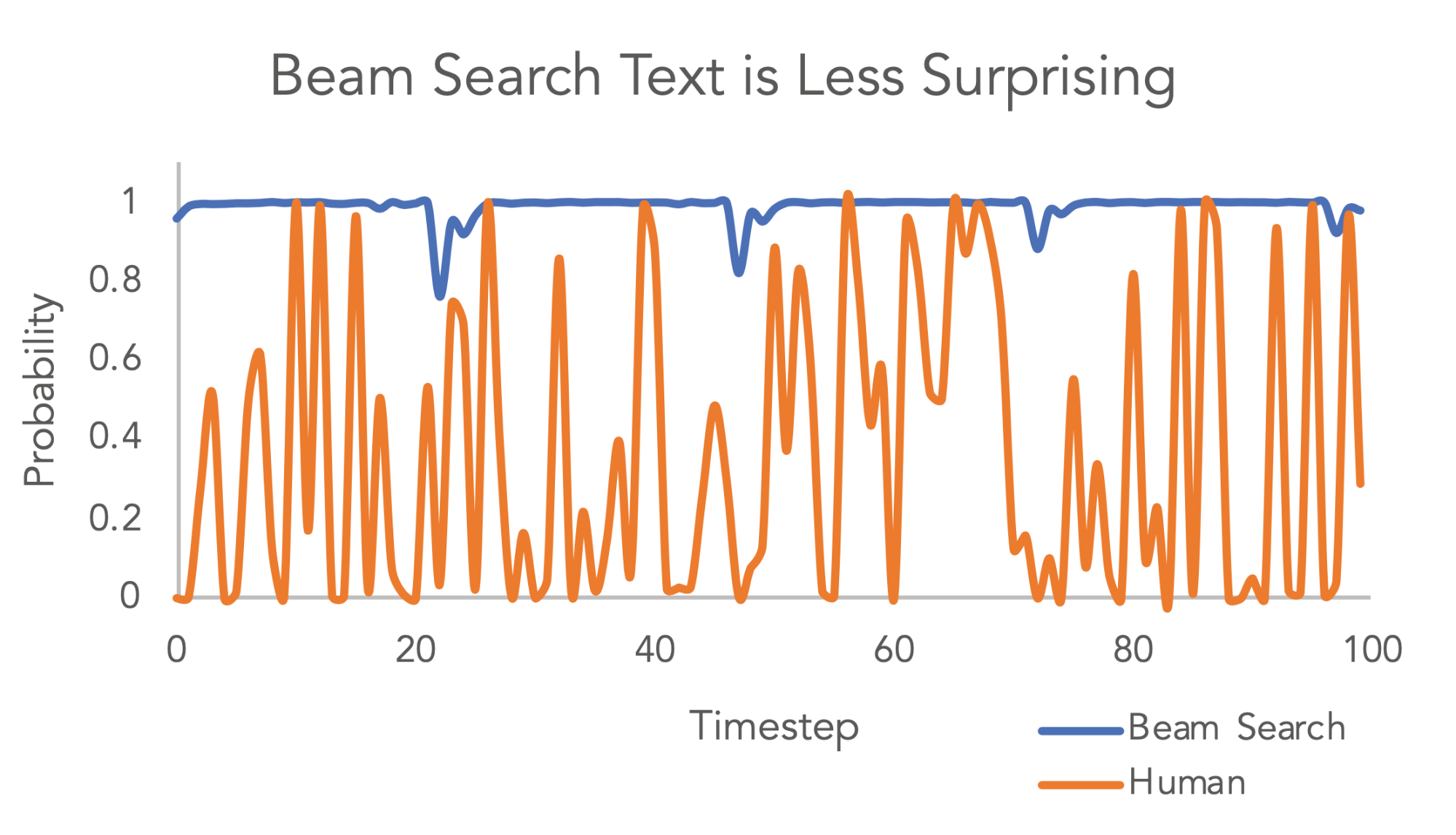
In practice, beam search doesn't seem to work well for generative models.

Temperature and top_k (two very similar parameters) were both introduced to account for the fact that human text is unpredictable stochastically for each sentence someone might say as such - as shown in this 2021 similar graph/reproduction of an older graph from the 2018/2019 HF documentation: https://lilianweng.github.io/posts/2021-01-02-controllable-t...

It could be that beam search with much longer length does turn out to be better or some merging of the techniques works well, but I don't think so. The query-key-value part of transformers is focused on a single total in many ways - in relation to the overall context. The architecture is not meant for longer forms as such - there is no default "two token" system. And with 50k-100k tokens in most GPT models, you would be looking at 50k*50k = A great deal more parameters and then issues with sparsity of data.

Just everything about GPT models (e.g. learned positional encodings/embeddings depending on the model iteration) is so focused on bringing the richness of a single token or single token index that the architecture is not designed for beam search like this one could say. Without considering the training complications.
Re: But what is a GPT? Visual intro to Transformers [video]

#45
post #26

Earlier quoted context omitted.

Can this be potentially dangerous -- e.g. if a user types "The answer to the expression 2 + 2 is", isn't there a chance it chooses an output beyond the most likely one?

> potentially dangerous > 2 + 2 You really couldn't come up with an actual example of something that would be dangerous? I'd appreciate that, because I'm not seeing reason to believe that an "output beyond the most likely one" output would end up ever being dangerous , as in, harming someone or putting someone's life at risk. Thanks.

That depends on how many people are putting blind faith in terrible AI. If it's your doctor or your parole board, AI making a mistake could be horrible for you.

Re: But what is a GPT? Visual intro to Transformers [video]

#46

Earlier quoted context omitted.

Yes, although it's also possible that the most likely token is incorrect and perhaps the next 4 most likely tokens would lead to a correct answer. For example if you ask a model what is 0^0, the highest probability output may be "1", which is incorrect. The next most probable outputs may be words like "although", "because", "Due to", "unfortunately", etc. as the model prepares to explain to the user that the value of…

Not sure if you were making a joke, but 0^0 is often defined as 1. https://en.wikipedia.org/wiki/Zero_to_the_power_of_zero

perhaps a hallucination

Re: But what is a GPT? Visual intro to Transformers [video]

#47

Earlier quoted context omitted.

Not sure if you were making a joke, but 0^0 is often defined as 1. https://en.wikipedia.org/wiki/Zero_to_the_power_of_zero

I honestly had forgot that, if I ever knew it. But I think the point stands that in many contexts you'd rather have the nuances of this kind of thing explained to you - able to represented by many different sequences of tokens, each individually being low probability - instead of simply taking the single-highest probability token "1".

I'd rather it recognize it should enter a calculator mode to evaluate the expression, and then can give context with the normal GPT behavior

Re: But what is a GPT? Visual intro to Transformers [video]

#48
post #3

Earlier quoted context omitted.

Incredible. This 3B1B series was started 6 years ago and keeps going today with chapter 5. If you haven't seen the first few chapters, I cannot recommend enough.

Would you be able to compare them to Andrew Ng's course?

IMO the style, formatting, and animations in 3B1B videos is what Coursera courses should have been about in the first place.

Andrew Ng's course doesn't use video effectively at all: half of each class is Andrew talking to the camera, while the other half is him slowly writing things down with a mouse. There's a reason why a lot of people recommend watching at 1.5x speed.

Online classes are online classes. If they try to make copy in-person classes, like most Coursera courses do, they will keep all of the weaknesses of online classes without any of its strengths.

Re: But what is a GPT? Visual intro to Transformers [video]

#50
post #3

Earlier quoted context omitted.

Incredible. This 3B1B series was started 6 years ago and keeps going today with chapter 5. If you haven't seen the first few chapters, I cannot recommend enough.

Would you be able to compare them to Andrew Ng's course?

IMO I think the 3Blue1Brown video is a good place to start to build intuitions about how things work generally if you're new, and Andrew Ng's courses will help you dig into more detail, experiment, and implement things to build on those intuitions.
Post reply on HN