Live data from Hacker News

Print(“lol”) doubled the speed of my Go function

medium.com

41–50 of 130 posts

Re: Print(“lol”) doubled the speed of my Go function

#41
post #38

Kind of tangential, but who are these people who are so comfortable with disassembling a high level language binary, reading assembly, and then making statements about branch prediction and other such low level esoterica? I've only ever meet people like that maybe two or thee times in my career, and yet it seems like every other blog post I read in certain language circles everyone is some kind of ASM and Reverse Eng…

This feels semi-normal to me... just have the curiosity to ask "why?" and the bias-to-action to move to "I'm going to find out".

You encounter far far more dead-ends than anyone ever says, and every unsolved mystery is a mild nerd snipe, an open case, that years from now you'll see someone else explain something you realise it answers that question from years prior.

For me, the hard bit is not over-indexing on this... you learn things, but biasing too much for them is a sure fire way to over-engineer or increase complexity to the point where something is now worse for you knowing something. But once in a while that tiny thing you learned years before is a 20% savings across the board with associated performance increase and everyone wondering how on Earth you could possibly have made those jumps.

Also related... incidents. "Why" and "I'm going to find out" is the best way these things don't recur in future. A high degree of observation and understanding is a happy engineer life as it can improve what can often be the most stressful parts of the work (on-call, etc).

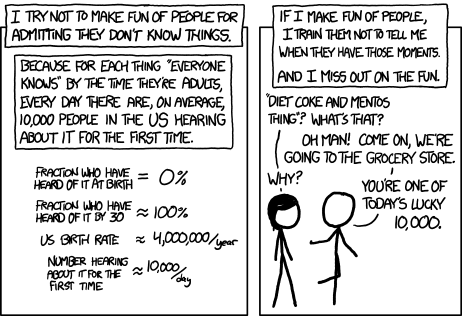
That XKCD comic about everyone learning something for the first time factors too... there is stuff you know that others do not, share it.
Re: Print(“lol”) doubled the speed of my Go function

#42

Earlier quoted context omitted.

> and the insertion of a conditional move in the original is totally sensible (albeit not intuitive if you haven't seen it). Would you mind expanding? If the conditional move isn't needed, and given that it's costly in terms of perfs, how is that “totally sensible” to have one here?

https://news.ycombinator.com/item?id=36623759

Thank you.

Re: Print(“lol”) doubled the speed of my Go function

#43
post #38

Kind of tangential, but who are these people who are so comfortable with disassembling a high level language binary, reading assembly, and then making statements about branch prediction and other such low level esoterica? I've only ever meet people like that maybe two or thee times in my career, and yet it seems like every other blog post I read in certain language circles everyone is some kind of ASM and Reverse Eng…

I think you'll find that the deeper you go into "traditional" computer scientists, the more you'll find the problem-solvers, hackers and tinkerers that post these types of blogs. Especially in odd cases where a random print statement doubles your profiled performance.

That being said, of all the people at all of the tech companies I've worked at, maybe ~5% of them had this sort of mentality and drive to execute on it.

Re: Print(“lol”) doubled the speed of my Go function

#44
post #41
post #38

Kind of tangential, but who are these people who are so comfortable with disassembling a high level language binary, reading assembly, and then making statements about branch prediction and other such low level esoterica? I've only ever meet people like that maybe two or thee times in my career, and yet it seems like every other blog post I read in certain language circles everyone is some kind of ASM and Reverse Eng…

This feels semi-normal to me... just have the curiosity to ask "why?" and the bias-to-action to move to "I'm going to find out". You encounter far far more dead-ends than anyone ever says, and every unsolved mystery is a mild nerd snipe, an open case, that years from now you'll see someone else explain something you realise it answers that question from years prior. For me, the hard bit is not over-indexing on this..…

https://imgs.xkcd.com/comics/ten_thousand.png for those who haven't heard of it.

Re: Print(“lol”) doubled the speed of my Go function

#45
post #41
post #38

Kind of tangential, but who are these people who are so comfortable with disassembling a high level language binary, reading assembly, and then making statements about branch prediction and other such low level esoterica? I've only ever meet people like that maybe two or thee times in my career, and yet it seems like every other blog post I read in certain language circles everyone is some kind of ASM and Reverse Eng…

This feels semi-normal to me... just have the curiosity to ask "why?" and the bias-to-action to move to "I'm going to find out". You encounter far far more dead-ends than anyone ever says, and every unsolved mystery is a mild nerd snipe, an open case, that years from now you'll see someone else explain something you realise it answers that question from years prior. For me, the hard bit is not over-indexing on this..…

I remember someone saying the difference between Physics and Computer Science is that in CS we are the masters of the universe - there are no laws of Physics that bind us.

For me that means that in our world of computers there is infinite curiosities to discover. (Not that the same isn't true for the natural world too)

Re: Print(“lol”) doubled the speed of my Go function

#47
post #38

Kind of tangential, but who are these people who are so comfortable with disassembling a high level language binary, reading assembly, and then making statements about branch prediction and other such low level esoterica? I've only ever meet people like that maybe two or thee times in my career, and yet it seems like every other blog post I read in certain language circles everyone is some kind of ASM and Reverse Eng…

They're a dying breed. We're forgetting how to look under the hood and understand "why something works".

Case in point, I'm slowly being replaced by Salesforce muppets for all my projects at work. They're little code monkeys with amazon ebook type knowledge, projects cost 20x more and I look like the mad scientist for speaking the truth. The products are worse in every possible metrics, I'm not crazy. The politics at play is the reason why I'm losing ground, not logic.

Cabinet designers are being replaced by Ikea flat pack artists in the software world. All we can do is stand by and watch.

And in regards to this blog, when Medium eventually go, that knowledge will go too. Blogs have died, personal websites as well, and their ability to be found in Google is almost non-existent.

Sorry I don't have anything more positive to add, except maybe that they're still there, slowly being alienated by the modern tech world!

Re: Print(“lol”) doubled the speed of my Go function

#48
post #47
post #38

Kind of tangential, but who are these people who are so comfortable with disassembling a high level language binary, reading assembly, and then making statements about branch prediction and other such low level esoterica? I've only ever meet people like that maybe two or thee times in my career, and yet it seems like every other blog post I read in certain language circles everyone is some kind of ASM and Reverse Eng…

They're a dying breed. We're forgetting how to look under the hood and understand "why something works". Case in point, I'm slowly being replaced by Salesforce muppets for all my projects at work. They're little code monkeys with amazon ebook type knowledge, projects cost 20x more and I look like the mad scientist for speaking the truth. The products are worse in every possible metrics, I'm not crazy. The politics at…

> We're forgetting how to look under the hood and understand "why something works".

Partly because that's often not what we're supposed to do; the stuff under the hood "just works" and we're meant to use it to write features, not worry about optimising the stuff that happens under the hood.

And partly it's because the stuff under the hood is increasingly weird and bizarre. Branch prediction is weird, and I still don't understand why that extra print statement changes the branch prediction. Why does it predict `v > maxV` is true when the alternative is to print something, but it doesn't predict that when the alternative is to do nothing?

Is it because printing is expensive, and therefore the branch predictor is going to strongly prefer avoiding that? It's weird that we'd basically have to deceive our code into compiling into a more performant form.

I don't want to have to second guess the compiler.

Re: Print(“lol”) doubled the speed of my Go function

#49

Why would an unconditional print have any effect on whether the branch predictor is invoked or not? The if statement is there in both cases, so branch prediction should kick in for both. I didn't find an explanation for this behaviour in the article.

The go compiler might have a heuristic where a branch with IO is considered cold compared to a branch without. In the original, it essentially faces If : Mov Else: Noop Considering these branches unpredictable, it generates a CMOV. With If : Mov Else: Print It now considers the first branch hot and the second cold, and thus branch predication valuable, and generates a branch instead. Turns out for the use case choice…

> Turns out for the use case choice (1) is a misfiring, as the branch is extremely predictable

Happens to be extremely predictable for this data. In general, over all possible inputs, it’s not extremely predictable.

If you assume all inputs are different (not something the compiler can assume, of course) the probability of having to update the max value goes down from 1 for the first iteration to 1/n for the last, so, possibly, the loop should be split into two halves. Go through the start of the sequence assuming the value needs updating more often than not, and switch to one where it doesn’t at some point.

For truly large inputs you could even add heuristics looking at how much room there is above the current maximum (in the limit, if you’ve found MAX_INT, you don’t have to look further)

Sorting programs used to have all kinds of such heuristics (and/or command line arguments) trying to detect whether input data already is mostly sorted/mostly reverse sorted, how many different keys there are, etc. to attempt avoiding hitting worst case behavior, but I think that’s somewhat of a lost art

Re: Print(“lol”) doubled the speed of my Go function

#50
post #38

Kind of tangential, but who are these people who are so comfortable with disassembling a high level language binary, reading assembly, and then making statements about branch prediction and other such low level esoterica? I've only ever meet people like that maybe two or thee times in my career, and yet it seems like every other blog post I read in certain language circles everyone is some kind of ASM and Reverse Eng…

There's some bias as topics like these are often on top of HN. Extrapolate the 2 or 3 people you've met to all the programmers in the world - that's how you get some amazing in depth blog posts every other week.
Post reply on HN