Live data from Hacker News

Cantonese Font with Pronunciation

visual-fonts.com

41–50 of 206 posts

Re: Cantonese Font with Pronunciation

#41
post #34

Earlier quoted context omitted.

I am not a Cantonese speaker; however, in Mandarin, fonts with phonetic guidance are very common. e.g., Hann-Tzong Wang's (王漢宗) free font collection[1] includes two typefaces with phonetic pronunciation guidance. These are wp{0..3}10-05.ttf and wp{0..3}10-08.ttf [2] As you can see from the filenames, there are actually four different font files for each of these two typefaces. The font files numbered {1..3} are for 「…

Thanks for sharing this. When I saw the link, I wanted to see if there was something similar for Mandarin. Looking at the PDF sample I don't see anything around how to pronounce the characters, i.e. there's nothing along the top or bottom that looks like pinyin with tonal markers. Am I missing something?

The fonts at the bottom of the first page (wp010-05.ttf) and the top of the second page (wp[123]10-05.ttf etc.) have zhuyin (aka bopomofo) phonetic symbols [1] to the right of each character. These are common in Taiwan, whereas pinyin is used in the mainland. jamesdutc also used them in the comment above; e.g., ㄐ一ˇㄩˇ = jǐ yǔ.
[1] https://en.wikipedia.org/wiki/Bopomofo

Re: Cantonese Font with Pronunciation

#42
post #39

My girlfriend’s family strictly speaks Cantonese and I known nothing about it. I was just talking with a friend in a similar situation who lamented the lack of resources for Cantonese. This is awesome! Does anyone have any other hidden-gem Cantonese learning resources?

Unaffiliated with this group, but there are a bunch of graded readers, romanized with Jyutping, freely available, and very high quality![1]

If you’d prefer physical books, this online store imports quite a few from Hong Kong.[2]

A dictionary program for Windows/Mac/Linux that I make [3], and another for mobile that I don’t make.[4]

Finally, a list of other good resources from Cantonese Alliance.[5]

[1] https://hambaanglaang.hk/

[2] https://kozzi.ca/

[3] https://jyutdictionary.com/

[4] https://www.pleco.com/

[5] https://cantonese-alliance.github.io/language.html

Re: Cantonese Font with Pronunciation

#43
post #18

As many have pointed here Mandarin, Thai, Cantonese and Vietnam are tonal languages and the meaning of words are depending on how you speak the syllables inside the words. Mandarin has four, Thai has five, Cantonese has six and Vitnamese has six tones. Overall about 20% or 1.5 billion of the world's population converse daily in tonal languages. It will be very helpful if someone come up with automatic tonal detection…

Isn't true that Cantonese has 9 tones?

I like to tell complete newbies that Cantonese roughly has "4 tones."

- High level

- Mid level

- Low (includes "low falling" and "low level")

- Rising (includes "low rising" and "mid rising")

I've combined similar tones into the Low and Rising categories. If you are a non-native Cantonese speaker, and don't differentiate between "low falling" and "low level", native Cantonese speakers will still understand you.

It's difficult for a non-native speaker to distinguish between "low rising" and "mid rising".... so just treat it as a rising tone. I'm a native speaker and sometimes I forget which type of rising tone a particular word is.... I didn't learn it that way, haha. I just learned to say the word the same way my parents did.

The 7th, 8th, and 9th tones are short versions of the three level tones, and they all end in a consonant (like "k"). If you pronounced them the same, but make the syllable very short, you'll be fine.

So yeah.... think of it as 4 tones, just like Mandarin. Three different level tones at high, middle, low pitches, and one rising tone :-).

Re: Cantonese Font with Pronunciation

#44
post #34

Earlier quoted context omitted.

I am not a Cantonese speaker; however, in Mandarin, fonts with phonetic guidance are very common. e.g., Hann-Tzong Wang's (王漢宗) free font collection[1] includes two typefaces with phonetic pronunciation guidance. These are wp{0..3}10-05.ttf and wp{0..3}10-08.ttf [2] As you can see from the filenames, there are actually four different font files for each of these two typefaces. The font files numbered {1..3} are for 「…

Thanks for sharing this. When I saw the link, I wanted to see if there was something similar for Mandarin. Looking at the PDF sample I don't see anything around how to pronounce the characters, i.e. there's nothing along the top or bottom that looks like pinyin with tonal markers. Am I missing something?

The fonts at the bottom of page one and the top of page two (王漢宗中明體注音 wp010-05.ttf and 王漢宗中楷體注音 wp010-08.ttf) include pronunciation guidance using zhùyīn fúhào 注音符號 (also called “Bopomofo” 「ㄈㄅㄇㄈ」 after the first four consonants): https://en.wikipedia.org/wiki/Bopomofo

This is the phonetic system that is used most commonly in Taiwan.

Typically, phonetic pronunciation guidance is used only in educational materials. For native speakers, this means materials only for very small children. However, in Taiwan, it's not uncommon to see 注音符號 guidance to indicate when a word should be said with a non-Mandarin pronunciation. You'll see this, for example, in shops whose names contain a pun when using the Taiwanese Hokkien pronunciation.

There are other fonts that include pronunciation guidance in hànyǔ pīnyīn 漢語拼音, the phonetic system used most commonly in China: e.g., http://fonts.mobanwang.com/200909/5832.html

I don't think there are any fonts with pronunciation guidance in any of the other phonetic systems (e.g., 通用拼音, Wade-Giles, 國語羅馬字) but these have almost all fallen into disuse and appear only in old signage, historical place names, or in people's names.

(Presumably, if you are born in Taiwan, you get to pick how you want your named romanized… especially since you may want the spelling of your name to match that of your relatives. But are you allowed to pick any transliteration you desire?)

Re: Cantonese Font with Pronunciation

#46

Earlier quoted context omitted.

The annnoying part in written thai is thattherearenospacesbetweenwords.

Spaces between words is a relatively recent Irish invention (7th or 8th century) in western written language, so it’s not like it’s an obvious thing to have.

> Spaces between words is a relatively recent Irish invention (7th or 8th century) in western written language, so it’s not like it’s an obvious thing to have.

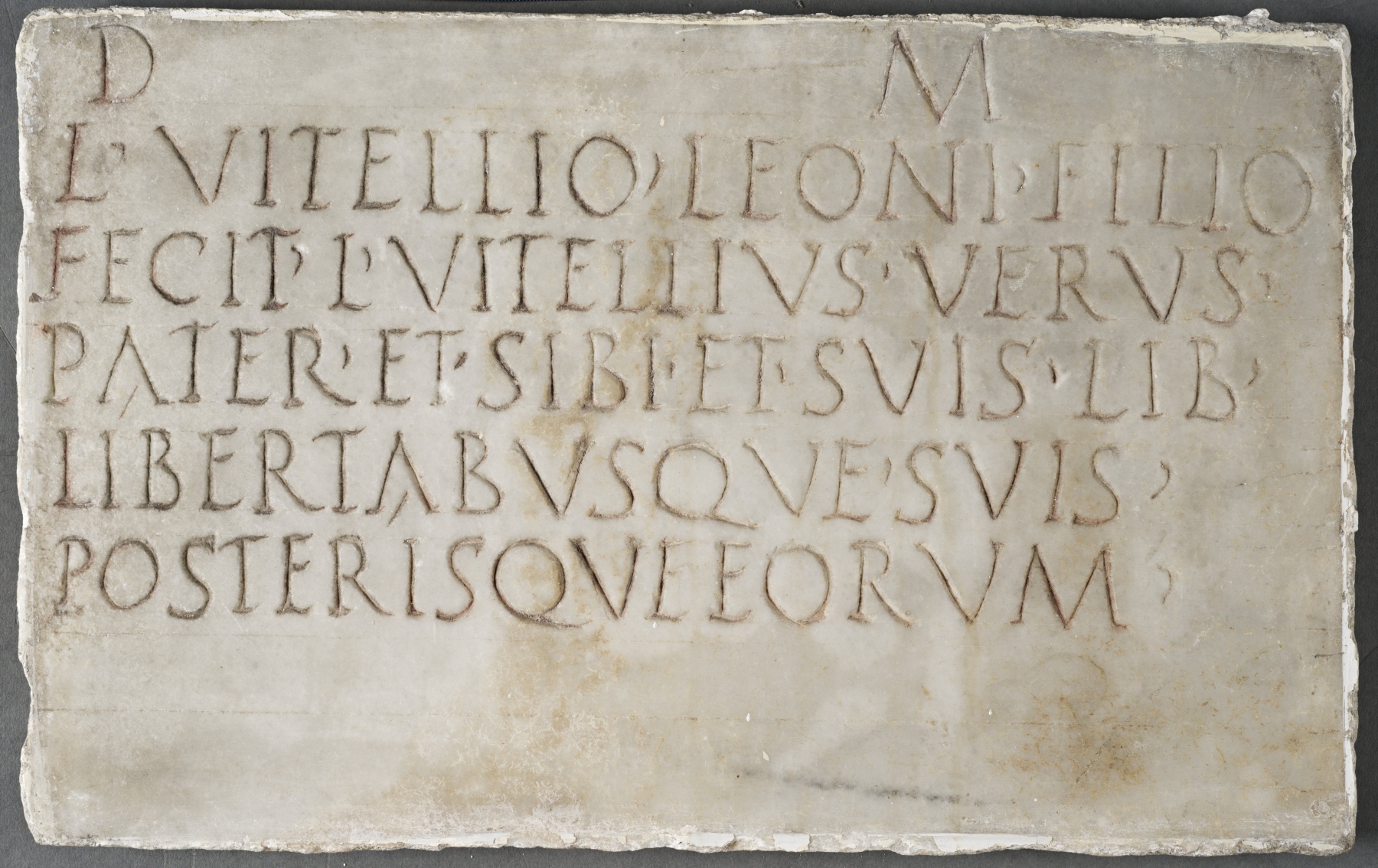
Perhaps, but interpuncts between words are several centuries older than that and occur as natural developments in e.g. the Roman Empire. https://loeb-art-center.vassarspaces.net/wp-content/gallery/...

The concept of word separation is an obvious thing to have. Whether the separator is empty space is unimportant.

Re: Cantonese Font with Pronunciation

#47
post #32

Earlier quoted context omitted.

> It will be very helpful if someone come up with automatic tonal detection systems for language learners to automatically check the correctness of their pronunciations […] The number embedded in the Jyutping pronunciation indicates the tone. However, the automatic tonal detection is not as straightforward as it might seem due the tone sandhi (the tone change of the word/syllable depending on surrounding morphemes),…

Note that while Cantonese has the phenomenon of changed tones (變音 - https://en.wikipedia.org/wiki/Changed_tone ), it is not actually considered tone sandhi ( https://en.wikipedia.org/wiki/Tone_sandhi#What_tone_sandhi_i... ). Tone sandhi is phonologically motivated, i.e., the tone changes arise from the pronunciation of the surrounding words, and are thus largely predictable. Cantonese changed tones, however, are gene…

It is true that the tone change in Cantonese is largely predictable due to it having the lexical nature. Since the parent raised a question about a generic solution to the tone marking problem, I thought I would use the tone sandhi as an example of a challenge that compounds the matter.

On the other hand, languages such as Hmong exhibit the complex tone sandhi. Tone sandhi is not as pronounced in Cantonese as it is in some other languages.

> Note that the Jyutping standard actually doesn't specify how tone changes are marked.

No, it does not, and whether an asterisk or a dash is used, it is largely immaterial. What is important, though, is that not every Cantonese dictionary marks off a lexical tone change which might misguide the learner or the seasonal reader.

Re: Cantonese Font with Pronunciation

#48
post #5

Earlier quoted context omitted.

Mandarin absolutely does: * 行: xíng or háng * 的: de or dì * 长: cháng or zhǎng (plus I'm sure many more that I can't think of just right now)

Did it get more numerous with the adoption of simplified characters?

Yes, it did if you're not a mandarin speaker. The simplification process was biased towards Mandarin and there are some words that were merged that have different pronunciations in Cantonese but not in Mandarin.

Re: Cantonese Font with Pronunciation

#49
post #24

Earlier quoted context omitted.

The annnoying part in written thai is thattherearenospacesbetweenwords.

Same with Chinese language, thus lexing and parsing requires knowing many more words than in languages with spaces between words.

No, it's different between Chinese and Thai.

Lexing is very clear in Chinese. It's never the case that you look at a Chinese sentence and don't know where a character ends and another begins. Take this sentence in both languages: "good morning, how are you"

早安,你好吗

This sentence clearly has "spaces" and I'm pretty sure any person illiterate in Chinese could tell you there are 5 characters / words. Technically the third character is composed of 人 and 尔 but I don't know that anyone, even kids or beginners, would mistake those as _not_ going together.

สวัสดีตอนเช้าคุณเป็นอย่างไรบ้าง

In contrast, Thai is as you say: lexing and parsing bleed together. There are 7 words in this sentence, but you need to lex the 10 syllables and run them through your mental dictionary to recognize the possible words they could be. My Thai is very limited, but there are examples of sentences out there that actually have multiple valid readings with different semantic meanings, depending on how you group sounds together.

Re: Cantonese Font with Pronunciation

#50

As many have pointed here Mandarin, Thai, Cantonese and Vietnam are tonal languages and the meaning of words are depending on how you speak the syllables inside the words. Mandarin has four, Thai has five, Cantonese has six and Vitnamese has six tones. Overall about 20% or 1.5 billion of the world's population converse daily in tonal languages. It will be very helpful if someone come up with automatic tonal detection…

> As many have pointed here Mandarin, Thai, Cantonese and Vietnam are tonal languages

There are also plenty of tonal languages outside East/Southeast Asia, in South Asia, Africa, Europe, North America, and that's just ones I know of.

Languages also switch, like ancient Greek.

Post reply on HN