Live data from Hacker News

My PhD Genealogy

robots.stanford.edu

41–50 of 62 posts

Re: My PhD Genealogy

#41
post #11

Academia is not that big, is quite incestuous, and such trees or descent are not rare. I think there was a website that listed people's academic family here is one for neuroscience: https://neurotree.org/neurotree/

what do you mean by "incestuous"? I'm having a hard time picturing the tree structure. Like if we keep things simple and assume every person on the tree "asexually spawns" multiple students, where does the "incest" come in? Maybe one student having more than one advisor? If that's the case, usually it's just a thesis committee or reviewer or something, and not really multiple _main_ advisors

The academia is far more diverse than people think. More diverse between countries, between universities, between disciplines, and over time.

Having a junior and a senior advisor is fairly common. Sometimes the work is done in multiple institutions, with a separate advisor in each. In some systems, most people who supervise students are not formally qualified to do so, creating a need for a separate formal supervisor. Sometimes there are two equal advisors, and sometimes the advisor changes for various reasons. Sometimes the student is an independent scholar and the advisors are only loosely involved in the work. If you only have written records, it can be impossible to tell which of these was the case for a particular student.
Re: My PhD Genealogy

#42
post #8

I spent some time in 02016 digging through different sorts of academic lineages. It turns out, for example, that you can also trace Leibniz back to Copernicus: https://dercuano.github.io/notes/academic-lineage.html Thrun's page seems to have an error about Leibniz: "Gottfried Wilhelm Leibniz 1966, 1967, 1976" It would be nice to be able to trace figures like al-Tusi back to Plato and Imhotep, to know if there really…

I feel that the possibility of tracing academic lineage back to antiquity in the West is very dim, for the same reason that tracing descent from antiquity[0] in Europe has proven impossible - too few records survived. Even in the Catholic Church, the longest unbroken chain (i.e., for which records survive) of apostolic succession (i.e., which bishop consecrated each bishop) goes only back to the 1400s with Guillaume…

Agreed.

Re: My PhD Genealogy

#45
post #11

Academia is not that big, is quite incestuous, and such trees or descent are not rare. I think there was a website that listed people's academic family here is one for neuroscience: https://neurotree.org/neurotree/

This is the site that does it for math: https://www.genealogy.math.ndsu.nodak.edu/

Re: My PhD Genealogy

#46
post #8

I spent some time in 02016 digging through different sorts of academic lineages. It turns out, for example, that you can also trace Leibniz back to Copernicus: https://dercuano.github.io/notes/academic-lineage.html Thrun's page seems to have an error about Leibniz: "Gottfried Wilhelm Leibniz 1966, 1967, 1976" It would be nice to be able to trace figures like al-Tusi back to Plato and Imhotep, to know if there really…

> "02016" Thank you for preparing for the Y10K problem.

How does it help to create a Y100k problem by using fixed-width numerals with five digits, instead of using variable-width numerals like we normally do for years?

Re: My PhD Genealogy

#48
post #11

Academia is not that big, is quite incestuous, and such trees or descent are not rare. I think there was a website that listed people's academic family here is one for neuroscience: https://neurotree.org/neurotree/

what do you mean by "incestuous"? I'm having a hard time picturing the tree structure. Like if we keep things simple and assume every person on the tree "asexually spawns" multiple students, where does the "incest" come in? Maybe one student having more than one advisor? If that's the case, usually it's just a thesis committee or reviewer or something, and not really multiple _main_ advisors

> what do you mean by "incestuous"?

To give you an example, about half of my group at University X did a Bachelor's in statistics at University X, then a Mater's in statistics at University X, then a PhD in statistics at University X, and some are even doing a PostDoc (in statistics at University X)!

Re: My PhD Genealogy

#49
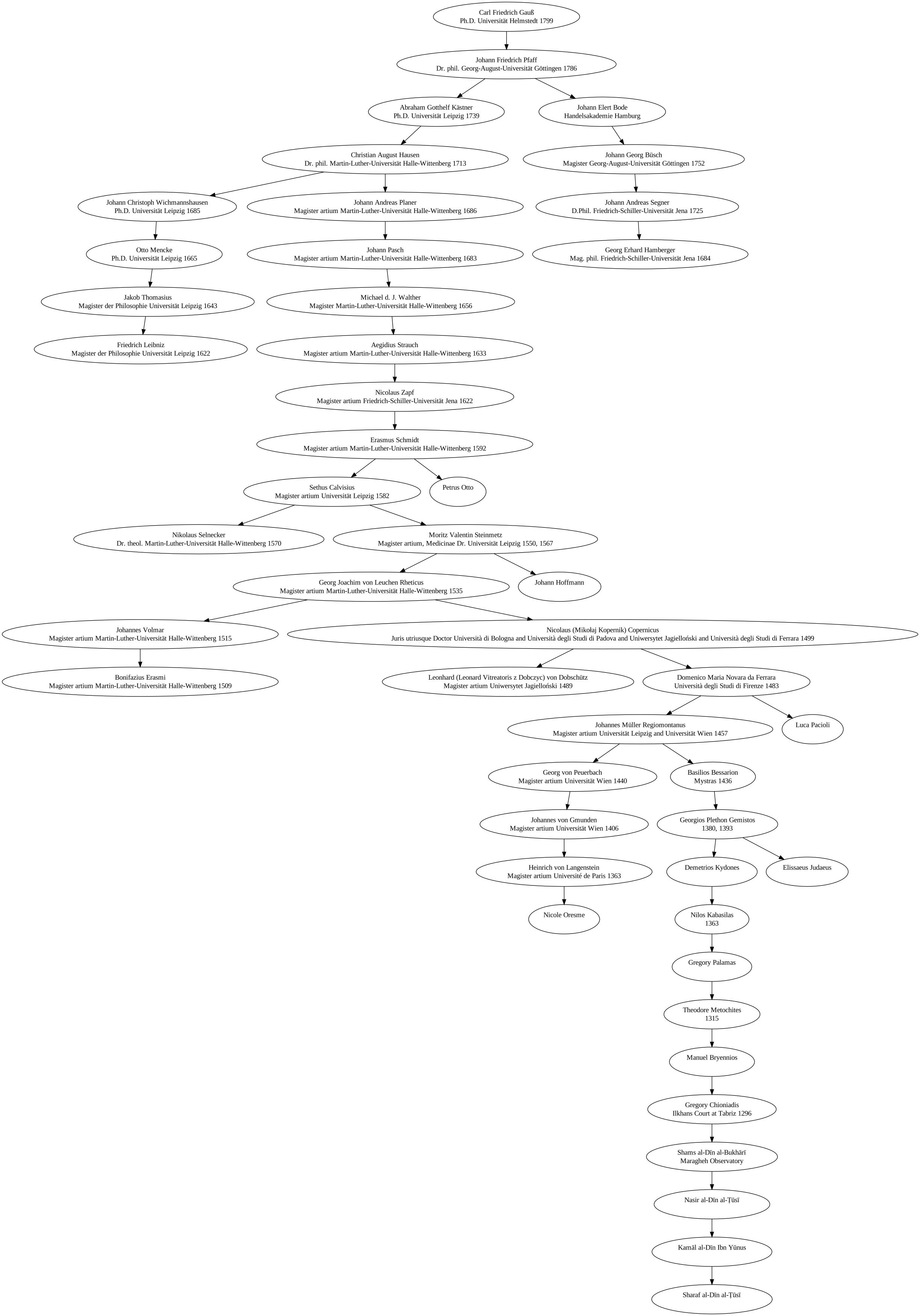
This looked like fun so I wrote a tiny script to generate these graphs for mathematicians using data from https://www.mathgenealogy.org/. Here is what it looks like for Gauss: https://raw.githubusercontent.com/parsiad/math-genealogy-gra.... If you want to make your own, I stuck the script here: https://github.com/parsiad/math-genealogy-graph.

Re: My PhD Genealogy

#50

Earlier quoted context omitted.

> "02016" Thank you for preparing for the Y10K problem.

How does it help to create a Y100k problem by using fixed-width numerals with five digits, instead of using variable-width numerals like we normally do for years ?

exactly, it seems like a faulty solution to a problem that doesn't exist -- at present, we would say 900 and 1, not 0900 and 0001.
Post reply on HN