That's what I did during lockdown - got a knot book, taught myself twenty knots. A manager noticed and dared me to tie them blindfold. Did so, and won myself a metre of licorish!
Which you proceeded to tie into a knot, I presume
41–50 of 151 posts
That's what I did during lockdown - got a knot book, taught myself twenty knots. A manager noticed and dared me to tie them blindfold. Did so, and won myself a metre of licorish!
Note that the monkey’s fist is an illegal knot everywhere in Australia and you can go to jail just for tying one.
I don't know about Australia, but in Germany this knot is illegal to own and carry this knot if it is additionally weighted with, for example, metal balls.
Sources:
Wikipedia: https://de.wikipedia.org/w/index.php?title=Affenfaust&oldid=...
Primary source: https://www.bka.de/SharedDocs/Downloads/DE/UnsereAufgaben/Au...
Random comment: Securing the trace eight with a second knot is really not necessary, as it is a self tightening knot. Most climbers don't do it, my climbing safety book doesn't show it and all gyms I've been too, sans one in Vancouver WA for some reason, don't require it. Rough rule is two fists length for the tail and you're good. Another comment mentioned this too, it's much easier to untie if tied in a specific wa…
Earlier quoted context omitted.
Fair point re: the Klemheist although the Prussik serves well enough. For my part I wouldn't use a figure 8 in a bight to get a loop in the middle of a lonf rope that's going to take load - the butterfly knot is far superior.
What makes it superior? Is it easier to adjust or untie?
I would use either for a directional load, but only an alpine butterfly if loading the loop is conceivable. And using the flat 8 as a bend is suicidal.
[1] http://user.xmission.com/~tmoyer/testing/EDK.html [2] https://www.animatedknots.com/alpine-butterfly-bend-knot [3] https://en.wikipedia.org/wiki/Offset_figure-eight_bend
Random comment: Securing the trace eight with a second knot is really not necessary, as it is a self tightening knot. Most climbers don't do it, my climbing safety book doesn't show it and all gyms I've been too, sans one in Vancouver WA for some reason, don't require it. Rough rule is two fists length for the tail and you're good. Another comment mentioned this too, it's much easier to untie if tied in a specific wa…
stupid question from a sailor: how does a trace eight differ from a standard figure of eight?
Random comment: Securing the trace eight with a second knot is really not necessary, as it is a self tightening knot. Most climbers don't do it, my climbing safety book doesn't show it and all gyms I've been too, sans one in Vancouver WA for some reason, don't require it. Rough rule is two fists length for the tail and you're good. Another comment mentioned this too, it's much easier to untie if tied in a specific wa…
Random comment: Securing the trace eight with a second knot is really not necessary, as it is a self tightening knot. Most climbers don't do it, my climbing safety book doesn't show it and all gyms I've been too, sans one in Vancouver WA for some reason, don't require it. Rough rule is two fists length for the tail and you're good. Another comment mentioned this too, it's much easier to untie if tied in a specific wa…
stupid question from a sailor: how does a trace eight differ from a standard figure of eight?
Random comment: Securing the trace eight with a second knot is really not necessary, as it is a self tightening knot. Most climbers don't do it, my climbing safety book doesn't show it and all gyms I've been too, sans one in Vancouver WA for some reason, don't require it. Rough rule is two fists length for the tail and you're good. Another comment mentioned this too, it's much easier to untie if tied in a specific wa…
stupid question from a sailor: how does a trace eight differ from a standard figure of eight?
While the eight you use for sailing is mostly a stop knot at the end of the rope. So two very different uses.
I know that I'm highly unlikely to use any of these but I like to believe I will and I need to know. Recently, Knots3D[1] was on Hackernews Homepage and I bought the app. Now, while I'm waiting for something, and am not reading; instead of Twitter or other scrolling apps, I just watch the knots! One day, any day, at some fateful party with friends, we may need to tie a knot, any knot, and I'm going to pick up one fro…
A somewhat feasible scenario if you make friends with a certain type of interest, go to parties with a certain type of theme, and diligently study knots like the Somerville Bowline.
(There is, perhaps unsurprisingly, a good deal of overlap in the rope skills and gear required for mountain climbing and, well, the other type of hobby where one suspends bodies from a rope.)
Earlier quoted context omitted.
stupid question from a sailor: how does a trace eight differ from a standard figure of eight?
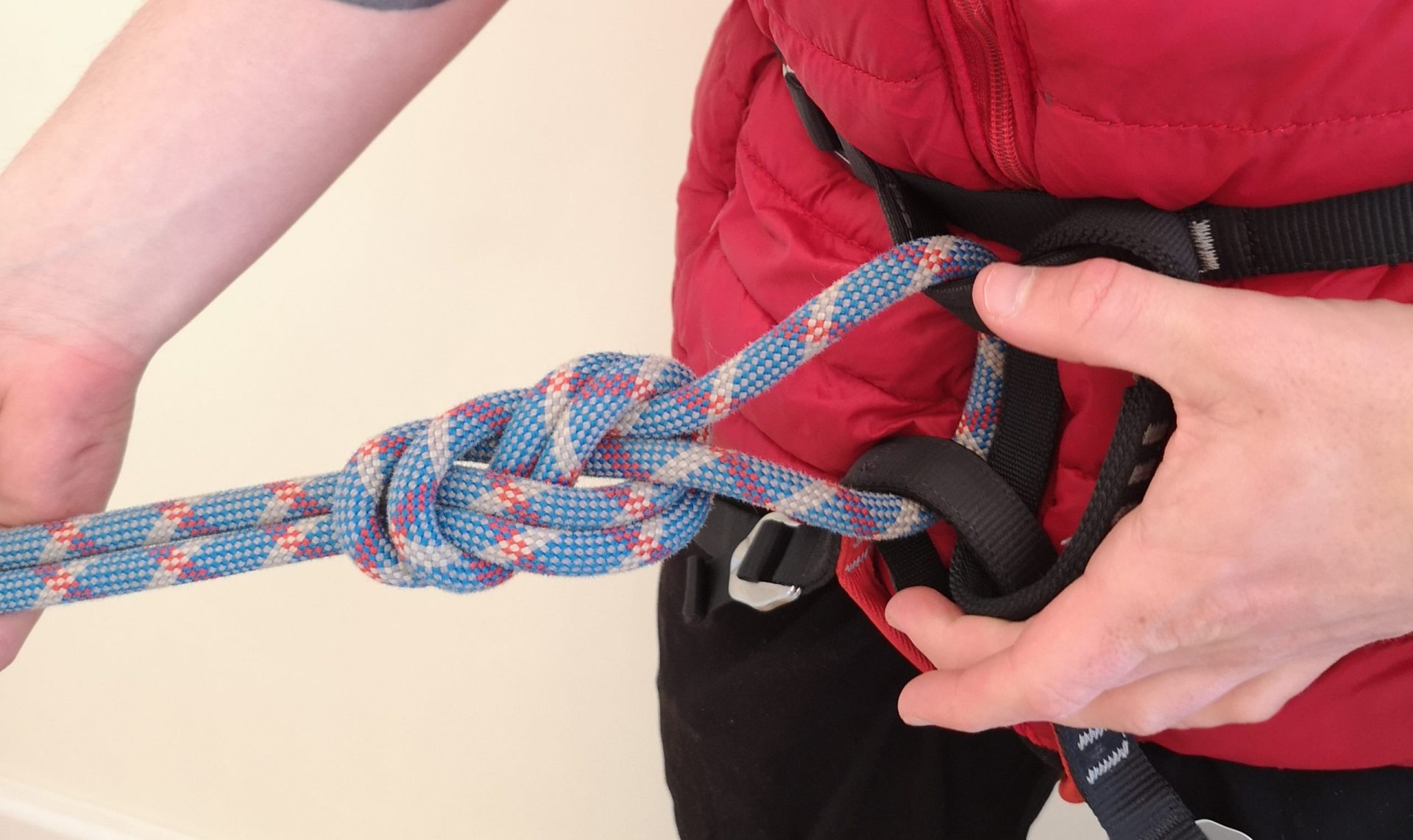
It's a loop knot made using a figure-8, then retracing the knot with the tail. Climbers use it where sailors would tend to use a bowline. I've heard various reasons why: "it's easier to teach people in the gym", "it's harder to get wrong", "the dynamic ropes climbers use put bowlines at risk of capsizing".
1. It's very easy to visually check (five pairs of parallel lines) (by easy I don't just mean reliably, I also mean low effort, which is important because you do it a lot - point fingers at the pairs of parallel lines: "two four six eight ten"). It's very symmetric. If done wrong it tends to look radically different.
2. It requires pulling in 2 places in different directions to come undone. The bowline opens if you pull in 1 bad spot.
(3. In the gym, you can just leave the normal figure eight on the rope, which saves the next climber a bit of time. Not a lot, but it's a nice feature.)