Earlier quoted context omitted.
I think the issue is many translation databases just hold the English text and then all the translations. So the entry is “Open ticket” and then you just drop in the translation anywhere that phrase shows up. But sometimes “open” is a verb, sometimes a noun. The actual identifier should be something like “Open a ticket (imperative, button)” and then that phrase has translations, including the English “Open ticket”.
Or maybe the translator should get annotated screenshots of the app. Laid out in a story board. If you just hand someone a list of strings to translate, there's no way you'll get sensible results. Also, you should test you translations. Some of the translations that I've seen (even from reputable companies) are so bad that it's pretty obvious no native speaker has ever looked them over.
What they don’t tell you when you translate your app
41–50 of 236 posts
Re: What they don’t tell you when you translate your app
#42> People may prefer the English experience because they expect the translated version to be inferior As an Italian, I can relate so much to this, because translated apps will happily treat verbs as adjectives and vice versa. A couple example: * Flixbus' app translates "Open ticket" to "Biglietto aperto" (treating "open" as an adjective, not as an imperative verb). Correct translation should be "Apri biglietto". Nothi…
Re: What they don’t tell you when you translate your app
#43Earlier quoted context omitted.
I think the issue is many translation databases just hold the English text and then all the translations. So the entry is “Open ticket” and then you just drop in the translation anywhere that phrase shows up. But sometimes “open” is a verb, sometimes a noun. The actual identifier should be something like “Open a ticket (imperative, button)” and then that phrase has translations, including the English “Open ticket”.
That's actually a nice idea in forcing even the default language to be handled by the same workflows, processes, and tools as the other languages. I've found that in a lot of those cases there simply is lots of context missing from the strings that should be translated. If all you get is the English text without any indication of how and where it's used in the UI, you're bound to make such mistakes in the translation…
Re: What they don’t tell you when you translate your app
#44“Planning ahead helps, but nothing will prepare you for German,” [Joe Mirabello] said. “German destroys your best laid plans. German will defeat you. That text field you thought would only ever need a single 10-20 character word? Nope. German has a unique word for that and it’s a hundred and twelve characters long. We even have a native German developer on our team and he refuses to translate our games into German. This is all said tongue-in-cheek, of course, just to illustrate a point, and that is; whatever scaling flexibility you think you’ve planned for in your UI to account for localization? It’s not enough. It’s never enough.”
Re: What they don’t tell you when you translate your app
#45One annoying issue with translated apps the author doesn't cover is "googlability", the fact that we often need to google an error message or menu label in order to solve a problem. This leads to a lot of bilingual people running their software in English just in case they need to paste an error message into a search engine.
Re: What they don’t tell you when you translate your app
#46> People may prefer the English experience because they expect the translated version to be inferior As an Italian, I can relate so much to this, because translated apps will happily treat verbs as adjectives and vice versa. A couple example: * Flixbus' app translates "Open ticket" to "Biglietto aperto" (treating "open" as an adjective, not as an imperative verb). Correct translation should be "Apri biglietto". Nothi…
I have a similar experience as a german on the internet. Aliexpress (straight up wrong translations), Discord (anglicism, adjective ordering and weird sentence/tone structures) and plenty of others I don't remember, the list is pretty long. Size doesn't really seem play an effect aswell. Another big issue are potential bugs you encounter. If you just get a translated error message without any error number or somethin…
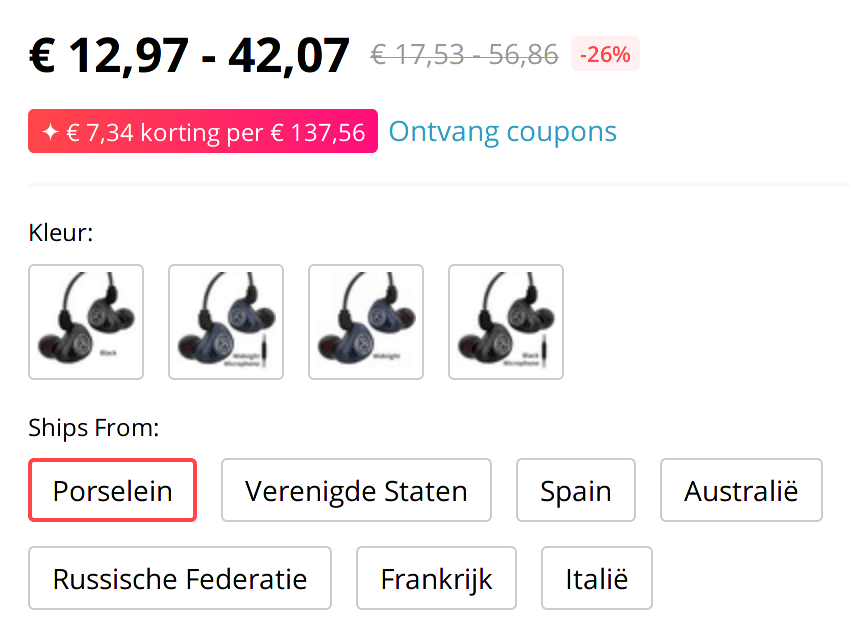
Plenty of items on Aliexpress can be shipped from multiple locations. "China" is almost always one of the options. Well, in Dutch they've translated that to "Porselein". That is a valid translation, if you are talking about plates and dishes made from porcelain)
I wonder how actively harmful this bad translation is to their business.
https://en.wikipedia.org/wiki/China_(material)
screenshot: https://fransdejonge.com/wp-content/uploads/2019/11/Screensh...
Re: What they don’t tell you when you translate your app
#47Earlier quoted context omitted.
I think the issue is many translation databases just hold the English text and then all the translations. So the entry is “Open ticket” and then you just drop in the translation anywhere that phrase shows up. But sometimes “open” is a verb, sometimes a noun. The actual identifier should be something like “Open a ticket (imperative, button)” and then that phrase has translations, including the English “Open ticket”.
Obj-C and Swift allow comments to go along with translation strings, so you would add let buttonStr = NSLocalizedString("Open ticket", comment: "For user to open a ticket") And the comment would make its way into the eventual xliff file sent to translators
Many translation tools give the locations in the code where a string is used. It's a first step, though translators are not always able to read code.
Re: What they don’t tell you when you translate your app
#48Re: What they don’t tell you when you translate your app
#49> People may prefer the English experience because they expect the translated version to be inferior As an Italian, I can relate so much to this, because translated apps will happily treat verbs as adjectives and vice versa. A couple example: * Flixbus' app translates "Open ticket" to "Biglietto aperto" (treating "open" as an adjective, not as an imperative verb). Correct translation should be "Apri biglietto". Nothi…
I think the issue is many translation databases just hold the English text and then all the translations. So the entry is “Open ticket” and then you just drop in the translation anywhere that phrase shows up. But sometimes “open” is a verb, sometimes a noun. The actual identifier should be something like “Open a ticket (imperative, button)” and then that phrase has translations, including the English “Open ticket”.
Yes, we improved on this somewhat. In the last rounds they got access to the software in English beforehand, and there are now also access keys to press to see the string id for any label in the app. It is still a very time consuming process, and I love it when a rollout is done to a country where we can just say, consumer facing texts get translated, our employees all speak English well enough to use this as is.
Re: What they don’t tell you when you translate your app
#50Earlier quoted context omitted.
I've run into this problem but I don't know there is a good solution. Let's say for whatever reason the app guesses the user wants Japanese. The app has no way to know what to present to allow to user to switch languages. Should they put a button that says "Language", how does that help a Chinese language person, a Korean person, a Thai person? Should they put "English"? Same point as above. As you complain, they'll…
National flags - who doesn't know their own flag or any of the major ones enough that they'll miss a Union Jack, Stars and Stripes or a Hinomaru ?
But that's not the question, anyway. The question is how to label the button that lets the user change the language when the user might not understand the current language at all. Perhaps a big bright "?" ...?