Live data from Hacker News

Why it took us thousands of years to see the colour violet

psyche.co

41–50 of 64 posts

Re: Why it took us thousands of years to see the colour violet

#41
post #28

> Egypt, Mesopotamia and the medieval Islamic cultures survived especially well in their extremely dry climates. And they had no violet in them at all. In ancient times purple was a luxury for dying clothes, even in medieval times, and harvesting sea snails for the dye was lucrative business between egyptians, phoeniceans etc. so how come they claim we can't see it? I dont think their claim is true. What's next? "Why…

Consider the color orange. There wasn't a name for the color in antiquity. When the fruit become available, its color was referred to as "the color of a norange" (this happened independently in various European languages. Unrelated factoid, many languages with an indefinite article that ends with n, assimilated the leading n of the fruit name in the article). Clearly our ancestors could see the orange colored before…

Purple had a name in ancient greek (porfyra) and egyptian times. The color was named after (or vice versa) the sea snail that makes it

I think the whole naming of "orange" had to do with the fact that the need arose to actually discriminate the fruit you wanted by its color
Re: Why it took us thousands of years to see the colour violet

#42
post #28

Earlier quoted context omitted.

Consider the color orange. There wasn't a name for the color in antiquity. When the fruit become available, its color was referred to as "the color of a norange" (this happened independently in various European languages. Unrelated factoid, many languages with an indefinite article that ends with n, assimilated the leading n of the fruit name in the article). Clearly our ancestors could see the orange colored before…

What does that have to do with "seeing the color". Of course there are words for many exact things that are typical examples of some colors. People couldn't see a particular mid-dark red before Ferrari? Bianchi celeste color? Surf green Stratocaster? Or maybe when Pantone launched their color reference system, people then suddenly started seeing them? Think how walking in a meadow must have felt after seeing all the…

> It is surprising that these kind of categorical errors get forwarded so easily.

This is usually a sign that it wasn't the article's author who misunderstood ;)

Physically, people obviously could see the same frequencies. But what to make of the raw perception has a cultural aspect - after all, the whole band from 400 nm to 780 nm is continuous, and we are able to perceive the complete range[0], so the color categories we use have to be arbitrary to a degree. So seeing here means consciously differentiating, not physically perceiving.

Anecdote: I was working in a print shop during university. After a few years of consciously comparing small hue differences, I became almost offended if someone in class talked about a "purple" line in a graph that was clearly magenta to me. I couldn't care less a few years before.

[0] = many parts indirectly, though, e.g. yellow is not a color we can see directly with the cones alone, it is processed first.

Re: Why it took us thousands of years to see the colour violet

#43

> Egypt, Mesopotamia and the medieval Islamic cultures survived especially well in their extremely dry climates. And they had no violet in them at all. In ancient times purple was a luxury for dying clothes, even in medieval times, and harvesting sea snails for the dye was lucrative business between egyptians, phoeniceans etc. so how come they claim we can't see it? I dont think their claim is true. What's next? "Why…

It took decades to fashion them out of tables

Re: Why it took us thousands of years to see the colour violet

#44
post #42

Earlier quoted context omitted.

What does that have to do with "seeing the color". Of course there are words for many exact things that are typical examples of some colors. People couldn't see a particular mid-dark red before Ferrari? Bianchi celeste color? Surf green Stratocaster? Or maybe when Pantone launched their color reference system, people then suddenly started seeing them? Think how walking in a meadow must have felt after seeing all the…

> It is surprising that these kind of categorical errors get forwarded so easily. This is usually a sign that it wasn't the article's author who misunderstood ;) Physically, people obviously could see the same frequencies. But what to make of the raw perception has a cultural aspect - after all, the whole band from 400 nm to 780 nm is continuous, and we are able to perceive the complete range[0], so the color categor…

That's just about caring or differentiating about relatively small difference. Not about not being able to see the whole color. Which is in the title.

Recently a lot of people forwarded the idea that ancient people couldn't see blue. If you look at Egyptian artefacts, they sure have a lot of symmetrical blue accents. If they really couldn't see the color, then by accident they should have at least at times picked some other color to the left piece than the right piece?

Re: Why it took us thousands of years to see the colour violet

#45
post #19

I do appreciate the feet-on-the ground research sentiment "Over the past 20 years, I visited 193 museums in 42 different countries. Equipped with 1,500 Munsell colour chips .. I examined 139,892 works of art, searching for violet. ... there were only .. few artworks before the 1860s" And the art historical conclusion feels convincing "in 1864 the influential French art critic Charles Blanc ... described how violet, p…

Funny, my first conclusion is that after 1864 you could buy violet paint easier.

Re: Why it took us thousands of years to see the colour violet

#46
post #45
post #19

I do appreciate the feet-on-the ground research sentiment "Over the past 20 years, I visited 193 museums in 42 different countries. Equipped with 1,500 Munsell colour chips .. I examined 139,892 works of art, searching for violet. ... there were only .. few artworks before the 1860s" And the art historical conclusion feels convincing "in 1864 the influential French art critic Charles Blanc ... described how violet, p…

Funny, my first conclusion is that after 1864 you could buy violet paint easier.

Well, you could mix it from blue and red. But if there are no subjects that are actually violet I presume you lack the incentive to incorporate this color. Violet cloths result in violet subjects etc.

The observation of lack of violet before 19th century is interesting no matter which pedestrian explanation is the most correct one.

Re: Why it took us thousands of years to see the colour violet

#47

> Egypt, Mesopotamia and the medieval Islamic cultures survived especially well in their extremely dry climates. And they had no violet in them at all. In ancient times purple was a luxury for dying clothes, even in medieval times, and harvesting sea snails for the dye was lucrative business between egyptians, phoeniceans etc. so how come they claim we can't see it? I dont think their claim is true. What's next? "Why…

[deleted]

Re: Why it took us thousands of years to see the colour violet

#48
post #42

Earlier quoted context omitted.

> It is surprising that these kind of categorical errors get forwarded so easily. This is usually a sign that it wasn't the article's author who misunderstood ;) Physically, people obviously could see the same frequencies. But what to make of the raw perception has a cultural aspect - after all, the whole band from 400 nm to 780 nm is continuous, and we are able to perceive the complete range[0], so the color categor…

That's just about caring or differentiating about relatively small difference. Not about not being able to see the whole color. Which is in the title. Recently a lot of people forwarded the idea that ancient people couldn't see blue. If you look at Egyptian artefacts, they sure have a lot of symmetrical blue accents. If they really couldn't see the color, then by accident they should have at least at times picked som…

> That's just about caring or differentiating about relatively small difference.

Which this is all about! The author talks about 51 Munsell color samples out of 1500, so only 3% of the gamut.

Look how specific "violet" is in the Munsell system: https://munsell.com/color-blog/munsell-book-of-color-1929-tr... (violet is at #17).

Re: Why it took us thousands of years to see the colour violet

#49
post #48

Earlier quoted context omitted.

That's just about caring or differentiating about relatively small difference. Not about not being able to see the whole color. Which is in the title. Recently a lot of people forwarded the idea that ancient people couldn't see blue. If you look at Egyptian artefacts, they sure have a lot of symmetrical blue accents. If they really couldn't see the color, then by accident they should have at least at times picked som…

> That's just about caring or differentiating about relatively small difference. Which this is all about! The author talks about 51 Munsell color samples out of 1500, so only 3% of the gamut. Look how specific "violet" is in the Munsell system: https://munsell.com/color-blog/munsell-book-of-color-1929-tr... (violet is at #17).

Yes, the article itself is nice but the title isn't. "Why it took us thousands of years to see the colour violet".

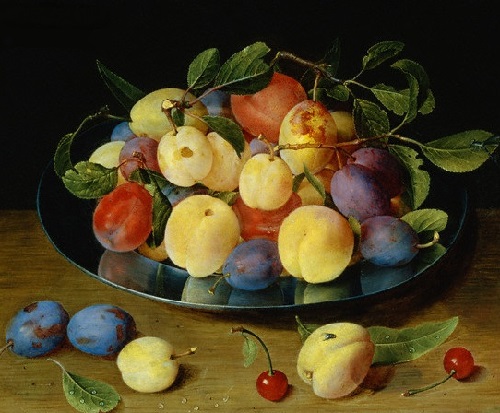
What do you make of plums in still life paintings? I don't know if it fills the criteria for violet. https://vsemart.com/wp-content/uploads/2015/02/Peaches-and-p...

Re: Why it took us thousands of years to see the colour violet

#50
post #28

> Egypt, Mesopotamia and the medieval Islamic cultures survived especially well in their extremely dry climates. And they had no violet in them at all. In ancient times purple was a luxury for dying clothes, even in medieval times, and harvesting sea snails for the dye was lucrative business between egyptians, phoeniceans etc. so how come they claim we can't see it? I dont think their claim is true. What's next? "Why…

Consider the color orange. There wasn't a name for the color in antiquity. When the fruit become available, its color was referred to as "the color of a norange" (this happened independently in various European languages. Unrelated factoid, many languages with an indefinite article that ends with n, assimilated the leading n of the fruit name in the article). Clearly our ancestors could see the orange colored before…

Though it would rhyme with "orange," there was not a norange:

https://www.phrases.org.uk/meanings/a-norange.html

Post reply on HN