I think this article really misses the point that Burry was making, which is that if the indexs see a sell off they won't find the liquidity in the market to cash out their positions and will drive the market down. This article seems to focus on all of the upsides of indexing, which are all true. However, those upsides don't negate the risk that is being pointed to.
A critique of the claim that passive investing is a bubble
41–50 of 200 posts
Re: A critique of the claim that passive investing is a bubble
#42Reminder: "index funds" are also managed by humans. For example, all stocks in the S&P 500 are chosen by Standard & Poors. Stocks are added and removed as they see fit based on various criteria such as profitability, float, market cap, &c. The only things that I can see that truly differentiate S&P from other active managers are that they (a) have very little skin in the game. (b) they get to make decisions about wha…
The S&P 500 is basically a group of largest established 500 market cap stocks traded in the US proportioned to market cap. There is no active management determining price and weights here.
Re: A critique of the claim that passive investing is a bubble
#43Apple alone has $50 billion in cash that will flow into Vanguard if index funds hit a 50% plunge. Same with Buffet. Index funds may be bubble priced, but they don't suffer from a liquidity issue.
Re: A critique of the claim that passive investing is a bubble
#44I think this article really misses the point that Burry was making, which is that if the indexs see a sell off they won't find the liquidity in the market to cash out their positions and will drive the market down. This article seems to focus on all of the upsides of indexing, which are all true. However, those upsides don't negate the risk that is being pointed to.
> if the indexs see a sell off they won't find the liquidity in the market to cash out their positions and will drive the market down When investors sell that amount, it doesn't matter whether they hold the underlying assets directly, or via index funds or ETFs, or via actively managed funds. The market will go down. So, which part of the problem is uniquely due to index funds? Burry hasn't made that point very clear…
Re: A critique of the claim that passive investing is a bubble
#45I think this article really misses the point that Burry was making, which is that if the indexs see a sell off they won't find the liquidity in the market to cash out their positions and will drive the market down. This article seems to focus on all of the upsides of indexing, which are all true. However, those upsides don't negate the risk that is being pointed to.
Exactly. The article, starting with the title, is pompous and overconfident. Burry made the unanswered point that in a sell-off large index funds will have to dump their smaller holdings at large discounts. We have never had a market crash with passive holdings this large (and consolidated in a small handful of funds)-- we're in unprecedented times. Burry's point is entirely plausible. And although that it wouldn't i…
First, I think he didn't made that point very clearly. Second, why would they be sold at a larger discount than larger holdings? It is all in proportion - they own less and sell less of the smaller holdings.
(There are issues conceivable where you have a liquidity mismatch (bonds, real estate), but I haven't seen a solid elaboration of that point. It's the good old "people worry about bond market liquidity" meme that Mark Levine pokes fun at in his Bloomberg Column "Money Stuff".)
Re: A critique of the claim that passive investing is a bubble
#46Earlier quoted context omitted.
>You'd basically need the entire market to become illiquid. Yes. It has happened before.
OK, but in that case is there a distinction between index funds and actively managed funds? Is this a risk that index funds are uniquely exposed to? Also, another thing to keep in mind is that this only affects people who are trying to sell at the bottom. Buy and hold investors care little for liquidity issues during a crash.
1) To track the actual index, index funds must continually rebalance their portfolio. In a liquidity pause they may not be able to do this, thereby becoming a non-index fund. Actively managed funds have the portfolio they have -- unless they're defrauding the public somehow. An index fund that becomes a non-index fund would fall in this latter category.
2) The index (not the funds) is assumed to reflect all the information that can be used to make some money by arbitrage. This process is referred as "price discovery". But in a liquidity pause, price discovery grinds to a halt. Actively managed funds have their own idea of what are the fundamental prices beyond what the public leaderboard says; their price discovery is not beholden to the existence of a liquidity market. Actually -- if the market goes for years with very low liquidity, it becomes more likely that people who, say, are shorting Herbalife for fundamental reasons, have more knowledge than the index. In this way the index is like an AI that can become starved for data.
Re: A critique of the claim that passive investing is a bubble
#47Earlier quoted context omitted.
What if my index fund is actually just buying and holding the underlying stock as opposed to just a price tracking entity? In that case not taker for my fund = no taker for the underlying stock right? Will this not have the liquidity risk that Bury mentions?
They are mostly not doing physical replication (physically owning all the shares) but using synthetic means.
https://www.investopedia.com/articles/markets/101415/4-best-...
Re: A critique of the claim that passive investing is a bubble
#48I think this article really misses the point that Burry was making, which is that if the indexs see a sell off they won't find the liquidity in the market to cash out their positions and will drive the market down. This article seems to focus on all of the upsides of indexing, which are all true. However, those upsides don't negate the risk that is being pointed to.
Exactly. The article, starting with the title, is pompous and overconfident. Burry made the unanswered point that in a sell-off large index funds will have to dump their smaller holdings at large discounts. We have never had a market crash with passive holdings this large (and consolidated in a small handful of funds)-- we're in unprecedented times. Burry's point is entirely plausible. And although that it wouldn't i…
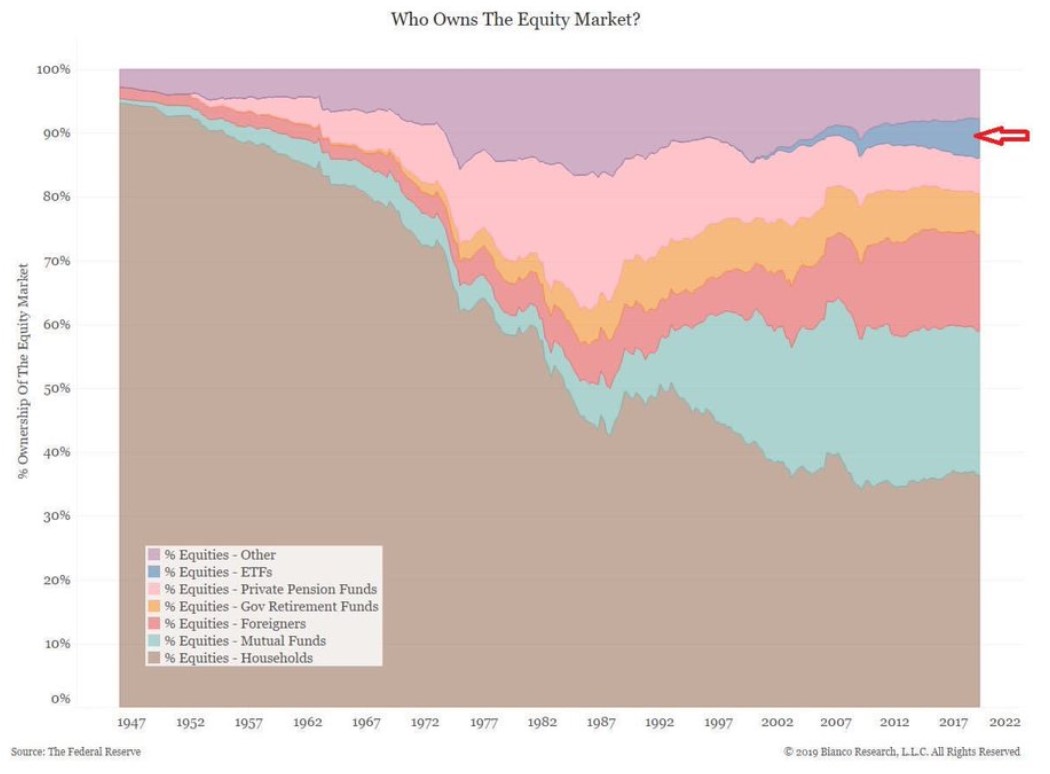
https://awealthofcommonsense.com/wp-content/uploads/2019/09/...
Re: A critique of the claim that passive investing is a bubble
#49Reminder: "index funds" are also managed by humans. For example, all stocks in the S&P 500 are chosen by Standard & Poors. Stocks are added and removed as they see fit based on various criteria such as profitability, float, market cap, &c. The only things that I can see that truly differentiate S&P from other active managers are that they (a) have very little skin in the game. (b) they get to make decisions about wha…
The S&P 500 is basically a group of largest established 500 market cap stocks traded in the US proportioned to market cap. There is no active management determining price and weights here.
That said, for all practical purposes it is basically the 500 largest companies.
Re: A critique of the claim that passive investing is a bubble
#50Earlier quoted context omitted.
What if my index fund is actually just buying and holding the underlying stock as opposed to just a price tracking entity? In that case not taker for my fund = no taker for the underlying stock right? Will this not have the liquidity risk that Bury mentions?
They are mostly not doing physical replication (physically owning all the shares) but using synthetic means.