Live data from Hacker News

Poka-yoke

en.wikipedia.org

41–50 of 62 posts

Re: Poka-yoke

#41
Take a look at this Audi production video and you start to notice poka-yoke being used when there is a human in the loop. https://www.youtube.com/watch?v=nZkyfZqlptA

In my experience these things are developed over time in response to failure. Always keeping the poka-yoke concept in the back of your mind helps when designing systems, but you don't really know how people will misuse tools until they're in action.

Re: Poka-yoke

#42

This seems like an interesting and useful process design concept on one hand, and on the other hand, it also sounds like a Japanese buzzword for foolproofing (in fact, the article notes that the term was originally “baka-yoke”, which is literally “foolproof” or “idiot-proof”). On the one hand, I don’t think Toyota invented the concept of foolproofing; on the other hand, giving it a cool buzzword gives you an excuse t…

I don't really understand the point of your message, it feels like forced cynicism around the cultural reception of the term.

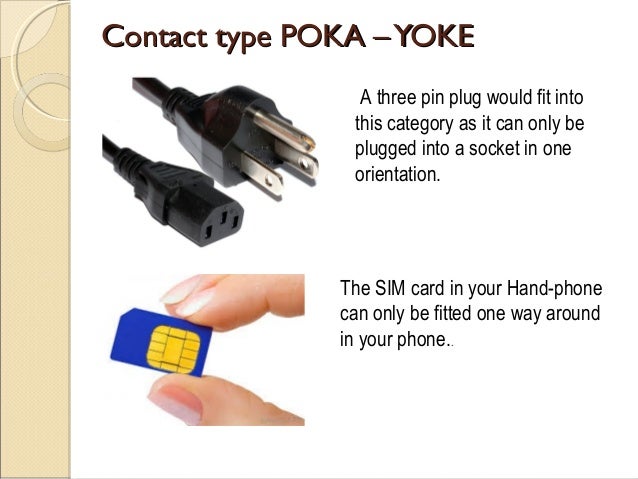
Perhaps you're saying that the phrase is akin to "big data" or "AI" in that it doesn't really say much. The idea that this concept can be misapplied doesn't serve well to steelman its useful core concept and philosophy which is timeless. My favorite example are electrical plugs [1]. Whatever beef you have with Toyota, Japanese, or buzzwords just seems inappropriate here and lowers the quality of discussion.

[1] https://image.slidesharecdn.com/pokayoke-150112043214-conver...

Re: Poka-yoke

#43
post #34

Just want to share some stories: One of my professors (I am an Industrial engineer) used the example of a SIM card. I imagine people can still get it wrong when putting it in, but much less so ( ehem USB ) because of that slight cut in the rectangle. It also helps a lot when manufacturing those things to get the orientation right. Another mistake proofing anecdote I've heard was about one of his students interning at…

That’s a story which I have seen a few variants of before this; I doubt this is really one of the professor’s students, it’s more likely an urban legend.

Re: Poka-yoke

#44

This seems like an interesting and useful process design concept on one hand, and on the other hand, it also sounds like a Japanese buzzword for foolproofing (in fact, the article notes that the term was originally “baka-yoke”, which is literally “foolproof” or “idiot-proof”). On the one hand, I don’t think Toyota invented the concept of foolproofing; on the other hand, giving it a cool buzzword gives you an excuse t…

[deleted]

Re: Poka-yoke

#45

This seems like an interesting and useful process design concept on one hand, and on the other hand, it also sounds like a Japanese buzzword for foolproofing (in fact, the article notes that the term was originally “baka-yoke”, which is literally “foolproof” or “idiot-proof”). On the one hand, I don’t think Toyota invented the concept of foolproofing; on the other hand, giving it a cool buzzword gives you an excuse t…

>I’m also kind of amused at how the entire business world basically said, “man, this company made super reliable cars in the 80’s and 90’s[1], let’s learn their secrets” and it turns out that once you strip away the exotic Japanese veneer, it’s mostly just systemized common sense. Which is not a minor thing to do, to be fair, except it’s easy for businesses to take good, well-systemized ideas and utterly misapply the…

>This was basically all done over UAW's dead body. It's not like process engineers working at the big three in the 80s didn't want to do those things. They were aware of what industry best practices were as any competent professionals would be. They just couldn't get those best practices implemented until the Japanese manufacturers created an existential threat to the status quo.

Have you come across this podcast / radio programme episode? https://www.thisamericanlife.org/403/nummi

It's about a joint venture between Toyota and GM in the 1980s. It discusses the culture shock the US workers experienced and the labour relations at the plant. The people interviewed give their own views on why GM didn't / couldn't adopt the lessons learnt in their own plants.

tl;dl The previous GM plant on the site had had terrible problems with the workers there. The new venture hired the same people (starting with the shop stewards) and brought in a totally different way of doing things which totally changed the culture. GM struggled to adopt the Toyota way of doing things in it's own plants because the entire manufacturing chain and culture across the industry had to change to make it possible. I really recommend listening to the whole thing.

After NUMMI closed the Fremont site was taken over by another US manufacturer that sought to improve on existing methods with a greater degree of automation.
Re: Poka-yoke

#46
The term is used quite often in manufacturing. For a part when picking, for example, a part may have two colored squares on the label so the operator looks at the color on the squares to validate as an extra step. We call the colored squares the poka-yoke.

Re: Poka-yoke

#47

This seems like an interesting and useful process design concept on one hand, and on the other hand, it also sounds like a Japanese buzzword for foolproofing (in fact, the article notes that the term was originally “baka-yoke”, which is literally “foolproof” or “idiot-proof”). On the one hand, I don’t think Toyota invented the concept of foolproofing; on the other hand, giving it a cool buzzword gives you an excuse t…

I don't really understand the point of your message, it feels like forced cynicism around the cultural reception of the term. Perhaps you're saying that the phrase is akin to "big data" or "AI" in that it doesn't really say much. The idea that this concept can be misapplied doesn't serve well to steelman its useful core concept and philosophy which is timeless. My favorite example are electrical plugs [1]. Whatever b…

> Whatever beef you have with Toyota, Japanese, or buzzwords just seems inappropriate here and lowers the quality of discussion.

Hey, I'm sorry it came across that way, because I don't have a beef with anyone. But I've explained and expanded on what I've said in this thread a lot before you came along with that comment, and I think it's uncalled for (and "lowers the quality of discussion") to assume bad faith the way that you're doing right now.

Re: Poka-yoke

#48
post #25

Earlier quoted context omitted.

> They called it the obvious word in their own language, it's only a cool buzzword to non-native speakers reading English Wikipedia. I'm more making fun of the American business consultants who are going to try and cargo-cult this idea and make it sound more impressive than it actually is by not using the already commonplace American English idiom that describes the same concept. The term "poka-yoke" seems to date fr…

In a large part, it's because Western business practices suffer from a lot of ego. I suspect consulting has a lot of cargo-culting because you need to wrap things up in a foreign veneer in order to implement certain optimizations without outright calling someone an idiot.

I wonder if that's why American manufacturers didn't listen to Deming in the first place, until after he taught Japanese manufacturers how to kick their asses.

Re: Poka-yoke

#50

Earlier quoted context omitted.

It's hard not to be dismissive of what appears to be a simple set of concepts, but you're missing on an opportunity to learn a very cool set of skills here. I recommend that anyone who wants to live a better life and do better work read books on the Toyota Production System and Taiichi Ohno. As for Poka-Yoke, It's a word that seems simple but when used in industry contexts communicates a deeper set of requirements th…

Any specific books you would recommend? Doing a quick search on Amazon I found: Toyota Production System: An Integrated Approach to Just-In-Time https://www.amazon.com/dp/143982097X/ref=sr_ob_1?ie=UTF8&qid... Taiichi Ohnos Workplace Management: Special 100th Birthday Edition https://www.amazon.com/Taiichi-Ohnos-Workplace-Management-Bi... The Toyota Mindset: The Ten Commandments of Taiichi Ohno https://www.amazon.com/…

The best book on Lean for beginners is “2 Second Lean” by Paul Akers. You can buy the book or get it free directly from Paul Akers’ website. https://paulakers.net/books/2-second-lean

Mr. Akers also has several hundred videos about Lean on his YouTube channel. https://paulakers.net/lean-videos

And for an impressive display of what Lean can do, watch this video “Lean Manufacturing - Kaizen Methodology - Lean FastCap Style” https://www.youtube.com/watch?v=su9CulCZTBg

Post reply on HN