So the new top-end Nvidia cards will have dedicated ray tracing cores. However, real-time ray tracing is still so computationally expensive that games can only implement a hybrid form of it whereby ray tracing is applied for a certain effect or single object, and plain old rasterization is used for everything else. I applaud NV for stepping up and delivering something in a new direction. Just think- how long has it b…
10 GigaRays/sec = 80 rays per pixel at 1080p60fps. That should be enough to do full scene real-time raytracing with rays per pixel to spare (usually 10 rays per path are more than enough).
The Nvidia Turing GPU Architecture Deep Dive: Prelude to GeForce RTX
41–50 of 54 posts
Re: The Nvidia Turing GPU Architecture Deep Dive: Prelude to GeForce RTX
#42Other than that Nvidia cards are severely restricted due to their lack of support for Adaptive Sync or HDMI 2.1 VRR.
Re: The Nvidia Turing GPU Architecture Deep Dive: Prelude to GeForce RTX
#43Earlier quoted context omitted.
10 GigaRays/sec = 80 rays per pixel at 1080p60fps. That should be enough to do full scene real-time raytracing with rays per pixel to spare (usually 10 rays per path are more than enough).
Where did you base that "10 rays are more than enough" on? https://chunky.llbit.se/path_tracing.html
Re: The Nvidia Turing GPU Architecture Deep Dive: Prelude to GeForce RTX
#44Re: The Nvidia Turing GPU Architecture Deep Dive: Prelude to GeForce RTX
#45We are at the end of the console cycle, which means games hardware requirements will plateau until the next gens are out. So from now, at 1080p, a 1070 is enough to handle everything at 60fps until then. That probably translates to a 2060 this generation - which is the card I'm really interested in. Other than that Nvidia cards are severely restricted due to their lack of support for Adaptive Sync or HDMI 2.1 VRR.
Re: The Nvidia Turing GPU Architecture Deep Dive: Prelude to GeForce RTX
#46So the new top-end Nvidia cards will have dedicated ray tracing cores. However, real-time ray tracing is still so computationally expensive that games can only implement a hybrid form of it whereby ray tracing is applied for a certain effect or single object, and plain old rasterization is used for everything else. I applaud NV for stepping up and delivering something in a new direction. Just think- how long has it b…
Even if PUBG would support ray tracing, most users would probably turn it off, because being able to spot things in competitive games is more important than visuals. Good players even turn off shadows and post processing effects in order to get an advantage over players who dont. Ray tracing is a nice feature for single player games or multiplayer games that are not competitive (e.g. PvE games like Diablo).
Re: The Nvidia Turing GPU Architecture Deep Dive: Prelude to GeForce RTX
#47There are a lot of use cases for ray tracing that are not games. So far NVIDIA has done a great job at changing their GPU architecture in a way that is mutually beneficial to all of their diverse customer base.
Re: The Nvidia Turing GPU Architecture Deep Dive: Prelude to GeForce RTX
#48The Turing architecture is also used in Quadro RTX cards, and those have a ridiculous amount of VRAM. Is there any professional/computational use for these RT cores beyond raytracing? One case that comes to mind is perhaps raytracing acoustics, and although interesting it's technically still raytracing. As far as gaming is concerned, personally I'd love if the RT cores could contribute—however inefficiently—to render…
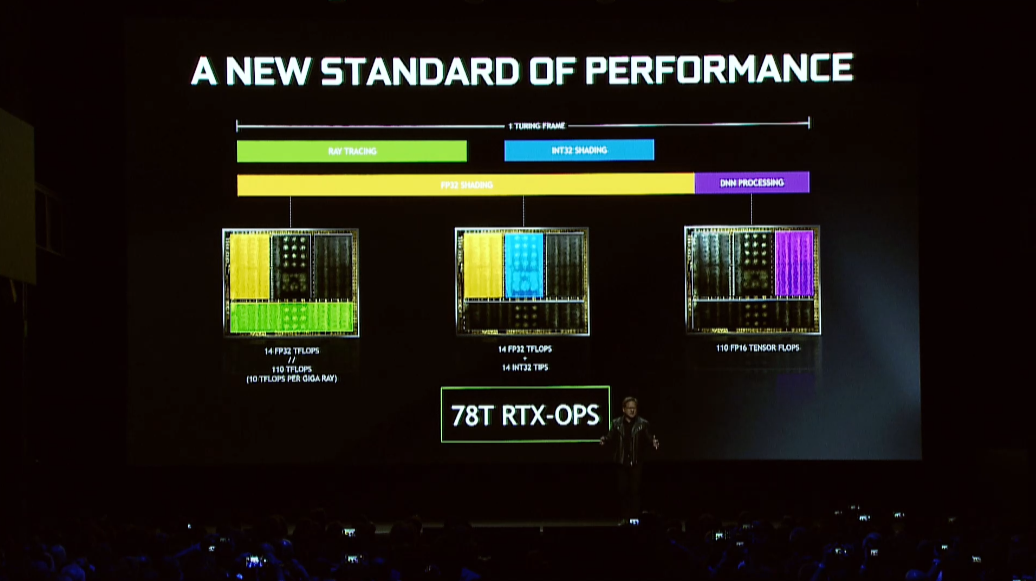
> It's annoying that 50% of the die is allocated to hardware Source on 50%?
Re: The Nvidia Turing GPU Architecture Deep Dive: Prelude to GeForce RTX
#49Earlier quoted context omitted.
> It's annoying that 50% of the die is allocated to hardware Source on 50%?
Roughly* 50%: https://i.kinja-img.com/gawker-media/image/upload/t_original...
B) that said, looks more like 30% to me.
Re: The Nvidia Turing GPU Architecture Deep Dive: Prelude to GeForce RTX
#50Earlier quoted context omitted.
Roughly* 50%: https://i.kinja-img.com/gawker-media/image/upload/t_original...
A) that's a marketing image. The green box is placed over a random portion of the die, not just the raytracing units. (They are distributed throughout the die, not shoved on one side). B) that said, looks more like 30% to me.
https://i.redd.it/gxmyxo2c5yf11.png
Just by looking at that you can intuitively see that the colored boxes in the previous image appear to be arbitrary. On the other hand, the previous image does seem to be trying to convey that a substantial portion of the die isn't shading units, even if the distribution is misrepresented.
>B) that said, looks more like 30% to me.
Was talking about RT and Tensor combined, not just RT.