Live data from Hacker News

Intel 28-core fantasy vs. AMD 32-core reality

techspot.com

41–50 of 134 posts

Re: Intel 28-core fantasy vs. AMD 32-core reality

#41
post #13

I think of AMD's current approach - a microarchitecture with slower cores, but more cores, than Intel - as very similar to what Sun/Oracle tried to do from 2005 to 2010 with the Niagara family (UltraSPARC T1-T3). Each core in those chips was seriously underclocked compared to a Xeon of similar vintage and price point (1-1.67 GHz; compared to 1.6 GHz to 3 or more), and lacked features like out-of-order execution and b…

It's not similar at all. AMD's cores are 10-20% slower while Niagara was 80-90% slower. And AMD isn't intentionally slower; they designed the Zen core for maximum single-thread performance but they just didn't do as good a job as Intel because their budget is vastly smaller.

Zen does a decent job in clock-for-clock performance, huge killer on the desktop is raw clock speed. When you pit a Ryzen chip maxing out around 3.8-4.2GHz (depending on generation and silicon lottery) to an i7-8700K that has a base frequency of 4.7GHz it's pretty obvious which is going to come out on top.

Most of that clock hit comes from the 12nm LPP process that AMD is currently using too from what I can tell, low-power process typically equates to lower clocks (see mobile chips) so it's not surprising - and why Zen 2 being based on GloFo's 7nm process will hopefully close that gap.
Re: Intel 28-core fantasy vs. AMD 32-core reality

#42
post #33

Earlier quoted context omitted.

That's literally what the OP did. A 1950X is only $799 now, so less than half a top end i9.

That's extremely recent. It was more like $900 a day or two ago: https://camelcamelcamel.com/AMD-Threadripper-32-thread-Proce... And it is still $960 on Newegg: https://www.newegg.com/Product/Product.aspx?Item=N82E1681911...

Eh its just a matter of patience I guess. I got mine for $799 in December.

Re: Intel 28-core fantasy vs. AMD 32-core reality

#43
post #9
post #5

I believe Intel's designs are based on a single die compared to AMD threadripper which are multichip.

You’re right, but obviously the advantage that used to give them isn’t working out anymore. AMD’s interconnect seems fast enough, and they don’t have the yield/cost problems from massive single die chips.

More importantly that they can target desktops, high end desktops, and servers with the same exact silicon. So they can amortize their R&D across more units, and of course the supply line is much simpler. So AMD doesn't have to guess ahead of time what mix of ryzen, threadripper, and epyc chips they will sell.

Re: Intel 28-core fantasy vs. AMD 32-core reality

#44

Earlier quoted context omitted.

When VMware charges per socket and not per core.

Big ditto for Oracle. probably others.

Realistically, it is easy to count cores. Some companies still count MAC addresses.

Re: Intel 28-core fantasy vs. AMD 32-core reality

#45

Which one of these companies does at better job with free/libre software? I've always had a soft spot for AMD because it's the underdog, but I want to make sure that they are free, too.

GPUOpen [1] is AMD's branded Open Source / Open protocol initiative.

[1] https://gpuopen.com/

Re: Intel 28-core fantasy vs. AMD 32-core reality

#46
post #13

I think of AMD's current approach - a microarchitecture with slower cores, but more cores, than Intel - as very similar to what Sun/Oracle tried to do from 2005 to 2010 with the Niagara family (UltraSPARC T1-T3). Each core in those chips was seriously underclocked compared to a Xeon of similar vintage and price point (1-1.67 GHz; compared to 1.6 GHz to 3 or more), and lacked features like out-of-order execution and b…

It's not similar at all. AMD's cores are 10-20% slower while Niagara was 80-90% slower. And AMD isn't intentionally slower; they designed the Zen core for maximum single-thread performance but they just didn't do as good a job as Intel because their budget is vastly smaller.

Just figured I'd mention that AMD significantly closed this gap with the Ryzen 2. The less parallel friendly applications (like many games) now seem to be faster on AMD or Intel depending on the application. Additionally the up to date security patches tend to hurt Intel more than AMD.

As always, if you really care about a single application, then you test it. But I wouldn't say that Intel wins on all single thread or few thread workloads anymore.

Especially if you consider that often a new Intel CPU requires a new Intel motherboard, and AMD often keeps motherboard compatibility across multiple generations, like the Ryzen and Ryzen 2.

Re: Intel 28-core fantasy vs. AMD 32-core reality

#47

I just recently replaced my old i7 920 in the homeserver with an AMD Ryzen 5 2600. Really like it so far. Price / performance is great. This is my first AMD since probably ever.... The two things I don't like is that their CPUs are pin based. It seemed kind of old fashioned after Intel CPUs. But this is really a minor thing. The other issue is memory compatibility is a bit finicky. Maybe it has to do with the CPU bei…

Threadripper is lga ;-)

Re: Intel 28-core fantasy vs. AMD 32-core reality

#48
post #31
post #26

Earlier quoted context omitted.

It has to do with memory. In server grade computers, each socket has memory local slots that it can read and write to very fast. Read this: https://en.wikipedia.org/wiki/Non-uniform_memory_access

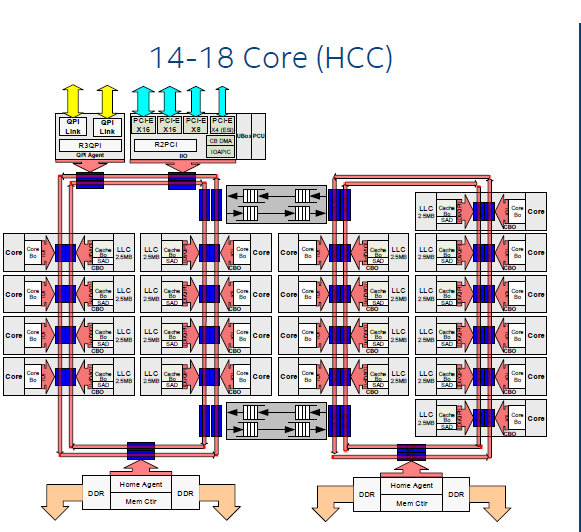
It is already the case with Thread Ripper processors. They have multiple NUMA nodes inside one socket.

Exactly the same case as single die Xeon architecture with 2 separate rings inside with different memory modules attached to each ring - https://images.anandtech.com/doci/9193/HaswellEPHCCdie_575px...

Re: Intel 28-core fantasy vs. AMD 32-core reality

#49
post #36

Earlier quoted context omitted.

A slightly OT question: Wasn't that 10-20% before meltdown? Or is there still some similar disadvantage in clock speed per Watt or IPC?

AMD still takes the hit for Spectre mitigations, even if it does not need Meltdown mitigation. And I'm not sure it's possible to fairly discount Intel's performance with meltdown mitigations applied. I think the impact will vary depending on workload.

> AMD still takes the hit for Spectre mitigations, even if it does not need Meltdown mitigation.

That's why I wanted to keep it out of the discussion and just mentioned Meltdown, AFAIK Spectre applies to both so it would be pure speculation to identify who'll be hit harder.

> And I'm not sure it's possible to fairly discount Intel's performance with meltdown mitigations applied. I think the impact will vary depending on workload.

I think we have this problem already all the time (with or without mitigations applied), that's why we (should) interpret benchmarks only as a proxy.

Re: Intel 28-core fantasy vs. AMD 32-core reality

#50

Which one of these companies does at better job with free/libre software? I've always had a soft spot for AMD because it's the underdog, but I want to make sure that they are free, too.

AMD has been doing a lot of hardwork to get their stuff into mainline (AMDGPU as a recent example) and they opensource a lot of their GPU stuff on github.

On the CPU side, AMD has patched Linux way before Ryzen was available in shops and has been contributing various patches afterwards.

I'd say they are working to get a decent track record for their Ryzen and Vega lineups.

Post reply on HN