Is the light refracting to make the atom appear bigger than it actually is?
Picture of a Single Atom Wins Science Photo Contest
41–50 of 88 posts
Re: Picture of a Single Atom Wins Science Photo Contest
#42Earlier quoted context omitted.
They say it was a long exposure. The atom was illuminated and irradiated light for a long enough time to register on the sensor.
Even if the exposure were for a year, if the amount of light being emitted is less than the hardware can perceive, it wouldn't register - hence the need for electron-microscopes and such. There's a story here about the size of the light being emitted that doesn't seem satisfactorily answered (not by you, the article and stuff in general).
Think about it this way: every photon your eyes perceive came from a single atom.
Re: Picture of a Single Atom Wins Science Photo Contest
#43Lame. This is an optical illusion. Call me when you actually image an atom at the atomic scale.
That's what I was expecting, when I read the title description: Picture of a Single Atom Wins Science Photo Contest
Like, the helical structure of DNA. I want to see how an atom looks like in reality, on the atomic scale. Along with the protons, neutrons, and maybe the electrons flying around it.
Zzz.. going back to sleep now..
Re: Picture of a Single Atom Wins Science Photo Contest
#44Earlier quoted context omitted.
Even if the exposure were for a year, if the amount of light being emitted is less than the hardware can perceive, it wouldn't register - hence the need for electron-microscopes and such. There's a story here about the size of the light being emitted that doesn't seem satisfactorily answered (not by you, the article and stuff in general).
> Even if the exposure were for a year, if the amount of light being emitted is less than the hardware can perceive, it wouldn't register That is not true. It might be noisy, but it would show up. In point of comparison the human eye can see a single photon. A single atom can emit a single photon, ergo you can see a single atom. You won't get any detail out of it obviously, but you'll see it as a dot of light. That's…
If we're seeing the single photon emitted by a single atom, then how much larger is the spot of light in the image compared to the atom that emitted it?
Why isn't there a ruler somewhere in the picture? My brain is absolutely failing to make sense of the scales and sizes in this image.
Re: Picture of a Single Atom Wins Science Photo Contest
#45Lame. This is an optical illusion. Call me when you actually image an atom at the atomic scale. That's what I was expecting, when I read the title description: Picture of a Single Atom Wins Science Photo Contest Like, the helical structure of DNA. I want to see how an atom looks like in reality, on the atomic scale. Along with the protons, neutrons, and maybe the electrons flying around it. Zzz.. going back to sleep…
> Along with the protons, neutrons, and maybe the electrons flying around it.
That is not how reality works. Stuff is quantum mechanical and has no analog in the macroscopic world.
All one can ever see are consequences of interactions. This is what we are seeing.
Re: Picture of a Single Atom Wins Science Photo Contest
#46View it here in actual life size on your display. http://beta.lifesizer.com/view?user=5&ref=_59&h=1080&w=1920
Edit: based on seeing it in actual size, I would say it would be hard to see it with the naked eye, that said as pointed out in other comments, I suppose not impossible if a human eye can detect a single photon.
Re: Picture of a Single Atom Wins Science Photo Contest
#47Earlier quoted context omitted.
Maybe it's light reflected by the atom at multiple points? The article mentions that it's "held nearly motionless" but over a long exposure perhaps the degree of movement allowed created a composite large enough to show up in the photo.
No, that's not it. Just because it is small, doesn't make it invisible. You can't see single atoms because they normally don't send any light toward you. But if they did, and this one is, you would see that light. You aren't seeing the atom exactly, you are seeing what it sends toward you, and the human eye can see single photons. (And so can cameras.)
> No, that's not it.
That has to be at least partially it for the rest of your comment to be right (which it is!). To say the atom was "held nearly motionless" is to say it moved a little during the exposure. It sent the light toward the sensor from all of its positions.
Re: Picture of a Single Atom Wins Science Photo Contest
#48This makes me think of Voyager 1's pale blue dot photograph. https://upload.wikimedia.org/wikipedia/commons/7/73/Pale_Blu...
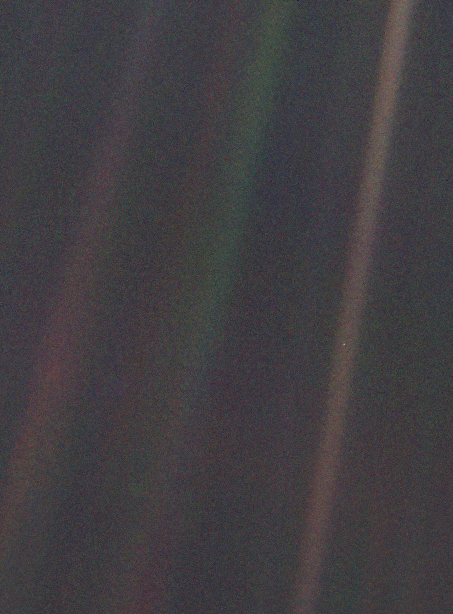
I find the parallel awesome.
Re: Picture of a Single Atom Wins Science Photo Contest
#49Earlier quoted context omitted.
That explanation doesn't really satisfy. Perhaps, based on a large body of experimental evidence, it is known that the number of atoms present can be determined by the apparent brightness. Perhaps it's something totally different. Regardless, it would be helpful if the author/photographer/somebody explained the rationale that makes them confident that this is only a single atom.
They only put 1 atom there, and it's in vacuum. It can't be anything else because of that :)
I'm guessing there are at least two layers of glass between that atom and the sensor. Not really specific to this (excellent) picture, but I imagine that avoiding distortion due to the glass or smudges on the glass must be a huge part of high magnification photography. The whole light from a single atom part just makes it more amazing how clean and clear that window is...
Re: Picture of a Single Atom Wins Science Photo Contest
#50How do they know it's a single atom?