Earlier quoted context omitted.
I'm wonder if they're cutting out a lot of the rendering that PhantomJS is doing. Not to say that any type of rendering is cheap but I'm guessing they have a limited version of a JS rendering engine that does just enough to index the page. I bet they'd also skip on all the FB like buttons and other common social media elements that don't impact the content.
They're starting to consider page load speed as a factor in rankings, which would lead me to believe that they're letting all the social buttons / trackers / media load.
Deprecating our AJAX crawling scheme
41–50 of 80 posts
Re: Deprecating our AJAX crawling scheme
#42So they're actually evaluating all js and css Googlebot is consuming. That's insane. Can we forget about any new competitors in search engine land now? Not only do you have to match Google in relevance you'll actually have to implement your own BrowserBot just to download the pages.
So they're using headless browsers. Why can't anyone do that?
Re: Deprecating our AJAX crawling scheme
#43Gary Illyes @goog said this was happening Q1 this year, and like others mentioned lots of other direct/indirect signals have pointed this way. http://searchengineland.com/google-may-discontinue-ajax-craw... March 5th: Gary said you may see a blog post at the Google Webmaster Blog as soon as next week announcing the decommissioning of these guidelines. Pure speculation but interesting... The timing may have something…
Re: Deprecating our AJAX crawling scheme
#44Earlier quoted context omitted.
You should still be worried. Just because googlebot expensively evaluates JS for some websites doesn't mean it will evaluate JS for your brand-new website. You might get crawled a lot less deeply than if you had good content in your static pages.
By abandoning their AJAX crawling scheme as described in the OP, they are essentially saying that they will evaluate JS for all sites. Do you have some reason to doubt that?
As a former web-scale search engine CTO, my opinions are commonly surprising to folks who haven't built a web-scale crawler/search engine.
Re: Deprecating our AJAX crawling scheme
#45
I don't actually use #! URLs, (or pushstate, though I might use pushstate in the future) but without both of these Google can't see anything JS generated - using Google Webmaster Tools to check.Does this announcement mean I can remove the tag and stop using prerender.io now?
Re: Deprecating our AJAX crawling scheme
#46Wow, I built a project that rendered JS built webpages for search engines via NodeJS and PhantomJS. Rendering webpages is extremely CPU intensive, I'm amazed at the amount of processing power Google must have to do this at Internet scale. I really hope this works, lots of JS libraries expect things like viewport and window size information, I wonder how Google is achieving that.
The XHTML+XSLT+XML-FO stack produced pages that took 3x-10x less CPU to render. But that's dead of course.
Was it ever alive? I never found a decent browser XSL-FO renderer, there were some that seemed kind of proof-of-concept-ish (the only decent XSL-FO rendering I ever encountered was intended for print-like media, mostly PDF, rather than for browsing.)
Re: Deprecating our AJAX crawling scheme
#47So they're actually evaluating all js and css Googlebot is consuming. That's insane. Can we forget about any new competitors in search engine land now? Not only do you have to match Google in relevance you'll actually have to implement your own BrowserBot just to download the pages.
Re: Deprecating our AJAX crawling scheme
#48Wow, I built a project that rendered JS built webpages for search engines via NodeJS and PhantomJS. Rendering webpages is extremely CPU intensive, I'm amazed at the amount of processing power Google must have to do this at Internet scale. I really hope this works, lots of JS libraries expect things like viewport and window size information, I wonder how Google is achieving that.
Re: Deprecating our AJAX crawling scheme
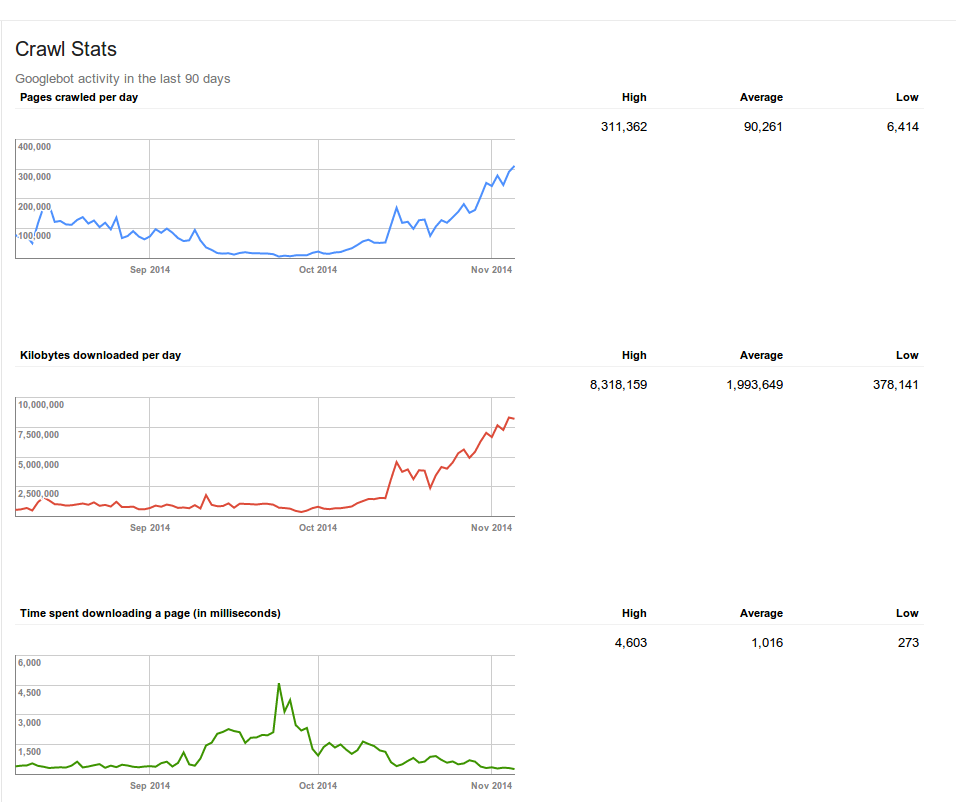
#49Don't believe the hype. Google has been saying that they can execute javascript for years. Meanwhile, as far as I can see, most non-trivial applications still aren't being crawled successfully, including my company's. We recently got rid of prerender because of the promise from the last article from google saying the same thing [1]. It didn't work. 1: http://googlewebmastercentral.blogspot.com/2014/05/understan...
[1] This image is from 2014, when Google previously announced they were crawling JavaScript websites, showing our customer's switch to an AngularJS app in September. Google basically stopped crawling their website when Google was required to execute the JavaScript. Once that customer implemented Prerender.io in October, everything went back to normal.
Another customer recently (June 2015) did a test for their housing website. They tested the use of Prerender.io on a portion of their site against Google rendering the JS of another portion of their site. Here are the results they sent to me:
Suburb A was prerendered and Google asked for 4,827 page impressions over 9 days Suburb B was not prerendered and Google asked for 188 page impressions over 9 days
We've actually talked to Google some about this issue to see if they could improve their crawl speed for JavaScript websites since we believe it's a good thing for Google to be able to crawl JavaScript websites correctly, but it looks like any website with a large number of pages still needs to be sceptical about getting all of their pages into Google's index correctly.
1: https://s3.amazonaws.com/prerender-static/gwt_crawl_stats.pn...
Re: Deprecating our AJAX crawling scheme
#50Currently I use prerender.io and this meta tag: I don't actually use #! URLs, (or pushstate, though I might use pushstate in the future) but without both of these Google can't see anything JS generated - using Google Webmaster Tools to check. Does this announcement mean I can remove the tag and stop using prerender.io now?