Live data from Hacker News

Aphantasia: A life without mental images

bbc.com

41–50 of 78 posts

Re: Aphantasia: A life without mental images

#41

Is there a more objective test than telling someone to visualize something and then asking, "Well, could you visualize it?"? For instance, are there visual tasks a person with or without aphantasia objectively could not perform? Like a psych 101 student, I immediately think I have a touch of any vaguely described mental condition, but I also know I probably don't.

How about this - Picture an elephant sideways. Don't let the elephant move. Is the trunk on the left or on the right side? If they can't answer, then it's possible they have Aphantasia.
Re: Aphantasia: A life without mental images

#42
post #41

Is there a more objective test than telling someone to visualize something and then asking, "Well, could you visualize it?"? For instance, are there visual tasks a person with or without aphantasia objectively could not perform? Like a psych 101 student, I immediately think I have a touch of any vaguely described mental condition, but I also know I probably don't.

How about this - Picture an elephant sideways. Don't let the elephant move. Is the trunk on the left or on the right side? If they can't answer, then it's possible they have Aphantasia.

Might want to say "side-on" instead, I rotated the elephant around the wrong axis and was confused for a moment.

Re: Aphantasia: A life without mental images

#43

Is there a more objective test than telling someone to visualize something and then asking, "Well, could you visualize it?"? For instance, are there visual tasks a person with or without aphantasia objectively could not perform? Like a psych 101 student, I immediately think I have a touch of any vaguely described mental condition, but I also know I probably don't.

The test in the article was extremely easy for me, I guess I can visualize better than most people (I had no idea some people have trouble with that). It's funny, because I've considered myself to be an "auditory" person.

Something I tried to visualize recently, and found quite challenging, was trying to remember this video: https://www.youtube.com/watch?v=9yW--eQaA2I

I watched it a couple of years ago, and last night I replayed it in my head, but with great difficulty.

Re: Aphantasia: A life without mental images

#44

Is there a more objective test than telling someone to visualize something and then asking, "Well, could you visualize it?"? For instance, are there visual tasks a person with or without aphantasia objectively could not perform? Like a psych 101 student, I immediately think I have a touch of any vaguely described mental condition, but I also know I probably don't.

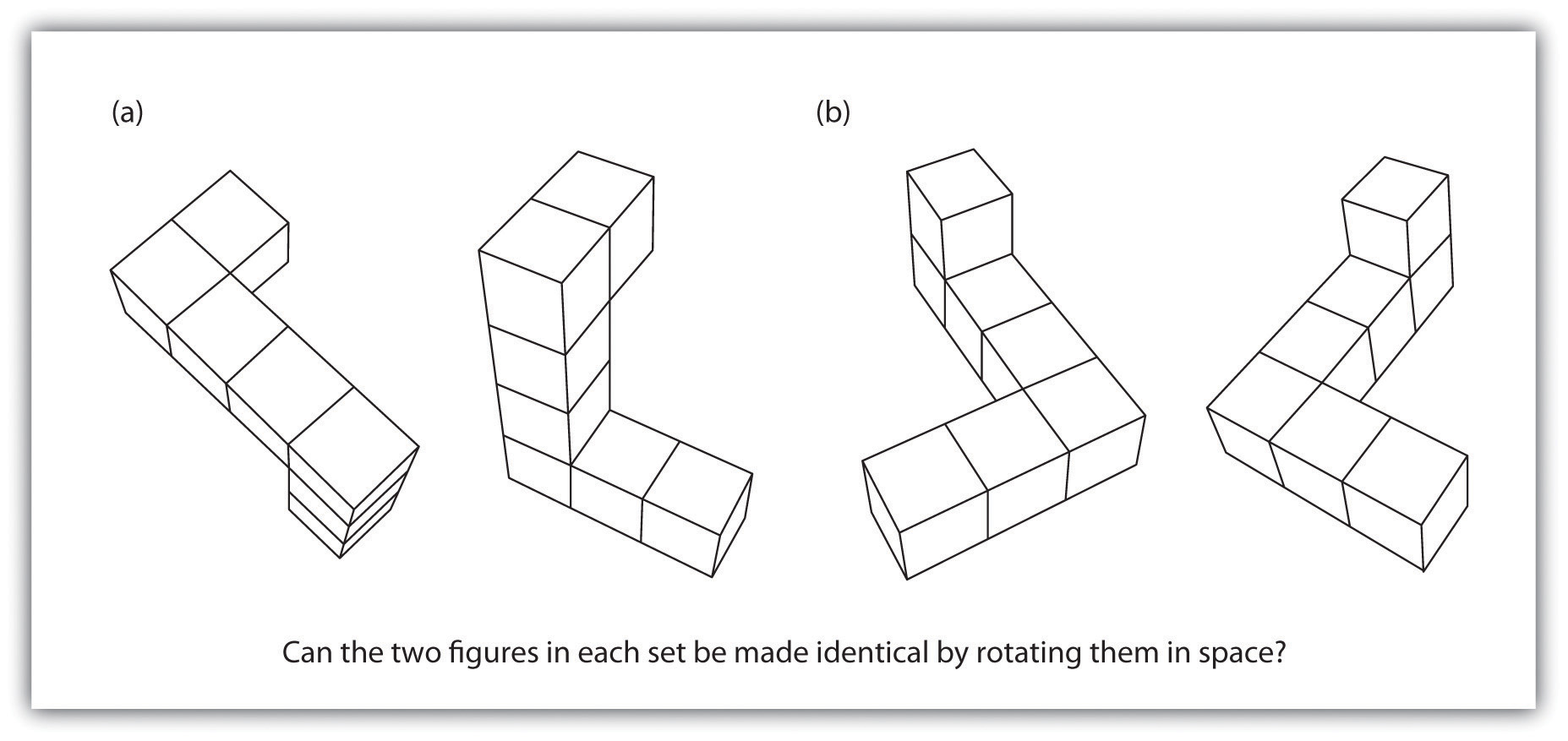
some questions on IQ tests depict rotated images of figures, and ask things like:

> can the two figures in each set be made identical by rotating them in space? [0]

this isn't my domain, so without knowing any better i would kind of expect the Vividness of Visual Imagery Questionnaire and its abridged version to ask similar questions. but if they didn't, and you wanted to create another test, here's where i'd start:

1. devise a test with a bunch of similar questions (to the one in the above example) of varying difficulty. use these hypotheses:

H_{0}: there will be no difference in performance for people with aphantasia

H_{1}: people with aphantasia will perform worse.

2. find some people with aphantasia and test them to get a baseline.

3. test a random sample.

4. compare results. maybe use a one-tailed test.

[0] link to image: https://saylordotorg.github.io/text_introduction-to-psycholo...

Re: Aphantasia: A life without mental images

#45

Earlier quoted context omitted.

How do you dream?

Rarely, if ever, and never as images. If your dreams are like movies, mine are like stumbling through a dark house.

@cottonseed, @sall, @x3n

How do you remember faces or your house, or your car?

Re: Aphantasia: A life without mental images

#46

Wow, I finally have a word to describe my mental experience. To others, I've described the vividness of my memory as like a wireframe. I can feel spatial relationships but I don't see them like a picture in my head. There are occasions that I can see color in my minds eye, but it's mostly greyscale.

Wow, it's crazy how different our minds can be. And I thought it 'strange' to see colours differently - I always double-check with my wife if I can wear this shirt with these pants. Now, this is amazing, I can't even picture what you are describing, but wish I could!

Re: Aphantasia: A life without mental images

#47

Wow, I finally have a word to describe my mental experience. To others, I've described the vividness of my memory as like a wireframe. I can feel spatial relationships but I don't see them like a picture in my head. There are occasions that I can see color in my minds eye, but it's mostly greyscale.

Woah, I always thought that what you've described was the universal experience of mental visualization. A combination of wireframes / blueprints / spatial relationships. When I think of my living room I can very clearly place where the couch is, its three dimensional form, what's next to it, the colour of the couch. However, when I recall these things in my head it's almost like I recall a "couch" object with a certa…

I'm wondering whether work with 3D modeling software can improve that. I used to play a lot with Blender when I was young and my brain has clearly installed some sort of graphics engine as a result. I can easily imagine specific perspectives in my room, rotate objects in ~10 degree steps and tweak the point of view. It's surprisingly difficult to translate objects by a small amount though. It also takes a while until I get the colors right, and they are just superimposed on the eigengrau and fade quickly. Colors work very well with specific objects, for example a Red Bull can or an apple.

Re: Aphantasia: A life without mental images

#48
My experience has been that visual vividness comes and goes with mental fatigue. When I am well rested, comfortable, and haven't spent much time thinking earlier in the same day, I can close my eyes and plainly see detail in childhood toys, places I've traveled, faces, and even illustrations from high school textbooks. When I'm tired or have spent the whole day thinking intensely, I can barely remember what my roommates faces look like. I suspect that the ability to vividly imagine images is an expensive neural process that becomes much more difficult when the brain is not at peak performance.

Curiously, my ability to recall sounds and music does not seem to change with fatigue. Whether I'm feeling energetic or super tired, I can bring to mind any song I'm familiar with or hear arbitrary words spoken in the voices of my close friends and family. My suspicion here is that simulating sound is much less expensive and therefore the ability not as easily degraded. That would not be surprising considering the anecdotal point that I can get headaches from too much sunlight but not too much noise (unless it interrupts my sleep).

Re: Aphantasia: A life without mental images

#49
If you have aphantasia, and wantto describe it to someone else: try asking them to picture "democracy" or some other abstract concept. Most people don't then have mental images of ballot papers or flags. Then tell them that what they're experiencing is what you experience when someone asks you to picture an elephant.

Re: Aphantasia: A life without mental images

#50
This is supposed to be a 'condition' and an 'inability'? I have this and have always associated it with an enhanced ability to think abstractly, and more generally intellectual facility. I had never met anyone else having this, until I came upon a paragraph by Einstein who comments about his absence of mental images, replaced by geometrical-like thinking. That only confirmed my intuitive assumption that it related to enhanced intellectual abilities in the analytical and abstract thinking domain. It is therefore bizarre to read about this as a 'condition' or even 'disability'... On the bright side, it is wonderful to see that it is shared by others, even studied and meet fellow geometrical thinkers here -- hi fellow Jedis ;)
Post reply on HN