I don't know if this is common but I've encountered an issue with two different devices with the latest reversible USBs that it would only charge if I plugged it in one way and not the other. I would plug my phone and I had to check the screen to see if it was charging or not; if not, I had to unplug, turn the connector around and plug back in the other way. I remember longing for the older micro USB where the right…
USB inventor explains why the connector was not designed to be reversible (2019)
381–390 of 544 posts
Re: USB inventor explains why the connector was not designed to be reversible (2019)
#382Earlier quoted context omitted.
To help visualize: 1: GND 2: DATA +/- 3: VCC 4: DATA +/- 5: GND
With that pinout you'd end up with one orientation being full/high-speed and the other being low speed. Edit: see https://en.wikipedia.org/wiki/USB_communications#Signaling_s...
Re: USB inventor explains why the connector was not designed to be reversible (2019)
#383Earlier quoted context omitted.
4. Yes, all USB-C to USB-C cables can charge at a minimum of 60W which should be sufficient to charge almost anything 5. It depends, but the output capacity is printed on the power supply[0]. (Compare to USB-A, where the most you could do is 12W.) 6. The minimum of the cable (60W for any cable, 100W for some cables, 240W for a very few[1]) and the charger [0] Annoyingly, this problem is compounded when using a power…
That’s incorrect on all three counts. Some “low wattage” specification USB-C devices are compliant with USB-C but are only compatible with USB-A power bricks because thet require 5V: https://www.reddit.com/r/UsbCHardware/comments/c3q4s6/why_do... Some USB-C cables are only 31 watts, and some devices can’t charge with less than 60W: https://www.macworld.com/article/234030/how-to-tell-whether-... Example brands from th…
https://hackaday.com/2022/12/27/all-about-usb-c-illegal-adap...
There is a certain combination of cable+adapter+device that can ruin your device. I don’t remember the details. I heard about it on the Accidental Tech Podcast
Re: USB inventor explains why the connector was not designed to be reversible (2019)
#384Re: USB inventor explains why the connector was not designed to be reversible (2019)
#385Earlier quoted context omitted.
There are also reversible USB plugs that are a single "tongue", inheriting that design from USB drives that don't have any plug to speak of but look more like a card-edge connector: https://www.pcgamer.com/youre-telling-me-we-could-have-had-r... https://2b.com.eg/en/2b-cv177-cable-usb-type-a-reversible-pl...
I got these by accident, spent a month thinking I had incredible USB skills, then discovered and became fascinated by the tongue.
Re: USB inventor explains why the connector was not designed to be reversible (2019)
#386> Making USB reversible to begin with would have necessitated twice as many wires and twice as many circuits, and would have doubled the cost. This is... not correct. You can make USB reversible with 1 extra pin and 1 extra wire. Grounds on pins 1 and 5, data on pins 2 and 4, and VCC on pin 3. Then have those pins on both sides of the plug and a socket with a single set of contacts on one side. That's BASICALLY what…
Data lines -- use differential signalling and polarity determined by whether +/- got reversed by the rectifier or not.
Or do like Comcast does and put all bidirectional data through 1 conductor at multi-gigabit speeds.
Re: USB inventor explains why the connector was not designed to be reversible (2019)
#387Earlier quoted context omitted.
4. Yes, all USB-C to USB-C cables can charge at a minimum of 60W which should be sufficient to charge almost anything 5. It depends, but the output capacity is printed on the power supply[0]. (Compare to USB-A, where the most you could do is 12W.) 6. The minimum of the cable (60W for any cable, 100W for some cables, 240W for a very few[1]) and the charger [0] Annoyingly, this problem is compounded when using a power…
That’s incorrect on all three counts. Some “low wattage” specification USB-C devices are compliant with USB-C but are only compatible with USB-A power bricks because thet require 5V: https://www.reddit.com/r/UsbCHardware/comments/c3q4s6/why_do... Some USB-C cables are only 31 watts, and some devices can’t charge with less than 60W: https://www.macworld.com/article/234030/how-to-tell-whether-... Example brands from th…
This is because they are not USB-C compliant, despite physically featuring a USB-C port. The USB-C spec calls for any USB-C sink (i.e. device that consumes power) to include a pull-down resistor (Rd in the diagram on page 4: https://www.ti.com/lit/wp/slyy109b/slyy109b.pdf?ts=169690039...)
Devices that do not include this resistor, and are therefore unable to be powered with a USB-C to USB-C cable, are noncompliant and should not exist.
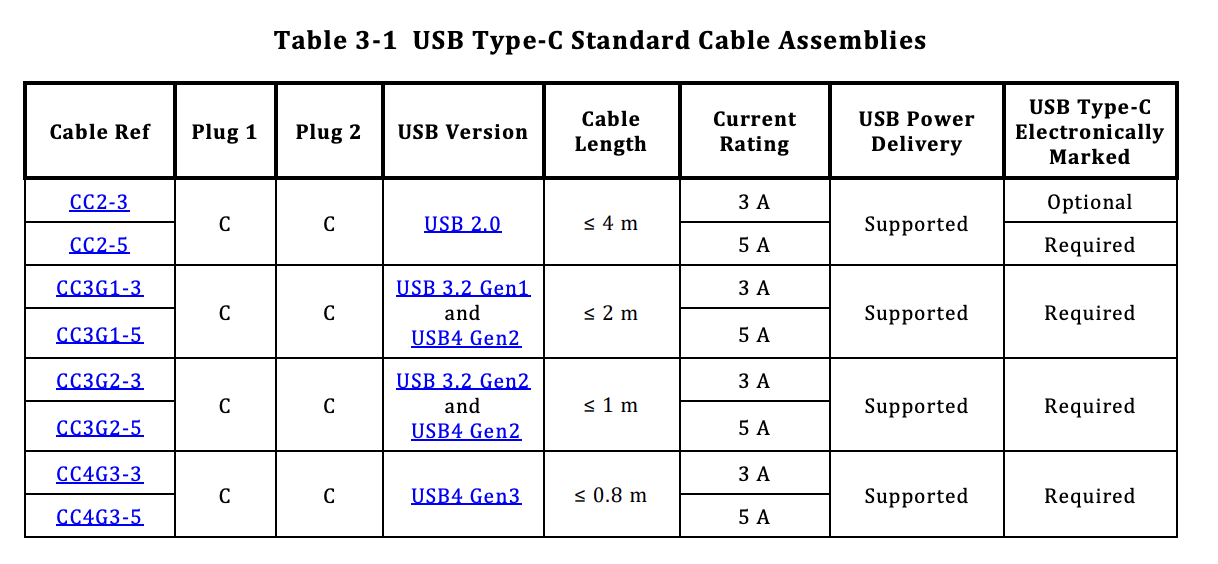
> Some USB-C cables are only 31 watts, and some devices can’t charge with less than 60W
As seen in [0], page 37, even USB 2.0 C-to-C cables will support USB-PD at 3A: https://host.zlsadesign.com/HJU_Drfba.png
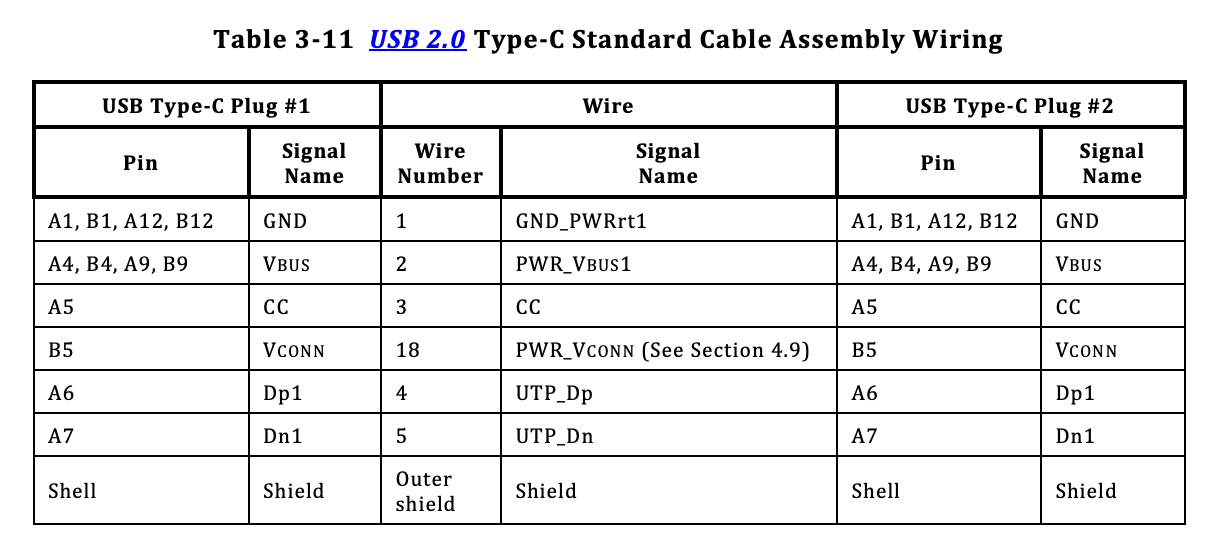
The USB-PD handshake is performed independently of the cable, and uses the CC wire that is mandatory even in USB 2.0 C-to-C cables (page 76 of [0]): https://host.zlsadesign.com/Bk62vSMZp.png
You're right about the 60W point. Anecdotally, every device I've ever tried to charge has had no problems at 60W (although of course they'll charge more slowly than if they had 100W), but this is definitely not guaranteed.
0: https://www.usb.org/sites/default/files/USB%20Type-C%20Spec%...
Re: USB inventor explains why the connector was not designed to be reversible (2019)
#388Earlier quoted context omitted.
4. Yes, all USB-C to USB-C cables can charge at a minimum of 60W which should be sufficient to charge almost anything 5. It depends, but the output capacity is printed on the power supply[0]. (Compare to USB-A, where the most you could do is 12W.) 6. The minimum of the cable (60W for any cable, 100W for some cables, 240W for a very few[1]) and the charger [0] Annoyingly, this problem is compounded when using a power…
4) A USB 2 cable with USB-C in both ends can't 60W.
0: https://www.usb.org/sites/default/files/USB%20Type-C%20Spec%...
Re: USB inventor explains why the connector was not designed to be reversible (2019)
#389Earlier quoted context omitted.
Hah! I recently had to put ends on a Cat 6 cable for weird reasons, and spent a few minutes deciding if it needed to be crossover or not.
The worst is trying to repair one end of an existing cable and having to think really hard about whether to use A or B wiring.
That was my introduction to wiring up CAT-5 cables and rj45 connectors and, with so many to make, I needed a way to remember the wiring diagram without having to read it over and over or use a visual reference. The mnemonic rhythm I used to remember the pattern was "orange/white, orange... green/white, blue... blue/white, green... brown/white, brown". Of course, said out loud, you couldn't tell if it was "orange/white, orange" or "orange, white/orange" and I kept confusing the rest of the team when I'd say it, but it worked for me.
This was circa 2005/2006 and I still say it like that. It just stuck.
Re: USB inventor explains why the connector was not designed to be reversible (2019)
#390Earlier quoted context omitted.
Yeah, I want the connector that can be attached by only moving the TV a few inches, just enough to get my hand to fit and feel around, not something I have to rearrange the furniture for and break out some headlight to see which direction the cable is oriented. With BNC cables, I could do it with my eyes closed.
I find that a USB-A fits reasonably by feel into an Ethernet port for extra points.