Live data from Hacker News

AI adoption and Solow's productivity paradox

fortune.com

371–380 of 783 posts

Re: AI adoption and Solow's productivity paradox

#371

Earlier quoted context omitted.

And if you make someone 3x faster at producing a report that 100 people has to read, but it now takes 10% longer to read and understand, you’ve lost overall value.

You are forgetting that they are now going to use AI to summarize it back.

This is one of my major concerns about people trying to use these tools for 'efficiency'. The only plausible value in somebody writing a huge report and somebody else reading it is information transfer. LLM's are notoriously bad at this. The noise to signal ratio is unacceptably high, and you will be worse off reading the summary than if you skimmed the first and last pages. In fact, you will be worse off than if you did nothing at all.

Using AI to output noise and learn nothing at breakneck speeds is worse than simply looking out the window, because you now have a false sense of security about your understanding of the material.

Relatedly, I think people get the sense that 'getting better at prompting' is purely a one-way issue of training the robot to give better outputs. But you are also training yourself to only ask the sorts of questions that it can answer well. Those questions that it will no longer occur to you to ask (not just of the robot, but of yourself) might be the most pertinent ones!
Re: AI adoption and Solow's productivity paradox

#372
post #64

Earlier quoted context omitted.

What if LLMs are optimizing the average office worker's productivity but the work itself simply has no discernable economic value? This is argued at length in Grebber's Bullshit Jobs essay and book.

[dead]

What a load of nonsense, they won't be producing a report in a third of the time only to have no-one read it. They'll spend the same amount of time and produce a report three times the length, which will then go unread.

Re: AI adoption and Solow's productivity paradox

#373

Earlier quoted context omitted.

And if you make someone 3x faster at producing a report that 100 people has to read, but it now takes 10% longer to read and understand, you’ve lost overall value.

You are forgetting that they are now going to use AI to summarize it back.

So what we now have is a very expensive and energy-intensive method for inflating data in a lossy manner. Incredible.

Re: AI adoption and Solow's productivity paradox

#374

Earlier quoted context omitted.

I find that highly unlikely, coding is the AIs best value use case by far. Right now office workers see marginal benefits but it's not like it's an order of magnitude difference. AI drafts an email, you have to check and edit it, then send it. In many cases it's a toss up if that actually saved time, and then if it did, it's not like the pace of work is break neck anyway, so the benefit is some office workers have a…

Code is much much harder to check for errors than an email. Consider, for example, the following python code: x = (5) vs x = (5,) One is a literal 5, and the other is a single element tuple containing the number 5. But more importantly, both are valid code. Now imagine trying to spot that one missing comma among the 20kloc of code one so proudly claims AI helped them "write", especially if it's in a cold path. You wo…

> Code is much much harder to check for errors than an email.

Disagree.

Even though performing checks on dynamic PLs is much harder than on static ones, PLs are designed to be non-ambiguous. There should be exactly 1 interpretation for any syntactically valid expression. Your example will unambiguously resolve to an error in a standard-conforming Python interpreter.

On the other hand, natural languages are not restricted by ambiguity. That's why something like Poe's law exists. There's simply no way to resolve the ambiguity by just staring at the words themselves, you need additional information to know the author's intent.

In other words, an "English interpreter" cannot exist. Remove the ambiguities, you get "interpreter" and you'll end up with non-ambiguous, Python-COBOL-like languages.

With that said, I agree with your point that blindly accepting 20kloc is certainly not a good idea.

Re: AI adoption and Solow's productivity paradox

#375

Earlier quoted context omitted.

It’s also pretty wild to me how people still don’t really even know how to use it. On hacker news, a very tech literate place, I see people thinking modern AI models can’t generate working code. The other day in real life I was talking to a friend of mine about ChatGPT. They didn’t know you needed to turn on “thinking” to get higher quality results. This is a technical person who has worked at Amazon. You can’t expec…

> I see people thinking modern AI models can’t generate working code. Really? Can you show any examples of someone claiming AI models cannot generate working code? I haven't seen anyone make that claim in years, even from the most skeptical critics.

Depends what they mean. Generate working code all the time or after going a few iterations of trying and promoting? It can very easily happen, that an LLM generates something that is a straight error, because it hallucinates some keyword argument or something like that, which doesn't actually exist. Only happened to me yesterday. So going from that, no, they are still not able to generate working code all the time. Especially, when the basis is a shoddy-made library itself, that is simply missing something required.

Re: AI adoption and Solow's productivity paradox

#376

Earlier quoted context omitted.

Not a phase, I’d argue that 90% of modern jobs are bullshit to keep cattle occupied and economy rolling.

> Not a phase, I’d argue that 90% of modern jobs are bullshit to keep cattle occupied and economy rolling. Cattle? You actually think that about other people?

It seems more like they're implying it's those at the top think that about other people.

Re: AI adoption and Solow's productivity paradox

#377

Earlier quoted context omitted.

It's possible to automate the pointless stuff without realising it's pointless.

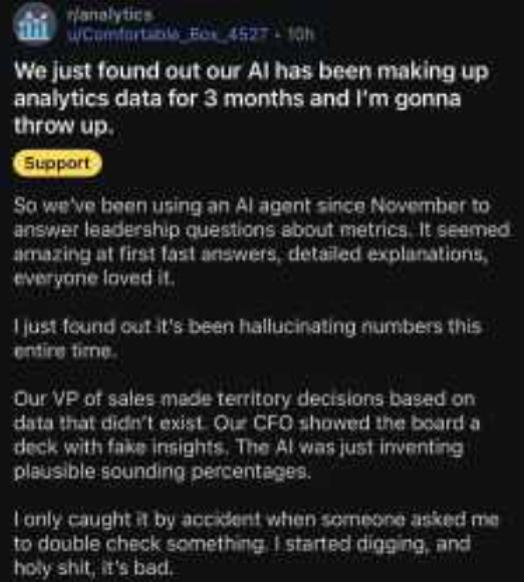
Made me think of this. https://imgur.com/T4DAGG8

Imgur is banned on UK.

I recommend using https://catbox.moe/ which can even use remote-links so pasting the imgur link in it can also work.

https://files.catbox.moe/4dhvok.jpeg

Re: AI adoption and Solow's productivity paradox

#378

Earlier quoted context omitted.

[dead]

Maybe the take is that those reports that people took a day to write were read by nobody in the first place and now those reports are being written faster and more of them are being produced but still nobody reads them. Thus productivity doesn't change. The solution is to get rid of all the people who write and process reports and empower the people who actually produce stuff to do it better.

> Thus productivity doesn't change.

Indeed, productivity has decreased, because now there’s more output that is waste and you are paying to generate that excess waste.

Re: AI adoption and Solow's productivity paradox

#380
post #283

CEOs have no clue what's going on at the IC level. I bet many CEO PA are using AI for many tasks. It's typically a role where AI is very useful. Answering emails, moving meetings around, booking and buying a bunch of crap.

I ask this as a genuine question: who needs help "answering emails" and what part of it do they need help with?

A lot of people obsess over phrasing.

Like for instance you want to tell a coworker his work is shit, but don't know how to put it in a way that's not going hurt them or make you look like an asshole.

I know people who'd potentially spend hours on a single email like this.

Post reply on HN