Live data from Hacker News

Germany extends lifetime of all 3 remaining nuclear plants

dw.com

371–380 of 392 posts

Re: Germany extends lifetime of all 3 remaining nuclear plants

#371
post #320

Earlier quoted context omitted.

The problem is that nuclear plants only need to fail once to have global catastrophic consequences. Chernobyl was so catastrophic that Gorbachev blamed the Soviet Union's collapse on it. Solar and other renewable energy sources can never even remotely approach this level of environmental risk.

> The problem is that nuclear plants only need to fail once to have global catastrophic consequences. As opposed to many other reliable generation types which have global catastrophic consequences† while running normally . And by "reliable" I mean can consistently provide power more that 50% of the time: * https://en.wikipedia.org/wiki/Capacity_factor#Capacity_facto... † E.g., climate change.

> And by "reliable" I mean can consistently provide power more that 50% of the time:

Compare it dollar for dollar.

You can get a lot of curtailment, oversupply, and storage for $12/W

Also if you look at France, nuclear's not doing so hot on the availability front.
Re: Germany extends lifetime of all 3 remaining nuclear plants

#372
post #345

Earlier quoted context omitted.

Nuclear energy is the future. It's the lowest-carbon and the safest form of energy we know of. China knows this, which is why they're adding 150 new nuclear power plants in the next 15 years. [1] [1] https://www.bloomberg.com/news/features/2021-11-02/china-cli...

I think it will be part of a future solution. But building new right now isn't cheap and will just take to long. In addition the old reactors are pretty expensive. I'm looking forward to see how new reactor designs and modular solutions will fare in the next few years.

> I think it will be part of a future solution.

I agree completely. Along with solar, wind, hydro (+storage appropriate to each) and probably even natural gas peaker plants.

> But building new right now isn't cheap and will just take to long.

Yep, definitely - but it should be done. If you're interested I'd suggest listening to the most recent Odd Lots with Jigar Shah, who's in charge of the DoE loan program (~300B in capital). He talks about how building reactors right now is like building airports - each one a custom specimen for the given landscape and conditions - whereas he believes we should move to a model of building airplanes, mass-producing reactors that fit only where conditions permit out of reusable components.

> I'm looking forward to see how new reactor designs and modular solutions will fare in the next few years.

Me too!

Re: Germany extends lifetime of all 3 remaining nuclear plants

#373

Earlier quoted context omitted.

But as it turned out, this was just more fear than harm. These radiation turned out to have almost no health consequences in the population. (And 500kBq is not much. The human body is already 5kBq naturally) > What if the next accident happens not in the Soviet Union or Japan, but in one of the power plants next door? That would be terrible. But how does it compare to other terrible events such as the flood of last y…

> These radiation turned out to have almost no health consequences in the population. Thousands died of thyroid cancer but for the population that is easily described as "almost no consequences" due to scale. https://unis.unvienna.org/unis/en/pressrels/2018/unisous395.... The death of a man is a catastrophe. A thousand deaths is a statistic!

Your source does not support what you claim.

> About 20,000 cases of thyroid cancer cases were registered in the period 1991−2015 in males and females, who were under 18 in 1986 for the whole of Belarus and Ukraine, and for the four most contaminated oblasts of the Russian Federation. The Scientific Committee now estimates that one in four of those cases is attributable to radiation exposure.

This is not about Germany, but about the area much closer to the power plant. Also thyroid cancer has a 98% survival rate according to Wikipedia. So that would amount to 20000 * 0.25 * 0.02 ≈ 100 death caused by the accident in the most impacted area. Which is a catastrophe, but also not an apocalypse

But I was talking about Germany anyway where the most alarmist messages were delivered about the danger on the German population.

Re: Germany extends lifetime of all 3 remaining nuclear plants

#374
post #296

Earlier quoted context omitted.

Oh, really? https://de.wikipedia.org/wiki/Erdgasleck_in_der_Nordsee https://www.spiegel.de/wissenschaft/technik/elgin-gasaustrit... https://www.sciencedirect.com/science/article/abs/pii/S02648...

Absolutely those are horrifically bad. Now imagine humans can't even go within a few hundred meters to clean anything up, and we have no robots that can either. Also imagine that humans can't live within 500km ever again. Nuclear is clearly the best option, right up until the point it's the worst possible thing for humans and planet earth, which seems to happen about every 30 years or so. As I said, we've been lucky…

Which has never happened.

It’s fair to bring up hypotheticals, but you have to do it for everything you’re comparing!

It’s especially important to include “never happened” scenarios for brand new, or lightly used, methods of energy extraction!

What are the worst case scenarios for windmills? Solar panels?

Imagine a major Soviet-level accident at a rare earth element mine.

Imagine a large supply of rare earth metals are improperly labeled.

It might not be as bad as a major nuclear accident … then again maybe it would be.

Re: Germany extends lifetime of all 3 remaining nuclear plants

#375
post #319

Earlier quoted context omitted.

You are thinking too small. With enough 'nukes' we could suck the carbon out of the atmosphere, and use that to make syngas/synfuels for the applications where it would be impractical to replace them. That alone would be almost carbon neutral. Similar for hydrogen production by electrolysis and process heat for many industrial applications. Oh, and mass production of carbon zeolithes to regenerate the sucked empty ag…

> With enough 'nukes' we could Uh huh. And when exactly will they be online and performing all this work for us? As well as the time and cost to build the nukes, how much time and money will it take to build the machines to suck the carbon out of the air. I'm all for solutions, but 30+ years isn't going to cut it. 10 years is a huge risk.

Why? Assuming we need more energy over time, doesn’t it make sense to be preparing for 10/20/30 years down the road?

Re: Germany extends lifetime of all 3 remaining nuclear plants

#376

Earlier quoted context omitted.

Here are three arguments that I personally find both reasonable and convincing. 1) Nuclear fuel and waste are clearly dangerous. Your linked article makes a logical fallacy in that it claims a dangerous activity is safe because few people have died from it. But we know things are dangerous even when nobody dies from it. The level of security surrounding nuclear is beyond anything else, and it's required to keep it sa…

1) Can you point to negative implications of nuclear waste? Anyone that got hurt or harmed in Germany for example? 2) If it's too expensive it will not happen, no need for the government to step in. 3) Have a look at the link, some renewables like Biomass emit a lot of C02, all energy sources are trade offs

1) Again, we know it's dangerous even if nobody has been harmed in Germany yet. Related relevant reading: https://en.wikipedia.org/wiki/List_of_orphan_source_incident...

2) The only reason nuclear power exists is because governments have stepped in to support it and cover most of the expenses. If you remove that support, it can't exist. No organisation of any kind anywhere in the world can afford to run a business where income is generated for 50-60 years but expenses continue for 1000+ years after. France recently learned this: https://www.reuters.com/business/energy/france-keeps-edf-buy...

3) There are a lot of viable energy solutions with better tradeoffs than nuclear, and it seems reasonable to build them instead of building nuclear power plants. Heat storage, gravity storage, synthesized fuel, hydrogen gas to name a few. The costs of a nuclear power plant invested in any of these concepts would go a long way.

Re: Germany extends lifetime of all 3 remaining nuclear plants

#377

Earlier quoted context omitted.

Here are three arguments that I personally find both reasonable and convincing. 1) Nuclear fuel and waste are clearly dangerous. Your linked article makes a logical fallacy in that it claims a dangerous activity is safe because few people have died from it. But we know things are dangerous even when nobody dies from it. The level of security surrounding nuclear is beyond anything else, and it's required to keep it sa…

These are all valid. However, if only nuclear can get us past "bottleneck events" (e.g., oil supply chains falling apart due to deglobalization or the world's oil running out, either of which would (or possibly will) cause catastrophic effects), then that supersedes #2 and #3, and probably #1 as well in most analyses. I'm not well-versed enough in hard evidence to assert that we absolutely need nuclear to make it thr…

You make a good point, and I like the term "bottleneck event". :)

I think a case could be made that nuclear itself causes a bottleneck event in that we get addicted to the energy since it's deceptively cheap for current generations (as long as nothing goes south). It will also cause a problem that vastly outlasts the bottleneck itself. We will have to actively maintain nuclear waste for longer than humanity has used oil as fuel for example.

But to be fair, we already have the problem anyway, so keeping existing plants running makes sense to get through the bottleneck. A few more years of operation won't make a big difference.

But the amount of money needed for new plants, that will be operational 10+ years from now, should in my mind clearly be invested in things like green hydro, pumped storage etc.

Re: Germany extends lifetime of all 3 remaining nuclear plants

#378

Earlier quoted context omitted.

> The problem is that nuclear plants only need to fail once to have global catastrophic consequences. As opposed to many other reliable generation types which have global catastrophic consequences† while running normally . And by "reliable" I mean can consistently provide power more that 50% of the time: * https://en.wikipedia.org/wiki/Capacity_factor#Capacity_facto... † E.g., climate change.

> And by "reliable" I mean can consistently provide power more that 50% of the time: Compare it dollar for dollar. You can get a lot of curtailment, oversupply, and storage for $12/W Also if you look at France, nuclear's not doing so hot on the availability front.

> Also if you look at France, nuclear's not doing so hot on the availability front.

Meanwhile, in Ontario, Canada, where I live, nuclear+hydro generate base load 24/7 with little issue:

* https://ieso.ca/en/Power-Data

Re: Germany extends lifetime of all 3 remaining nuclear plants

#379

Earlier quoted context omitted.

> And by "reliable" I mean can consistently provide power more that 50% of the time: Compare it dollar for dollar. You can get a lot of curtailment, oversupply, and storage for $12/W Also if you look at France, nuclear's not doing so hot on the availability front.

> Also if you look at France, nuclear's not doing so hot on the availability front. Meanwhile, in Ontario, Canada, where I live, nuclear+hydro generate base load 24/7 with little issue: * https://ieso.ca/en/Power-Data

Candu's actually solve most of the problems the PWR constantly lies about. If people were proposing building those (and demonstrating that they weren't even more expensive) I don't see the issue.

They're hardly the super-100%-reliable baseload advertised, or anything approaching 'too cheap to meter' though.

Re: Germany extends lifetime of all 3 remaining nuclear plants

#380

Earlier quoted context omitted.

I was a teenager at that time in southern Germany. Most disturbing was that news about the radioactive cloud trickled in only days after the disaster and then only very, very gradually. It were the first nice, sunny and warm days of spring, but people went outside only when absolutely necessary, because of this invisible threat. No one knew how much there was to come, where it might hit, and how long it might last[1]…

What about the experience of (a much, much higher number than were affected by Chernobyl) people who die every year from cancer and other diseases caused by burning fossil fuels, especially coal? Are their lives less valuable than the right of the so called environmental activists (mainly referring to the ones from the 80s and 90s) to impose their irrational views on the rest of the society? If nuclear expansion cont…

The comparison with fossile fuel is irrelevant. You must compare it with renewables.

Worldwide we have roughly 10% nuclear energy for electricity. And we had roughly 20 to 25 years between nuclear disasters (Sellafield, Harrisburg, Chernobyl, Fukushima). If we had had 100% nuclear, it would mean such a disaster would occure approx. every 2 to 2.5 years.

We also cannot close the books about this disasters. They still are going to hurt and kill people. Ask the Russian soldiers that camped at Prypiat this spring. You might say: They should not have done this and known better. But this is how things play out in reality, while in theory they should not happen.

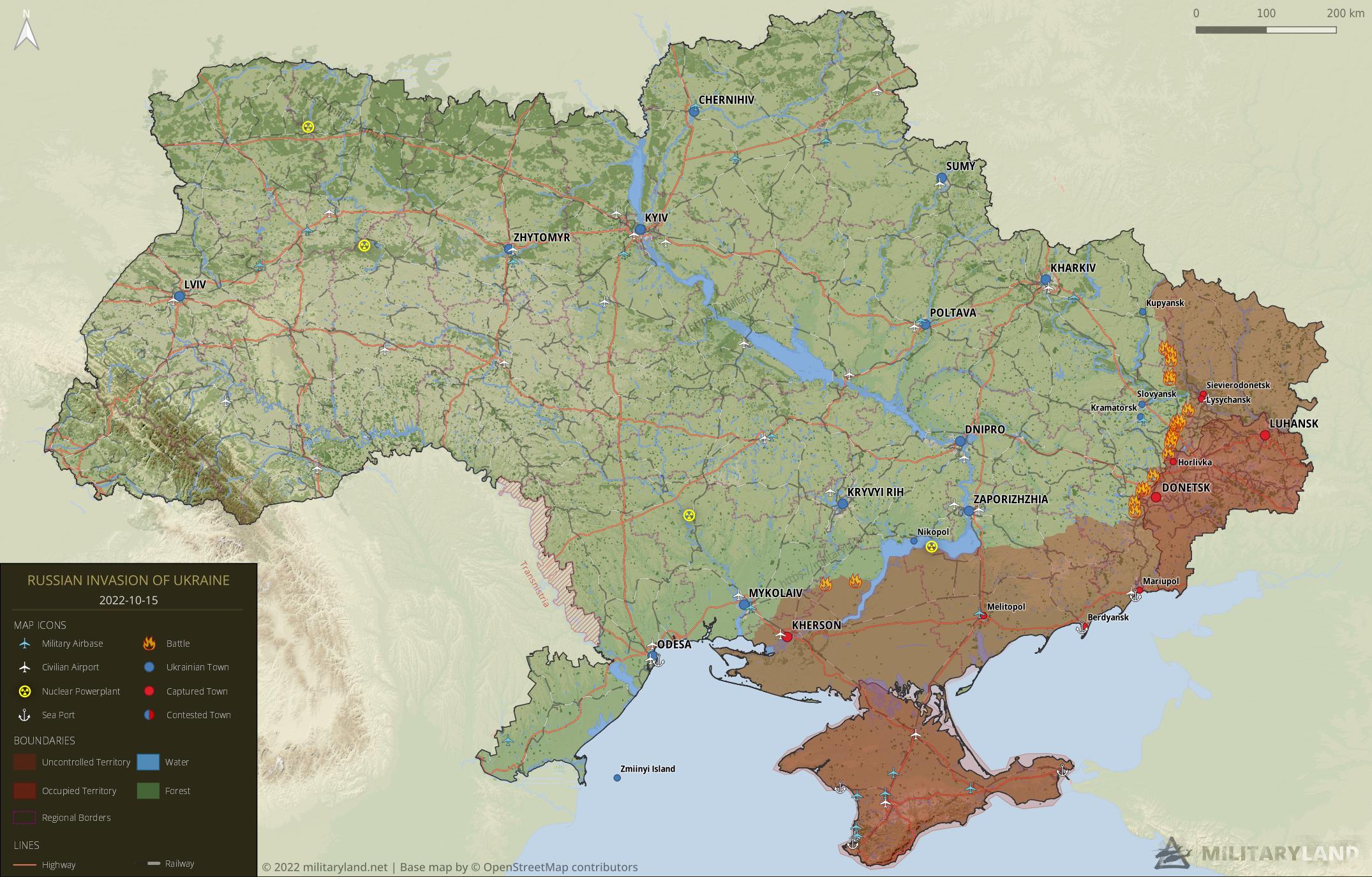
And then there is the strategic problem in a war. It is no wonder that on maps of the situation in Ukraine like this https://militaryland.net/wp-content/uploads/2022/10/day_234_... the locations of nuclear power plants are emphasized. Renewables would provide a far better situation for a nation that needs to defend itself, because they are decentralized.

Post reply on HN