Earlier quoted context omitted.
> "What? You obviously didn't read what I wrote. Are you ok?" You're ranting about Saturn and Jupiter for some reason. Why don't you calm down and look at page eight of the paper that Veritasium video was based on: https://ve42.co/luminet "Image of a spherical black hole with thin accretion disk Astronomy and Astrophysics, vol. 75, no. 1-2, May 1979, p. 228-235" Look at that last image, and squint at it until it gets…
It's really strange that you are unable to understand such a simple complaint I made, even after going to extra effort to spell it out. You even have even become aggressive insulting. I understand that some people become that way when they get confused, but how is it possible you are confused here? I think you are literally not even reading my comments. Either that, or you are going through some personal issues right…
Unveiling the first-ever image of a black hole [video]
361–370 of 525 posts
Re: Unveiling the first-ever image of a black hole [video]
#362Earlier quoted context omitted.
It doesn't. It escapes from outside the event horizon. The event horizon is the dark area in the middle.
A rephrasing: How does the gravity-information about what's inside the event horizon get out?
At first glance, I think that the gravity information can't escape from inside the event horizon, just like light can't. That means that the event horizon describes a frozen version of the mass inside it, not a current "live" version.
And that seems to work, if you think about gravity waves. There aren't any changes to the gravitational field coming out from inside the event horizon. But it doesn't work so well if you think about gravitons. "There aren't any gravitons coming out" should be equivalent to "flat worldlines", which is very much not true just outside the event horizon.
It also doesn't seem to work for a situation like a black hole merger. The spacetime outside the event horizon is this frozen snapshot, but it can still do this spiral around this other black hole? That doesn't seem to make a ton of sense.
So I'm not sure my answer is very good. But it's a fascinating question. If anyone has a real answer, I'd love to hear it.
Re: Unveiling the first-ever image of a black hole [video]
#363Earlier quoted context omitted.
The video by Veritasium is by a guy who literally got a PHD on the subject of making physics more approachable through videos. He is exactly the person I would expect to provide a more clear and understandable explanation. https://www.youtube.com/watch?v=S1tFT4smd6E&feature=youtu.be...
Why doesn't he work with the actual astronomers, then?
Re: Unveiling the first-ever image of a black hole [video]
#364Earlier quoted context omitted.
Uh.. It's the reason that the "shadow" is larger than the Schwarzschild radius. He's describing the ratio of the "rim" to the "hole". So while the picture may be fuzzy, there's information in it anyway about what the pictures means relative to how large/spin we think the black hole is. In fact I wish he'd said more about the Doppler effect.
Ok I mean, now what you're writing, that's not even wrong. The black part of the image being larger than the actual radius of the blackhole is a discussion about the relative size of the black area you see in the image, to the actual black hole itself. I think that should make sense to you? It's not an argument about why he predicts it will look like a "fuzzy coffee stain," as opposed to other simulated images. Are y…
The problem here is your expectation does not match the product. It's like you went to a car dealer and are upset they didn't sell you an airplane.
It isn't surprising to me that Derek focuses on one form, since Veritassium is providing content for the armchair consumer, that he chooses what he believes to be the best model and presents that. This isn't a PhD defense, after all, it's just a timely video so that folks can appreciate the image that the EHT group has released (is going to release, at the time of Veritassium's video.)
Did you have some other models in mind?
Interesting to me is that Veritassium's presented model doesn't explain the corona-like features, nor any attempt at explaining the "blobs" although he does say that blobs would be exiting to see. And there they are! What fun.
Re: Unveiling the first-ever image of a black hole [video]
#365Earlier quoted context omitted.
Not sure if I missed it, but can we tell which way the accretion disk is from our view of it?
perpendicular - we see it almost exactly from the top. Mentioned during the Q&A (41:33 to be exact)
Re: Unveiling the first-ever image of a black hole [video]
#366Re: Unveiling the first-ever image of a black hole [video]
#367Re: Unveiling the first-ever image of a black hole [video]
#368Re: Unveiling the first-ever image of a black hole [video]
#369Earlier quoted context omitted.
> "What? You obviously didn't read what I wrote. Are you ok?" You're ranting about Saturn and Jupiter for some reason. Why don't you calm down and look at page eight of the paper that Veritasium video was based on: https://ve42.co/luminet "Image of a spherical black hole with thin accretion disk Astronomy and Astrophysics, vol. 75, no. 1-2, May 1979, p. 228-235" Look at that last image, and squint at it until it gets…
It's really strange that you are unable to understand such a simple complaint I made, even after going to extra effort to spell it out. You even have even become aggressive insulting. I understand that some people become that way when they get confused, but how is it possible you are confused here? I think you are literally not even reading my comments. Either that, or you are going through some personal issues right…
Re: Unveiling the first-ever image of a black hole [video]
#370Good video that correctly predicted the image and describes why it looks the way it does [1]. TL; DR The dark area is the entire surface of the event horizon, including the side facing away from us, plus some more due to photons missing the event horizon "directly" being drawn in. One side is brighter due to its being Doppler boosted. [1] https://www.youtube.com/watch?v=zUyH3XhpLTo
Ok, wait a second. I liked a lot of this video, but there are some aspects which are kind of ridiculous. He says his reason for his confidence in this prediction is "I think it's going to look like a fuzzy coffee mug stain." He doesn't give an actual reason. He does talk a lot about theory, a lot of it interesting and novel to me, but by the end of the video, most of this theory suggests a different-looking image!
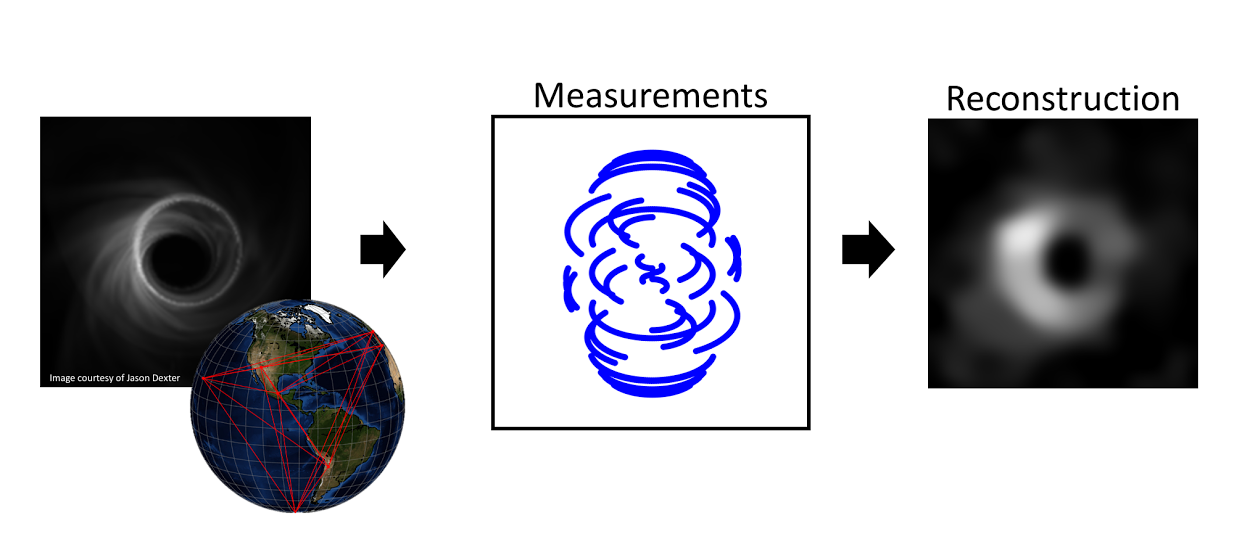
https://static.projects.iq.harvard.edu/files/styles/os_files...
Taken from here: https://eventhorizontelescope.org/science (the official site of the project).
On the left is how it would look like if we weren't so far -- we are 55 million light years far from that. You know the distance from us to our Sun, which you see on the sky but can cover with your own thumb? That object is 3,500,000,000,000 times farther than the Sun is far from us.
On the right is what we can reconstruct from the signals measured because we are so far and we have "only" the telescope the size of the Earth. More details would be visible (the picture would look more like the one on the left) either if we had even much bigger telescope than the Earth, or if the black hole of the same size were much closer to us, which it is not.