There is also another issue in the USA specifically, which is that certain people don't want to live around certain other people. This has driven a lot of the suburbanization in the USA AFAICT. I'm not sure what to do about it, exactly, but what's being done currently does not appear to be working.
If we want a shift to walking we need to prioritize dignity
351–360 of 713 posts
Re: If we want a shift to walking we need to prioritize dignity
#352Earlier quoted context omitted.
One problem in the United States is that transportation planners apparently think that buses are for the poor and people won’t ride them. Instead they want to build expensive light rail or subway when a good bus system would be much better, flexible, and affordable.
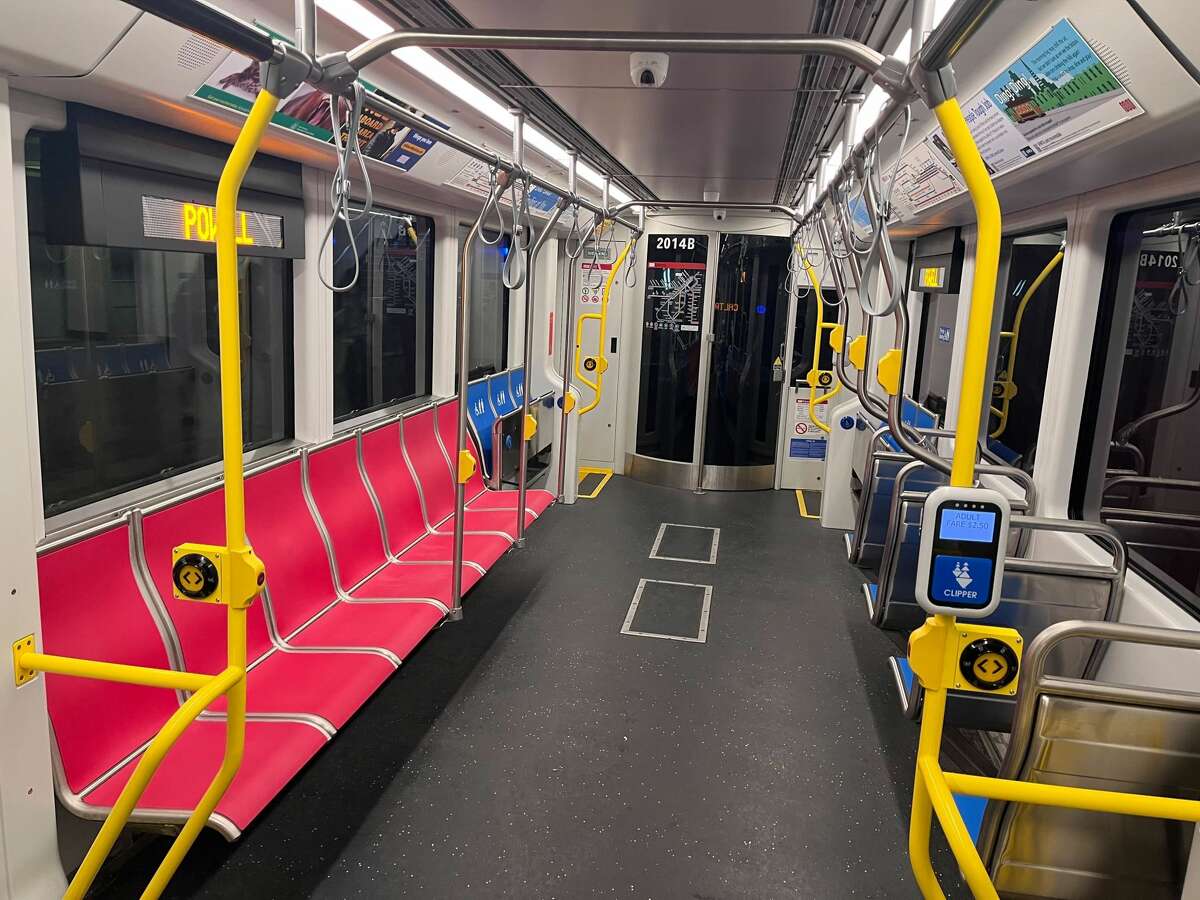
Buses could be ok, but the same attitude of compromise that swapped steel wheels for rubber also generates-- + hard plastic seats + inadequate climate control + poor maintenance leading to excessive nose and exhaust fumes in the cabin + extremely poor personal space + seating configurations with poor leg room + convoluted routes and schedules, degrading point-to-point travel + the driving can be uneven, because they…
hard plastic seats
https://s.hdnux.com/photos/01/23/05/56/21781404/4/1200x0.jpg inadequate climate control
I've not spent enough time on the current crop of Muni streetcars, but the old ones were horrific. They had fixed windows and really unreliable A/C. Perhaps the one saving grace of the first generation ones is that you could open the windows. BART's much worse, but the drivers will typically take note of cars without A/C because it can be indicative of bigger electrical problems. poor maintenance leading to excessive nose and exhaust fumes in the cabin
Poor maintenance is poor maintenance. For a while Muni drivers would disable the door interlocks on the trams because the doors were so unreliable. Used to be inattentive drivers would take off without checking to see if anyone was trying to board. Ask me how I know… extremely poor personal space
seating configurations with poor leg room
https://external-content.duckduckgo.com/iu/?u=https%3A%2F%2F...Check out that seat right by the articulation joint. Or the seats next to the stairs
convoluted routes and schedules, degrading point-to-point travel
This is a system not mode issue. BART's designed for point to point travel (mostly out of hubris really) and Muni is designed around multi-modal transfers. the driving can be uneven, because they aren't much better off than riders
Then you've really not seen just how bad auto train control can be. When manually operated I'd run into drivers who couldn't remember how long the train was and accelerate out of a 90 degree turn and knock people at the back out of their seats. In the early 00s Muni managed to actually derail real dramatically for the same reason.Light rail can be better but not always. Certainly the diesel vs electric issue can come into play (although you can make some truly awful trolley coaches too).
Re: If we want a shift to walking we need to prioritize dignity
#353Earlier quoted context omitted.
Too bad. You got outvoted in a democracy. Because most people do not hold this view.
No, most people don't even realize that urban areas tend to subsidize less dense areas. Usually when they're initially presented with this info, they immediately go into an obvious denial mode where they try to find some logic to explain why it isn't true.
Re: If we want a shift to walking we need to prioritize dignity
#354Earlier quoted context omitted.
People who want to live somewhere “dense” can go live there. The dense parts of most cities don’t have mandatory single zoning or parking minimums as far as I know. I’m not going to stop you from living in or near downtown and neither is anyone else in the suburbs. You do you and let the rest of us do us.
Except for price, because a lot of people want to live in dense areas. Why exactly do you think you should have a say over how other people live? That's what you claim to oppose, but your support of zoning in order to prevent other people from building density on their own property is exactly that.
And the way to fix that is for urban areas to allow for more construction of living space. Which, historically, urban areas are very bad at doing, for example by restricting the maximum height of buildings. But how is that the suburbs' fault?
> Why exactly do you think you should have a say over how other people live?
I have said no such thing. I have never said there should not be urban areas. Indeed, I have explicitly said that there should be areas of all different kinds, urban, suburban, and rural, so that everyone's different preferences can be accommodated somewhere. You are the one who keeps talking as if everywhere should be dense urban areas.
> your support of zoning in order to prevent other people from building density on their own property is exactly that.
So you think I should be able to build a single family home in the middle of Manhattan, provided I can buy the land?
Zoning is much more of an issue in urban areas, and in fact, as I noted above, is one of the main reasons why urban housing is overly expensive.
Re: If we want a shift to walking we need to prioritize dignity
#355Earlier quoted context omitted.
I use the busses in Boston all the time, and have been for over 20 years. Way back when it was a pain but ever since bus tracking apps showed up on the scene about 15 years ago it's been a smooth experience.
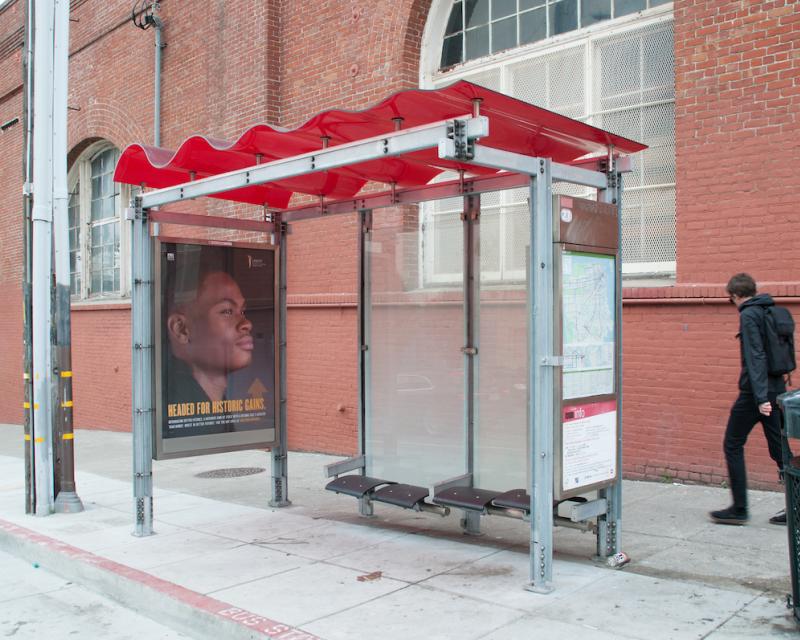
I live in Boston and would still use the T buses as an example of bus service as an afterthought. The buses are loud, uncomfortable, bus stops frequently have no shelter and are on busy roads with no buffer from 2-3 lanes of traffic, and there are almost no dedicated bus lanes so the bus gets stuck in the same traffic as all the cars.
https://www.sfmta.com/sites/default/files/styles/teaser-col-...
Re: If we want a shift to walking we need to prioritize dignity
#356This lens is underutilized in the discourse, but people feel it acutely. Even a lot of the anti-cycling stance comes down to, “What am I, poor?” When you are using transportation infrastructure that’s designed with contempt for you, you know, and you don’t want to be there. See also: rail slow zones, buses that shimmy and rattle violently on imperfect pavement, how Muni trains close their doors and pull one foot out…
Ah, let us look at the data. In reality, only rich (and white) folks can afford to live in areas that are not car-dependent. https://granfondodailynews.com/2020/01/17/is-north-american-... > From 2001 to 2017 the number of people cycling increased the fastest among high income, highly educated, employed, white men between the ages 25 and 44.
How is "cycling" defined? For pleasure or for day-to-day travel? How was the data collected? How did they include/ account for the unemployed 20-somethings in poor suburbs who aren't biking to work, aren't "cycling" in events, aren't carrying the family groceries home in a basket, but are on bikes constantly going between houses (and maybe a gas station food mart)?
Re: If we want a shift to walking we need to prioritize dignity
#357Earlier quoted context omitted.
> flipping off the drivers if they honked Honking within urban areas is forbidden unless used to prevent immediate danger (well, in France anyway). Honking for "educational purpose", ie to yell at someone, is a major nuisance. Every honk annoys dozens of people around the driver, wakes up babies and so on. Friends, don't let friends honk inconsiderately.
It's cultural. In India and other places in Asia, honking is just to say "hey, I'm here, did you see me?" and prevent an accident, but it happens so frequently that sitting in traffic is a cacaphony of honking at all times. In (my part of) the US, honking is to express displeasure at whatever it is the other driver did, and is infrequent. In other places, they might as well not install a horn, because it never gets u…
Aside: I really wish cars had two different horns. A nice little boop horn, to say "hey I'm here" or "lights green buddy" and then the big honking thing that says "you nearly hit me by rolling through that stop sign, pay better attention"
Re: If we want a shift to walking we need to prioritize dignity
#358Earlier quoted context omitted.
> When people want to live somewhere dense, and that's illegal to build It's not illegal to build everywhere. That should be obvious since there are lots of dense urban areas. I could just as easily ask why I'm not allowed to build a new single family home in Manhattan. The obvious answer is that Manhattan is not a suburb. The equally obvious answer to why you can't build dense urban housing in a suburb is that it's…
You can in fact build a new single family home in Manhattan, if you can afford the land to do so. Meanwhile, regardless of land price, dense housing is illegal to build pretty much everywhere that is not currently dense, due to zoning laws. Why shouldn't someone be able to build dense housing in a suburb? What it sounds like you advocate for is that everywhere currently dense can stay dense, and everywhere not curren…
Really? Where? Note that I don't mean a townhome or a row house, I mean literally a detached single family home.
> What it sounds like you advocate for is that everywhere currently dense can stay dense, and everywhere not currently dense must stay not dense.
Obviously this won't be the case long term; areas will evolve. Some will become more dense, some will become less dense.
What I am saying is that people have a wide variety of preferences, and that is just a fact of life. Talking as if one particular way of living is "better" does not recognize that.
> That doesn't make sense unless you want the dense area to continue to skyrocket in price as more people want to live there and we have no new housing to accommodate them.
Why would there be no new housing in urban areas? New construction is going on in cities all the time.
Re: If we want a shift to walking we need to prioritize dignity
#359Earlier quoted context omitted.
I live in the US in a "platinum rated" bike city (so there are a relatively high amount of bike commuters) and have gone through drive throughs on my bike a handful of times. Every time I have been served but told not to do it again.
But did they explain why?
During the pandemic most fast food places locked their lobbies and only did drive-through, which meant truckers couldn't get food because workers wouldn't serve them due to policies the companies refused to adjust.
I remember some police departments were volunteering to go through the drive-throughs for truckers.
Re: If we want a shift to walking we need to prioritize dignity
#360Earlier quoted context omitted.
Every time a politician anywhere in the world suggests adding more freeways or more lanes to freeways, I think they should be forced to live in LA for a year and do a ~1 hour commute each way in traffic. They need to see first hand what happens when you just add more freeways and more lanes. It's not good.
I had a conversation recently with someone lamenting that we didn't have roads like LA here in Boston. Saying their ideal road was 3 lanes, plus a bike lane, plus a bus lane in each direction. Imagine being a pedestrian trying to cross that! I really don't understand someone who looks at that traffic disaster and wants to build the same thing here at home.
Inside of a mall where there are only pedestrians is very safe. Freeways are fairly safe. Protected bike lanes are safe. Light rail is safe.
Mix all of those on a strode, rail, buses, trucks, cars, bicycles, pedestrians, not safe.