Earlier quoted context omitted.
I'm not an expert on the topic and don't really know the difference. But in the video they say it can finetune power delivery to individual parts of the SoC and reduce idle power.
Well, Every single CPU need some kind of voltage regulation module to work. About "fine tune" part, this does not relate to PMIC(or VRM) at all, more like CPU design: How many power domain does this CPU have ?
AMD claims Arm ISA doesn't offer efficiency advantage over x86
331–340 of 446 posts
Re: AMD claims Arm ISA doesn't offer efficiency advantage over x86
#332It's not the ISA. Modern Macbooks are power-efficient because they have: - RAM on package - PMIC power delivery - Better power management by OS Geekerwan investigated this a while ago, see: https://www.youtube.com/watch?v=Z0tNtMwYrGA https://www.youtube.com/watch?v=b3FTtvPcc2s https://www.youtube.com/watch?v=ymoiWv9BF7Q Intel and AMD have implemented these improvements with Lunar Lake and Strix Halo. You can buy an x…
Intel and AMD have implemented these improvements with Lunar Lake and Strix Halo. You can buy an x86 laptop with Macbook-like efficiency right now if you know which SoCs to pick. M4 is about 3.6x more efficient than Strix Halo when under load.[0] On a daily basis, this difference can be more because Apple Silicon has true big.Little cores that send low priority tasks to the highly efficient small cores. For Lunar Lak…
In the same video, they also measure perf/watt under heavy load, and it's close to the M1, but not the latest gen M4. I think that's pretty good considering it's a first gen product.
Regarding the discontinuation, it's still on shelves right now, but I'm not sure if there will be future generations. It would be awfully silly of them to discontinue it as it's the best non-Apple laptop chip you can buy right now if you care about efficiency.
Re: AMD claims Arm ISA doesn't offer efficiency advantage over x86
#333It's not the ISA. Modern Macbooks are power-efficient because they have: - RAM on package - PMIC power delivery - Better power management by OS Geekerwan investigated this a while ago, see: https://www.youtube.com/watch?v=Z0tNtMwYrGA https://www.youtube.com/watch?v=b3FTtvPcc2s https://www.youtube.com/watch?v=ymoiWv9BF7Q Intel and AMD have implemented these improvements with Lunar Lake and Strix Halo. You can buy an x…
Re: AMD claims Arm ISA doesn't offer efficiency advantage over x86
#334Earlier quoted context omitted.
Yeah I'm not sure I buy it either. It doesn't matter if most instructions have simple encodings. You still need to design your front end to handle the crazy encodings. I doubt it makes a big difference, so until recently he would have been correct - why change your ISA when you can just wait a couple of months to get the same performance improvement. But Moore's law is dead now so small performance differences matter…
The core argument in RISC vs CISC has never been that you can't add RISC style instructions to a CISC. If anything, the opposite is true, because CISC architectures just keep adding more and more instructions. The argument has been that even if you have a CISC ISA that also happens to have a subset of instructions following the RISC philosophy, that the bloat and legacy instructions will hold CISC back. In other word…
Obviously they've done an amazing job of working around it, but that adds a ton of complexity. At the very least it's going to mean you spend engineering resources on something that ARM & RISC-V don't even have to worry about.
This seems a little like a Java programmer saying "garbage collection is solved". Like, yeah you've made an amazingly complicated concurrent compacting garbage collector that is really fast and certainly fast enough almost all of the time. But it's still not as fast as not doing garbage collection. If you didn't have the "we really want people to use x86 because my job depends on it" factor then why would you use CISC?
Re: AMD claims Arm ISA doesn't offer efficiency advantage over x86
#335Earlier quoted context omitted.
Nice followup to your link: https://chipsandcheese.com/p/arm-or-x86-isa-doesnt-matter . Personally I do not entirely buy it. Intel and AMD have had plenty of years to catch up to Apple's M-architecture and they still aren't able to touch it in efficiency. The PC Snapdragon chips AFAIK also offer better performance-per-watt than AMD or Intel, with laptops offering them often having 10-30% longer battery life at simila…
Yes, Intel/AMD cannot match Apple in efficiency. But Apple cannot beat Intel/AMD in single-thread performance. (Apple marketing works very hard to convince people otherwise, but don't fall for it.) Apple gets very, very close, but they just don't get there. (As well, you might say they get close enough for practical matters; that might be true, but it's not the question here.) That gap, however small it might be for…
It's literally one of the main Apple M chips advantage over Intel/AMD. At the time when M chip came out, it was the only chip that managed to consume ~100GB/s of MBW with just a single thread.
https://web.archive.org/web/20240902200818/https://www.anand...
> From a single core perspective, meaning from a single software thread, things are quite impressive for the chip, as it’s able to stress the memory fabric to up to 102GB/s. This is extremely impressive and outperforms any other design in the industry by multiple factors, we had already noted that the M1 chip was able to fully saturate its memory bandwidth with a single core and that the bottleneck had been on the DRAM itself.
Re: AMD claims Arm ISA doesn't offer efficiency advantage over x86
#336Earlier quoted context omitted.
Intel and AMD have implemented these improvements with Lunar Lake and Strix Halo. You can buy an x86 laptop with Macbook-like efficiency right now if you know which SoCs to pick. M4 is about 3.6x more efficient than Strix Halo when under load.[0] On a daily basis, this difference can be more because Apple Silicon has true big.Little cores that send low priority tasks to the highly efficient small cores. For Lunar Lak…
Pardon my loose choice of words regarding the Mac-like efficiency. I was referring to the fact that the battery life is comparable to the M3 in day-to-day use, as demonstrated at around the 5:00 mark in the third video I linked. In the same video, they also measure perf/watt under heavy load, and it's close to the M1, but not the latest gen M4. I think that's pretty good considering it's a first gen product. Regardin…
In the same video, they also measure perf/watt under heavy load, and it's close to the M1, but not the latest gen M4. I think that's pretty good considering it's a first gen product.
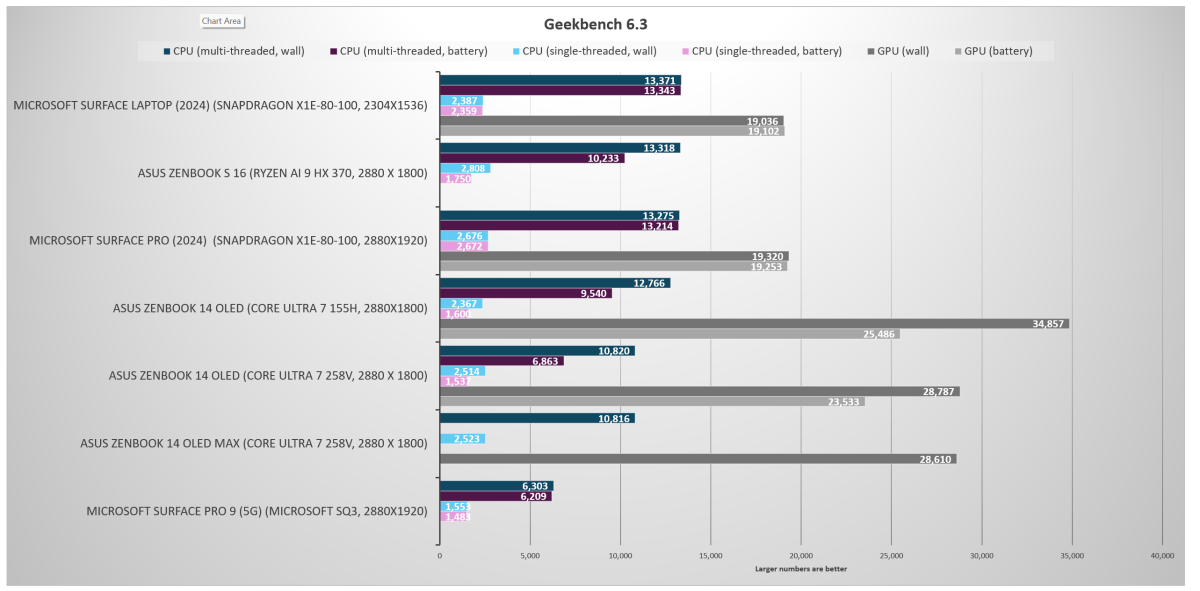
Which video and timestamp? Are you aware that LNL throttles heavily when on battery life?On battery life, M1 is a whopping 1.5x faster in single thread.[0] That makes M4 2.47x faster when compared to LNL on battery.
So no, LNL is very far behind even M1. That's why there are no fanless LNL laptops.
[0]https://b2c-contenthub.com/wp-content/uploads/2024/09/Intel-...
[0]https://www.pcworld.com/article/2463714/tested-intels-lunar-...
Re: AMD claims Arm ISA doesn't offer efficiency advantage over x86
#337Earlier quoted context omitted.
Intel and AMD have implemented these improvements with Lunar Lake and Strix Halo. You can buy an x86 laptop with Macbook-like efficiency right now if you know which SoCs to pick. This just isn't true. Yes, Lunar Lake has great idle performance. But if you need to actually use the CPU, it's drastically slower than M4 while consuming more power. Strix Halo battery life and efficiency is not even in the same ball park.
If you look the battery life benchmarks they did at around the 5:00 mark in the third video, you can see that it achieves similar battery life compared to the an M3 Macbook in typical day-to-day use. This reflects the experience most users will have with the device. It's true that the perf/watt is still a lot worse than the latest gen M4 under heavy load, but it's close enough to the M1 and significantly better than…
If you look the battery life benchmarks they did at around the 5:00 mark in the third video, you can see that it achieves similar battery life compared to the an M3 Macbook in typical day-to-day use. This reflects the experience most users will have with the device.
No. The typical day to day use of LNL is significantly slower than even M1. LNL throttles like crazy when on battery in order to achieve similar battery life.https://b2c-contenthub.com/wp-content/uploads/2024/09/Intel-...
Re: AMD claims Arm ISA doesn't offer efficiency advantage over x86
#338Earlier quoted context omitted.
Nice followup to your link: https://chipsandcheese.com/p/arm-or-x86-isa-doesnt-matter . Personally I do not entirely buy it. Intel and AMD have had plenty of years to catch up to Apple's M-architecture and they still aren't able to touch it in efficiency. The PC Snapdragon chips AFAIK also offer better performance-per-watt than AMD or Intel, with laptops offering them often having 10-30% longer battery life at simila…
There are just so many confounding factors that it's almost entirely impossible to pin down what's going on. - M-series chips have closely integrated RAM right next to the CPU, while AMD makes do with standard DDR5 far away from the CPU, which leads to a huge latency increase - I wouldn't be surprised if Apple CPUs (which have a mobile legacy) are much more efficient/faster at 'bursty' workloads - waking up, doing so…
Hardware Unboxed just did an interesting video[1] comparing gaming performance of 7600X Zen 4 and 9700X Zen 5 processors, and also the 9800X3D for reference. In some games the 9700X Zen 5 had a decent lead over the Zen 4, but in others it had exactly the same performance. But the 9800X3D would then have a massive lead over the 9700X.
For example, in Horizon Zero Dawn benchmark, the 7600X had 182 FPS while the 9700X had 185 FPS, yet the 9800X3D had a massive 266 FPS.
Re: AMD claims Arm ISA doesn't offer efficiency advantage over x86
#339This is an entirely uncontroversial take among experts in the space. x86 is an old CISC-y hot mess. RISC-V is a new-school hyper-academic hot mess. Recent ARM is actually pretty good. And none of it matters, because the uncore and the fabrication details (in particular, whether things have been tuned to run full speed demon or full power sipper) completely dominate the ISA. In the past x86 didn't dominate in low powe…
I agree with what you write otherwise, but not this. Why would AMD "let x86 fade away"? They are one of the two oligolistic CPU providers of the x86 ecosystem which is worth zillions. Why should they throw that away in order to become yet another provider of ARM (or RISC-V or whatnot) CPUs? I think that as long as the x86 market remains healthy, and AMD is in a position to compete in that market, they will continue doing so.
Re: AMD claims Arm ISA doesn't offer efficiency advantage over x86
#340Earlier quoted context omitted.
> Personally I do not entirely buy it. Intel and AMD have had plenty of years to catch up to Apple's M-architecture and they still aren't able to touch it in efficiency. The PC Snapdragon chips AFAIK also offer better performance-per-watt than AMD or Intel, with laptops offering them often having 10-30% longer battery life at similar performance. Do not conflate battery life with core efficiency. If you want to measu…
To me it's not as simple as comparing the efficiency under full load. I imagine the efficiency on x86 as some kind of log curve, which translates to higher power consumption even on lighter loads. Apple's ARM implementation tends to eat a lot less power on tasks that happen most of the time, hence greatly improving the battery life. I've tried a Ryzen 7 that had a similar efficiency to an M1 according to some tests,…
I recently had to remove Windows completely from a few years old laptop with an 12th gen cpu and a Intel Iris / GeForce RTX 3060 Mobile combo because it was running very hot (90c+) and the fans were constantly running. Running Linux, I have no issues. I just double checked since I had not for several months, and temperature is 40c lower on my lap than it was propped up on a book for maximum airflow. Full disclaimer, I would have done this anyways, but the process was sped up because my wife was extremely annoyed with the noise my new-to-me computer was making, and it was cooking the components.
I have learned to start with the OS when things are tangibly off, and only eventually come back to point the finger at my hardware.