Live data from Hacker News

How Bell’s Theorem proved ‘spooky action at a distance’ is real

quantamagazine.org

331–340 of 356 posts

Re: How Bell’s Theorem proved ‘spooky action at a distance’ is real

#331
post #293

Earlier quoted context omitted.

The balls in a bag experiment is exactly the kind that does use hidden variables that are local. No information has to be transmitted in either direction. Bell showed that the correlation is even greater than you can get using that sort of thinking. Reality is more like this: Bob and Alice each get a pair of bags, one black and one white. They open one of the bags in which they get either a red ball or a blue ball. I…

Thanks for the example. Could you point me to a resource where it explains why the reality is like that? If that’s an implication of a formula of quantum theory(which the article also mentioned briefly), I would like to learn about it and be able to derive this implication myself.

A more fleshed-out & professional explanation can be found here:

https://www.scottaaronson.com/democritus/lec11.html

scroll down to the section titled Relativistic Causality
Re: How Bell’s Theorem proved ‘spooky action at a distance’ is real

#332

Earlier quoted context omitted.

One thing I've not been able to clarify is whether Bell accounts for the possibility that passing through a polarization filter could effect the waveparticle in some way, like altering its polarization angle.

Yes, the "altering" you're describing is what the theorem would call a hidden variable. Seems reasonable, but when you do the math it's exactly he kind of theory Bell's inequality rules out. There's no way to set the "polarization angle" (or any other set of variables) such that they obey the probabilistic laws we've observed (without violating some other assumption, like single measurement outcomes, statistical inde…

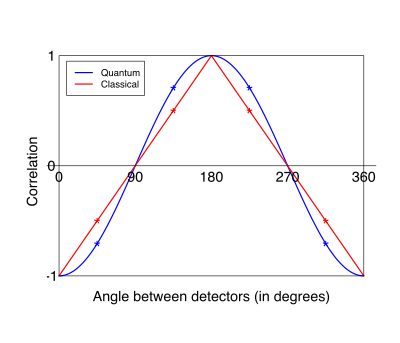
As I understand the P(passing) through a second filter is related to the blue line here:

https://upload.wikimedia.org/wikipedia/commons/thumb/e/e2/Be...

Couldn't the passage through the first filter effect the polarization angle in such a way that it matches the blue line instead of the red line. One could devise a physical contraption to demonstrate this is possible by sending bar magnets through slits of magnets of the same charge. Any magnet oriented such that it's too close to a slit will reorient slightly. Visually...

https://ibb.co/gDnpqCb

That is, if both photons or magnets happen to pass through the first filter, their probability of both going through the second filter is boosted from the slight reorientation, and thus their outcome correlation will be boosted, which is what the blue line in the graph above shows.

Re: How Bell’s Theorem proved ‘spooky action at a distance’ is real

#333
post #327

Earlier quoted context omitted.

There are no propositions that "we are in simulation" would imply (unless someone fundamentally lacks imagination). Being "in a simulation" doesn't imply that we're in simulation created by later humans, it doesn't give any indication how fine-grain the approximations are, etc. etc. "We're in a simulation" fundamentally discard Occam's Razor in the fashion of the belief in God as controlling everything. And thus this…

> There are no propositions that "we are in simulation" would imply (unless someone fundamentally lacks imagination). Not true! It implies we might find performance optimizations, especially at the lowest level. Lazy loading, caching, pointers to constants, that sort of thing. It also doesn't discard Occam's razor. We actually have examples of simulated worlds (physics engines in games), so we know they are possible,…

It implies we might find performance optimizations, especially at the lowest level. Lazy loading, caching, pointers to constants, that sort of thing.

Nah, as other have noted, no simulation could have a 1-1 relationship between data humans observe and data in a physical device that exists in a world congruent to what humans observe - because there aren't enough atoms in the reachable universe for this. So such simulation either compresses the actions it simulates using higher level constructs or its happening in some universe congruent to the world we're in. Any such machine is going be a product of a future we don't know about yet and so it's constraints could be wildly different. Moreover, since the standard assumption of this simulation foolishness is that future humans or future post-humans want to learn about their ancestors, one can naturally assume you mechanisms that compensate for any "glitches" that might otherwise be obvious. Which just adds to my original claim.

Re: How Bell’s Theorem proved ‘spooky action at a distance’ is real

#334
post #327

Earlier quoted context omitted.

There are no propositions that "we are in simulation" would imply (unless someone fundamentally lacks imagination). Being "in a simulation" doesn't imply that we're in simulation created by later humans, it doesn't give any indication how fine-grain the approximations are, etc. etc. "We're in a simulation" fundamentally discard Occam's Razor in the fashion of the belief in God as controlling everything. And thus this…

> There are no propositions that "we are in simulation" would imply (unless someone fundamentally lacks imagination). Not true! It implies we might find performance optimizations, especially at the lowest level. Lazy loading, caching, pointers to constants, that sort of thing. It also doesn't discard Occam's razor. We actually have examples of simulated worlds (physics engines in games), so we know they are possible,…

> Not true! It implies we might find performance optimizations, especially at the lowest level. Lazy loading, caching, pointers to constants, that sort of thing.

The issue is that you can only learn whether you're in a simulation if the simulator allows you to do so. Otherwise, the moment that you discover a performance optimization, the simulator could just pause the simulation, delete the discovery from your mind, and resume.

Re: How Bell’s Theorem proved ‘spooky action at a distance’ is real

#335

Earlier quoted context omitted.

Yes, the "altering" you're describing is what the theorem would call a hidden variable. Seems reasonable, but when you do the math it's exactly he kind of theory Bell's inequality rules out. There's no way to set the "polarization angle" (or any other set of variables) such that they obey the probabilistic laws we've observed (without violating some other assumption, like single measurement outcomes, statistical inde…

As I understand the P(passing) through a second filter is related to the blue line here: https://upload.wikimedia.org/wikipedia/commons/thumb/e/e2/Be... Couldn't the passage through the first filter effect the polarization angle in such a way that it matches the blue line instead of the red line. One could devise a physical contraption to demonstrate this is possible by sending bar magnets through slits of magnets of…

My main contention is that it's possible to construct a physical apparatus using visually observable non-quantum macro objects (like pairs of bar magnets) that pass through such filters with the same correlations shown by the blue line in the graph above. Such correlations would apparently violate Bells theorem, even though the objects were obeying classical laws of motion.

And it's certainly conceivable that passing through a slit could change the orientation of a wave, whether mechanical wave...

https://encrypted-tbn0.gstatic.com/images?q=tbn:ANd9GcSrnPB4...

or the wavefunction of a photon...

https://cronodon.com/images/Single_slit_diffraction_1.jpg

Re: How Bell’s Theorem proved ‘spooky action at a distance’ is real

#336
post #76

Does the article do justice to the hidden variables hypothesis? In case of the hidden variables, the spin is a (3-dimensional?) value that is identified by the measurement result. In case of quantum theory we have have a probability distribution. How is that probability distribution different from a hidden variables, except that it's not a straight number but a function instead? Speaking as a programmer, is the diffe…

Speaking as a lay person, I think the difference might be that it's specifically about local hidden variables. If two particles are coupled, there's no per-particle hidden variable?

Seriously, what's the difference between a non-local variable and a deterministic function that yields a pseudo-random value?

From what I understand, we have some function f that can be evaluated by the measurement and we have another, entangled function g, that can also be evaluated but will yield the opposite of f.

Now instead of assuming that f is truly random and somehow communicates its value instantaneously to g when evaluated, we could also assume that f and g contain a copy of the same pseudo-random number generator and the same seed.

In both cases the interpretation of the model is weird, of course. But I don't see a fundamental difference here that wouldn't allow for hidden variables. It's just that the hidden variables would be have very non-trivial domains.

Re: How Bell’s Theorem proved ‘spooky action at a distance’ is real

#337

Earlier quoted context omitted.

Would this be correct: You take a marble out of the bag without looking and give the bag to your friend. Your friend also take a marble out of the bag without looking. Both you and your friend now look at your marbles and they will both be the same colour every time. You can't send information this way because you don't know the colour until your friend has already taken a marble too. You cannot do anything with the…

This is, as stated, again classical correlation. Where have you used the fact that the observation of one marble affects the observation of the other? Your above experiment could be done with just a simple bag and two marbles without the need to contort yourself around looking or not looking. Here's an attempt to fix your example: You and your friend each take a marble out of the bag, go very far away from each other…

> Where have you used the fact that the observation of one marble affects the observation of the other?

Here: "they will both be the same colour every time"

> Your above experiment could be done with just a simple bag and two marbles without the need to contort yourself around looking or not looking.

They won't be the same colour every time, despite being able to be either colour prior to looking.

But ok, I see what you're saying in the attempted fix. Thanks.

Re: How Bell’s Theorem proved ‘spooky action at a distance’ is real

#338
post #153

Earlier quoted context omitted.

Contrary to some misunderstandings of it, it doesn't "add" extra worlds; it removes the concept of "wave function collapse", and leaves all the other known laws of quantum mechanics completely unchanged. Yes, it gets rid of the collapse postulate, but no, it actually introduces many worlds. You can wiggle a bit around, claim that prior to the wave function collapse there are also many worlds in Copenhagen or whatnot,…

it actually introduces many worlds No, this is the misunderstanding that I'm talking about. The extra "worlds" follow directly and exclusively from the existence of the various basis states in a wave function, and the laws of entanglement. No other postulates are needed. Before the measurement/entanglement, the system and environment are independent, and can be written (|0> + |1>) ⊗ (|0> + |1>). After the entanglemen…

[deleted]

Re: How Bell’s Theorem proved ‘spooky action at a distance’ is real

#339

Earlier quoted context omitted.

They don't perceive each other when they evolve independently, i.e. when they are valid solutions of the schrodinger equation.

Valid solutions to the Schrodinger equation give you the wave function amplitudes in multiple places; the particles in these places can interact with each other still, even if they are 'the same particle'. However, the wave function at different places interacts with the environment and start to shift in phase, eventually becoming unable to interfere with itself - this is called decoherence, and is a valid explanatio…

>Valid solutions to the Schrodinger equation give you the wave function amplitudes in multiple places; the particles in these places can interact with each other still, even if they are 'the same particle'.

I suppose it's destructive interference. It's qualitatively interesting, but its observation is complicated by orthogonal states: when you multiply orthogonal states you get zero. If you can thoroughly dismantle the state to observe it, you still can do it only on microscale, then you'll have a problem lifting it to macroscale evading destructive interference while orthogonal states are all over the place. Anyway, Schrodinger equation describes behavior of quantum states with mathematical precision and the math is quite conclusive that a linear equation behaves in a linear way. When you feel intuition doesn't get you much, you can resort to math, that's why math is seen as an indispensable part of science, because intuition isn't guaranteed to work, which is exactly your case.

>it does not derive from the Schrodinger equation

MWI derives it from the Schrodinger equation. Observation is experience of the observer and can be calculated. Unless you assume that the observer is supernatural and is thus unknowable.

Re: How Bell’s Theorem proved ‘spooky action at a distance’ is real

#340

Earlier quoted context omitted.

Valid solutions to the Schrodinger equation give you the wave function amplitudes in multiple places; the particles in these places can interact with each other still, even if they are 'the same particle'. However, the wave function at different places interacts with the environment and start to shift in phase, eventually becoming unable to interfere with itself - this is called decoherence, and is a valid explanatio…

>Valid solutions to the Schrodinger equation give you the wave function amplitudes in multiple places; the particles in these places can interact with each other still, even if they are 'the same particle'. I suppose it's destructive interference. It's qualitatively interesting, but its observation is complicated by orthogonal states: when you multiply orthogonal states you get zero. If you can thoroughly dismantle t…

> MWI derives it from the Schrodinger equation. Observation is experience of the observer and can be calculated. Unless you assume that the observer is supernatural and is thus unknowable.

This posits the notion of an observer that only observes one outcome, whereas the SE predicts that an observer will observe several different outcomes with different amplitudes. The MWI is postulating that we should only look at each outcome separately.

Furthermore, it is not possible to derive the actual probability value from the wave function amplitude without some additional postulate equivalent to the Born rule, for example that the number of observers that observe one outcome is proportional to the wave function amplitude of that outcome.

Post reply on HN