Live data from Hacker News

To Slow Global Warming, We Need Nuclear Power (Op-Ed)

nytimes.com

331–340 of 666 posts

Re: To Slow Global Warming, We Need Nuclear Power (Op-Ed)

#331
post #238

Earlier quoted context omitted.

"renewables' are also highly subsidized" Only this not true any more. Over the last decade Solar has become price competitive sans subsidies: https://www.youtube.com/watch?v=mmyrbKBZ6SU Even before that the subsidies for solar have been dwarfed by the subsidies that are in place for nuclear power. Recently in Germany the nuclear companies' lobbyists managed to get rif of the problem of end storage of nuclear waste by…

> Over the last decade Solar has become price competitive sans subsidies (...) // I haven't watched the video. Would love to see a text version thereof if it exists. Is it per unit of power that can be produced under optimal conditions or per unit of power averaged over a year? Note that half of the time in a year it's dark, so in order to produce the same amount of energy in a year you need a solar power plant with…

The german term "Stromgestehungskosten" is a well defined standing term for the price you have to pay for power generation. This price has come down to 5ct/kWh and the estimation is that these costs will be undercut in the upcoming solar projects. So the "Stromgestehungskosten" for solar going to go down even more.

Regarding storage and distribution the video reports on a current project in Utrecht/Netherlands where they are combining the untapped storage capacity of electrical cars. As a Tesla owner you can set the amount of milage you will need the next day and the rest of the capacity can/will be used for storage and distribution.

Imagine that, if demand is high and your Tesla is charged you can take the bike and sell the electricity for profit. So the Tesla might pay for itself over time.

Regarding potential over capacity by solar generation I think the electric car revolition is just about to start. There will be huge demand for electricity in the near future.

On the contrary to the costs of storage and distribution, which are often cited and remarked upon in discussions about renewables, the cost of enviromental damage is also not included in the power generation costs. If you factor in the value of the land that became virtually unusable by fukushima, I guess the power generation costs will unlikely be as low as the are presented to be. I vaguely remember figures from someone who did the math for nuclear, this person also subtracted the nuclear industry subsidies, and I think it was 69$/kWh. Yes, sixty nine dollars per kilowatt hour. I wish I had saved that reference. I can not vouch or this value, it is only from the back of my head.
Re: To Slow Global Warming, We Need Nuclear Power (Op-Ed)

#332

My undergrad is in Physics and I took engineering classes in Rickover Hall. I was stationed on a nuclear ship. Even after deploying for the Fukushima disaster, I am a fan of nuclear power. But I have a hard time justifying new investment in an era where solar is competitively priced. The downside of solar is approximately 0 compared to the downside of a reactor accident. I'll even allow for the high, high likelihood…

Don't even bother talking about political capital. Nuclear is a worse option because it is overpriced, period. It's not just the downsides that are subsidized by the government, the actual running cost is hidden behind reams of bureaucracy, hidden program budgets, optimistic amortizations, and underestimated decommissioning costs. And even then the reactors still manage to go massively over budget with the initial co…

First, there can be little doubt that a substantial fraction of the high cost of nuclear is down to almost the entire west being scared stiff of the stuff for thirty years. If we gave actual scientists and engineers a real mandate to come up with a pragmatic, realistic (ie accepting a small amount of risk as acceptable, perhaps something on the scale of a single Fukushima every 30 years, just like we accept a small amount of risk everywhere else - driving, living in hurricane country, even flying isn't perfectly safe) regulatory regime, costs would surely come back down.

Second, funny how costs suddenly matter when it's about nuclear. Barely a month goes by without some new unimaginable mind numbing (wholly impractical) 'solution' to climate change that we're being implored to consider, because it's about saving the planet for our children. Nuclear is a perfectly practical, much cheaper (if still very expensive), 80% solution to climate change that we can actually start implementing today, but somehow it's not on the table. Somehow it doesn't seem all that plausible that cost is really the issue.

In short, climate change is the biggest issue facing the world (except nuclear and fracking). I'm very excited that the NYT is being practical here.

Re: To Slow Global Warming, We Need Nuclear Power (Op-Ed)

#334
post #206

Earlier quoted context omitted.

> And the interesting thing is that no nuclear plant built starting today would have any of the issues that hit Fukishima, Chernobyl, or Three Mile Island. This might be true and is obviously a good thing but it does not make a good basis for your argument. That we have more faith in our designs now does not mean they are safe. There is still risk. I think there is a real possibility that nuclear may be necessary (du…

Fair enough. I don't dismiss an emotional argument, I recognize that one can't engage in it, there is no counter point to emotion. Its sometime hard to explain but if someone is afraid of the dark, no amount of explaining risks will change their emotional response. What you can do is ask someone what it is about something that makes them afraid and give them tools to be less afraid. I don't have any major concerns wi…

It's not simply an emotional argument. Fukishima, Chernobyl, and Three Mile Island weren't supposed to have the issues that hit them either, right up until the point that they did. Every nuclear power plant that ever failed was claimed to be safe until it did, and only after that point did it become so obviously unsafe that it shouldn't be compared to all the other safe nuclear plants. Even when the safety issues could have been and were predicted in advance, as with Fukishima and Three Mile Island, or were the result of major and likely routine violations of safety protocol as with Chernobyl and Three Mile Island, this is simply swept under the rug until the point of actual failure.

For example, a number of people in this HN discussion have held up France as an example of successful nuclear power. Except that as others have pointed out, it turns out that for decades the French manufacturer of their reactors and components, Areva, has been shipping parts that don't meet spec and falsifying their documents to cover this up. In another universe where one of their defective parts failed and caused a major nuclear accident, they would be the isolated incident that shouldn't condemn nuclear power as a whole and another country would be the success story - maybe even Japan if the tsunami hadn't happened.

Re: To Slow Global Warming, We Need Nuclear Power (Op-Ed)

#336

Earlier quoted context omitted.

Fukushima was badly built, badly protected, and badly operated. First few decades airplanes were deadly. Now not so much. All tech can be tamed if you put in the effort.

But what if someone doesn't. A chain is as strong as its weakest link.

Fukushima was also befell by a strongest tsunami in decades.

And even then, the greatest damage was by the tidal wave.

Re: To Slow Global Warming, We Need Nuclear Power (Op-Ed)

#337
post #75

Earlier quoted context omitted.

What happens to batteries that leak and no longer work?

You can recycle almost all of the Lithium and other metals in modern batteries.

If cost-effectiveness is a factor, unless Tesla manage to reap some pretty massive economies of scale, realistically we should be talking about recycling lead-acid batteries (like the one in your car). They are, by a pretty large margin, the cheapest method of storing energy: https://en.wikipedia.org/wiki/Comparison_of_battery_types#Co...

Re: To Slow Global Warming, We Need Nuclear Power (Op-Ed)

#338
post #45
post #40

Earlier quoted context omitted.

Are they really replacing with coal, still? Natural gas contribution to energy is on the rise, but coal seems to be on the decline. (I'm not calling you wrong, I just can't find data to back numbers of plants - only coal as an energy production method.)

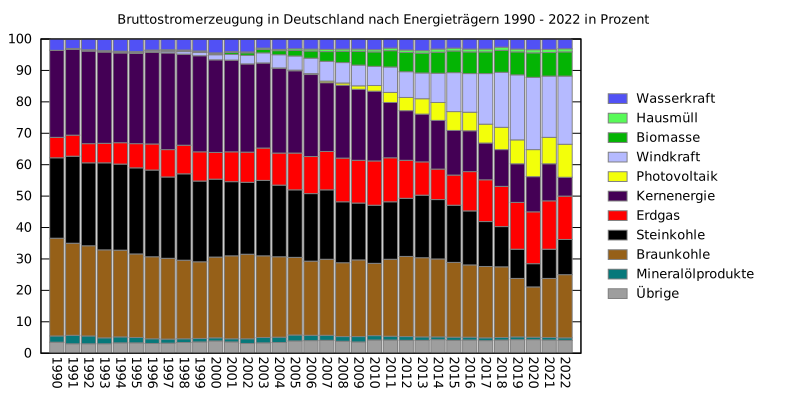
Germany replaced their nuclear power with new coal. It boggles the mind. https://cna.ca/news/germany-replaces-nuclear-coal-ghgs-skyro...

Except that it's not true at all: https://upload.wikimedia.org/wikipedia/commons/c/c9/Energiem... (percentage)

https://de.wikipedia.org/wiki/Stromerzeugung#Bruttostromerze... (absolute)

Kohle = coal, Kernenergie = nuclear energy,

Re: To Slow Global Warming, We Need Nuclear Power (Op-Ed)

#339
post #329

Earlier quoted context omitted.

It gets worse. Unless we develop viable (and affordable) grid-level battery technology, the intermittency problem of renewables makes most of them a non-starter from a cost perspective. To cover 'always on' baseload demand, you need about 5-6 time that amount of maximum generating capacity, optimally geographically dispersed to ensure at least one or a few are producing sufficient power while the others are essential…

Unless we develop viable (and affordable) grid-level battery technology Do you think grid-level energy storage needs to be batteries, as opposed to other forms? If so, why?

There is only so much pumped hydro storage you can make...

Re: To Slow Global Warming, We Need Nuclear Power (Op-Ed)

#340
post #329

Earlier quoted context omitted.

It gets worse. Unless we develop viable (and affordable) grid-level battery technology, the intermittency problem of renewables makes most of them a non-starter from a cost perspective. To cover 'always on' baseload demand, you need about 5-6 time that amount of maximum generating capacity, optimally geographically dispersed to ensure at least one or a few are producing sufficient power while the others are essential…

Unless we develop viable (and affordable) grid-level battery technology Do you think grid-level energy storage needs to be batteries, as opposed to other forms? If so, why?

Not at all, and sorry I guess I misspoke. Whatever works: pumping water up hill, spinning flywheels etc. all sound fine to me. It's simply a question of whether it meets current energy demand, environmental impact, and cost.

Come to think of it, I've only ever looked at the per KW hour cost of batteries (lead-acid seems to be the clear winner). You wouldn't happen to have references for other energy storage methods?

Post reply on HN