Live data from Hacker News

The Grug Brained Developer (2022)

grugbrain.dev

321–330 of 603 posts

Re: The Grug Brained Developer (2022)

#321
post #208

Earlier quoted context omitted.

On the other hand, John Carmack loves debuggers - he talks about the importance of knowing your debugging tools and using them to step through a complex system in his interview with Lex Friedman. I think it's fair to say that there's some nuance to the conversation. My guess is that: - Debuggers are most useful when you have a very poor understanding of the problem domain. Maybe you just joined a new company or are e…

It depends on the domain. Any complex long lived mutable state, precise memory management or visual rendering probably benefits from debuggers. Most people who work on crud services do not see any benefit from it, as there is practically nothing going on. Observing input, outputs and databases is usually enough, and when it's not a well placed log will suffice. Debuggers will also not help you in distributed environm…

Debuggers absolutely help in distributed environments, in the exact same way that they help with multithreaded debugging of a single process. It is certainly requires a little bit more setup, but there isn't some essential aspect of a distributed environment that precludes the techniques of a debugger.

The only real issue in debugging a distributed/multithreaded environment is that frequently there is a timeout somewhere that is going to kill one of the threads that you may have wanted to continue stepping through after debugging a different thread.
Re: The Grug Brained Developer (2022)

#322

“Good debugger worth weight in shiny rocks, in fact also more” I’ve spent time at small startups and on “elite” big tech teams, and I’m usually the only one on my team using a debugger. Almost everyone in the real world (at least in web tech) seems to do print statement debugging. I have tried and failed to get others interested in using my workflow. I generally agree that it’s the best way to start understanding a s…

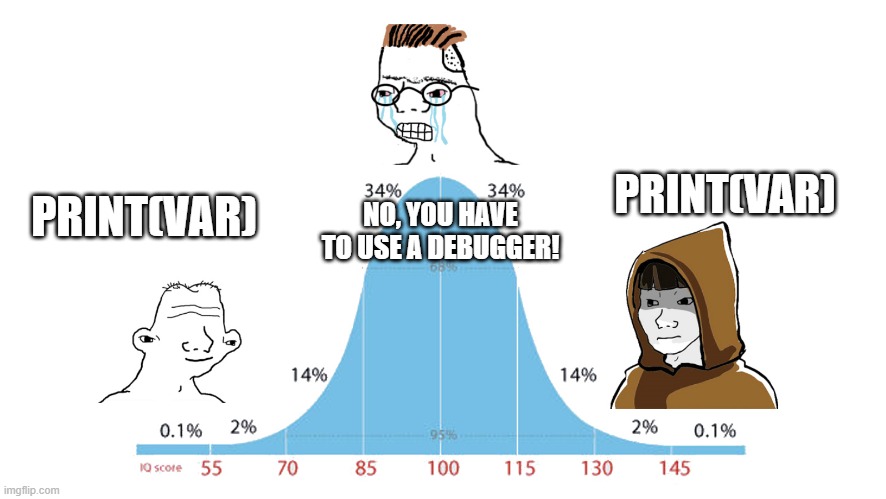
There was a good discussion on this topic years ago [0]. The top comment shares this quote from Brian Kernighan and Rob Pike, neither of whom I'd call a young grug: > As personal choice, we tend not to use debuggers beyond getting a stack trace or the value of a variable or two. One reason is that it is easy to get lost in details of complicated data structures and control flow; we find stepping through a program les…

https://i.imgflip.com/9xrblc.jpg

Re: The Grug Brained Developer (2022)

#323

“Good debugger worth weight in shiny rocks, in fact also more” I’ve spent time at small startups and on “elite” big tech teams, and I’m usually the only one on my team using a debugger. Almost everyone in the real world (at least in web tech) seems to do print statement debugging. I have tried and failed to get others interested in using my workflow. I generally agree that it’s the best way to start understanding a s…

I thought debugging was table stakes. It isn't always the answer. If a lot is going on logs can be excellent (plus grep or an observability tool)

However debugging is an essential tool in the arsenal. If something is behaving oddly even the best REPL can't match debugging as a dev loop (maybe lisp excepted).

I even miss the ability to move the current execution point back in .NET now I use Go and JS. That is a killer feature. Edit and continue even more so!

Then next level is debugging unit tests. Saved me hours.

Re: The Grug Brained Developer (2022)

#324

“Good debugger worth weight in shiny rocks, in fact also more” I’ve spent time at small startups and on “elite” big tech teams, and I’m usually the only one on my team using a debugger. Almost everyone in the real world (at least in web tech) seems to do print statement debugging. I have tried and failed to get others interested in using my workflow. I generally agree that it’s the best way to start understanding a s…

There was a good discussion on this topic years ago [0]. The top comment shares this quote from Brian Kernighan and Rob Pike, neither of whom I'd call a young grug: > As personal choice, we tend not to use debuggers beyond getting a stack trace or the value of a variable or two. One reason is that it is easy to get lost in details of complicated data structures and control flow; we find stepping through a program les…

You probably just don't know how to use conditional breakpoints effectively. This is faster than adding print statements.

Re: The Grug Brained Developer (2022)

#325

might be some good points in here but it's sooo hard to read.

Since you're being downvoted I just wanted to say I agree. I'm sure it was cathartic to write but it's not a good way to actually communicate. Also like a lot of programming advice it isn't actually that useful. Advice like "avoid complexity" sounds like it is good advice, but it isn't good advice . Of course you should avoid complexity. Telling people to do that is about as useful as telling people to "be more confi…

I raise you "premature optimization is the root of all evil". Great advice, so good in fact that it's true for literally anything: "premature X is the root of all evil".

If it's "unnecessary" or "premature", then of course it's bad. I don't need to be told that. What I do need is advice on telling apart the unnecessary and premature from the necessary and timely.

Re: The Grug Brained Developer (2022)

#326

Earlier quoted context omitted.

True, but then you're still left stepping through your breakpoints one by one. Printf debugging gives you the full picture of an entire execution at a glance, allowing you to see time as it happened. The debugger restricts you to step through time and hold the evolution of state in your memory in exchange for giving you free access to explore the state at each point. Occasionally that arbitrary access is useful, but…

I set a break point, look at the variables in play and then start looking up the call stack.

But that is still slow compared to print debugging if there is a lot happening. Print debugging you can just print out everything that happens and then scan for the issue and you have a nice timeline of what happens after and before in the print statements.

I don't think you can achieve the same result using debuggers, they just stop you there and you have no context how you got there or what happens after.

Maybe some people just aren't good at print debugging, but usually it finds the issue faster for me, since it helps pinpointing where the issue started by giving you a timeline of events.

Edit: And you can see the result of debugger use in this article, under "Expression Complexity" he rewrote the code to be easier to see in a debugger because he wanted to see the past values. That makes the code worse just to fit a debugger, so it also has such problems. When I use a debugger I do the same, it makes the code harder to read but easier to see in a debugger.

Re: The Grug Brained Developer (2022)

#327

“Good debugger worth weight in shiny rocks, in fact also more” I’ve spent time at small startups and on “elite” big tech teams, and I’m usually the only one on my team using a debugger. Almost everyone in the real world (at least in web tech) seems to do print statement debugging. I have tried and failed to get others interested in using my workflow. I generally agree that it’s the best way to start understanding a s…

There was a good discussion on this topic years ago [0]. The top comment shares this quote from Brian Kernighan and Rob Pike, neither of whom I'd call a young grug: > As personal choice, we tend not to use debuggers beyond getting a stack trace or the value of a variable or two. One reason is that it is easy to get lost in details of complicated data structures and control flow; we find stepping through a program les…

I feel like you need to know when to use what. Debugger is so much faster and easier for me when looking for errors in the use of (my own) abstractions. But when looking for errors in the bowels of abstracted or very small partitioned code print logs are far easier to see the devil in the detail.

Re: The Grug Brained Developer (2022)

#329

Earlier quoted context omitted.

There was a good discussion on this topic years ago [0]. The top comment shares this quote from Brian Kernighan and Rob Pike, neither of whom I'd call a young grug: > As personal choice, we tend not to use debuggers beyond getting a stack trace or the value of a variable or two. One reason is that it is easy to get lost in details of complicated data structures and control flow; we find stepping through a program les…

https://i.imgflip.com/9xrblc.jpg

There's a time and place for everything, and an escalation of tooling/environmental context for me.

1. Printing vars in unit tests may be the fastest first approach. If i know where the bug may be.

2. When that fails i usually bring in debuggers to unit tests.

3. When these aren't helping, you need debuggers on the entire binary.

4. Still stuck? Use a debugger in production.

Re: The Grug Brained Developer (2022)

#330

So many gems in here but this one about microservices is my favorite: grug wonder why big brain take hardest problem, factoring system correctly, and introduce network call too

I'm convinced that some people don't know any other way to break down a system into smaller parts. To these people, if it's not exposed as a API call it's just some opaque blob of code that cannot be understood or reused.

I swear I'm not making this up; a guy at my current client needed to join two CSV files. A one off thing for some business request. He wrote a REST api in Java, where you get the merged csv after POSTing your inputs.

I must scream but I'm in a vacuum. Everyone is fine with this.

(Also it takes a few seconds to process a 500 line test file and runs for ten minutes on the real 20k line input.)

Post reply on HN