Live data from Hacker News

The First Rule of Microsoft Excel: Don’t Tell Anyone You’re Good at It

wsj.com

321–330 of 435 posts

Re: The First Rule of Microsoft Excel: Don’t Tell Anyone You’re Good at It

#321
post #293

Earlier quoted context omitted.

I have a story that may amuse you. Recently I worked on a contract doing some data ingestion that the resident team didn't want to deal with. They had been provided a JSON api to get what should have been a batch file. The owner/api creator said "this is good enough we won't accommodate you." So much for sensible data transmission and batch processing. Because I have had to deal with these sorts of things before I ha…

What do you mean by "batch file"? Surely not a .bat.

He probably means the output of a batch processing pipeline. Clients will calculate a set of data once a day and shove it into some kind of storage[0] for you to download.

[0] probably an FTP server with no TLS and with the same weak username and password for everyone who connects, a setup which they won't change no matter how many times you ask
Re: The First Rule of Microsoft Excel: Don’t Tell Anyone You’re Good at It

#323

Earlier quoted context omitted.

> I just yell at them and tell them to stop using excel sheets as makeshift databases. What do you recommend to them as an alternative for makeshift databases? There could be a nice product opportunity for a lightweight database web app that is like Microsoft Access or a spreadsheet without formulas. Airtable probably fits that bill, but even it might be more complicated than many people need.

In a small organisation use PostgreSQL. In a large organisation (assuming the IT department won’t let people create ad-hoc databases, which is normal), use SAS, R, Python or whatever tool is available.

PostgreSQL should be accessible by default to anyone. And Excel should require approbation from higher management and IT after a painful bureaucratic procedure.

Unfortunately it’s always the other way around.

Don’t get me wrong: I really like Excel. But I don’t encode any data in Excel sheets anymore. Now I store everything in a PostgreSQL DB and use ODBC for native access and Pivot tables.

Re: The First Rule of Microsoft Excel: Don’t Tell Anyone You’re Good at It

#324

Earlier quoted context omitted.

Actually much earlier in 2012, when Excel first shipped with xVelocity branded PowerPivot. It supports a new data model that reminds me of Microsoft Access in some ways (drag & drop relationships etc). This is a whole different beast from copy/pasting data into sheets - in fact, the data doesn't show up in sheets by default and you usually have to add other things (like pivot tables) to take advantage of it. Microsof…

Is this power bi..? Ah, I think it is. I’ve really tried to get up to speed with it, but it feels so alien to normal excel in many ways. I feel an existential dread when I drop a column in power BI. But yeah, it’s very powerful. It’s very sql like in the way you have to treat actions and data.

Yes and no. Power BI is a mixed cloud/desktop thing - the desktop GUI for creating reports/charts is actually pretty cool. PowerPivot and Power Query in Excel are add-ons that tack on the same analytical engine that Microsoft purchased to power new features in SQL Server. I believe MS is branding this all now as Power BI, but it's still a little confusing to be honest.

In the Power BI desktop app you can connect to standard RDBMS' like MySQL, Postgres, or SQL Server and basically it works like Tableau. The really interesting part is you can export these data sources and hook them into Excel (local or via the cloud).

> It’s very sql like

It should be, this is essentially using Excel as an GUI on top of technology designed to run an analytics RDBMS. It actually is an entirely separate interface from Excel and feels bolted on after-the-fact.

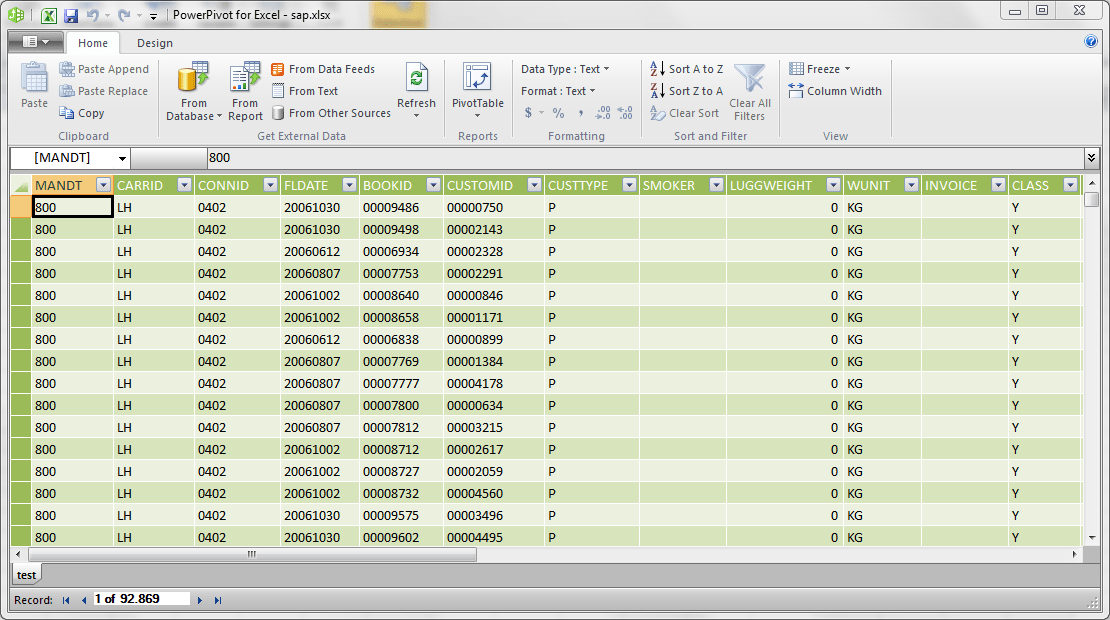
Here's an example of the PowerPivot Excel add-on screens:

https://i2.wp.com/www.kasperonbi.com/wp-content/uploads/2010... https://i.ytimg.com/vi/NDO6MpT70PM/maxresdefault.jpg

Re: The First Rule of Microsoft Excel: Don’t Tell Anyone You’re Good at It

#325
As bad (and deserved) as their reputation is for helping well-meaning users to create a big mess, spreadsheet software provides an incredibly intuitive UI to put in front of users that have the domain knowledge but not necessarily direct software engineering knowledge.

I've been thinking about this for years, ever since I first read "A Small Matter of Programming" by Bonnie Nardi: https://mitpress.mit.edu/books/small-matter-programming where she explored the history of end-user programming systems, and concludes that spreadsheet and CAD software are the only examples that have had widespread and undeniable success.

ASMOP was published in 1993 and I think it is still just as relevant today.

Just as it's possible to write a terribly-architected and designed program in any language, I suspect that with the right engineering effort and insight, modern software engineering practices could bring the complexity under control.

We shouldn't expect to just take spreadsheets and stick them into production, just as you wouldn't take a hastily-written prototype written in any programming language and do the same.

Re: The First Rule of Microsoft Excel: Don’t Tell Anyone You’re Good at It

#326

Earlier quoted context omitted.

What the other child poster said. This is 90% of my job. It’s really fun a lot of the time and absolutely brutal the rest of it. Be prepared for things like writing code that checks the color or text styling of cells etc. people encode data in whacky ways

Seriously. I frequently get handed spreadsheets with integers typed as strings... people using strings for things that, heaven's sake, should undoubtedly be booleans... Getting the thing into usable condition takes up more time and energy than the actual analysis they desire

I've seen that before, to "work around" locale issues, bring a European company recieving data from US companies

Re: The First Rule of Microsoft Excel: Don’t Tell Anyone You’re Good at It

#327

Earlier quoted context omitted.

Or maybe he is a peer of ours and we actually know something about him beyond ridiculous and disgusting media depictions. Here's a fun question for you as an HN'er: what was the name of Shkreli's pharmaceutical company?

Starts with R? Checks... retrophin. Shkreli was one of many finance types who have fully drunk the koolaid. He is not alone, and the others too would be prosecuted if people had the time and awareness to be incensed with the culture. In his defense, shkrelli didn’t know he was a tool. On the one hand singing praises of the free market and on the other taking advantage of every loophole someone could find. I mean the…

[deleted]

Re: The First Rule of Microsoft Excel: Don’t Tell Anyone You’re Good at It

#329

Earlier quoted context omitted.

Is this Poe's law at work?

If you think that kind of reaction is out of line, please kindly let me know where you keep your 1.6 million dollars. Thanks.

It is out of line. It's one thing to be angry at a person, another to wish bad things on their family/children who likely had no part is the issue.

Re: The First Rule of Microsoft Excel: Don’t Tell Anyone You’re Good at It

#330
post #308

Earlier quoted context omitted.

I don’t understand how editing a number in an excel file is any easier than editing a number in a text file. What was it that made the difference?

I have tinkered with modding Diablo II (which uses tab-separated values for parameters) and the classic Command & Conquer series (which uses INI files). Both approaches have tradeoffs: - TSV files can have so many columns that you can't really edit them in a text editor, you'll never find your place. Some of these in D2 have more than 256 columns. - INI files don't give you a full list of configurable parameters, so…

You could have json and a schema. VSCode for example does this, all settings is just a settings.json but it still has auto-complete inside it so you always know what settings are available.
Post reply on HN