Live data from Hacker News

Weight-loss drug found to shrink muscle in mice, human cells

ualberta.ca

311–320 of 461 posts

Re: Weight-loss drug found to shrink muscle in mice, human cells

#311

Earlier quoted context omitted.

Most kill you. If I didn't misread articles on ozempic, they can cause digestive problems where food rots in your stomach. Bad depression was another side effect which blows my mind since you'd think looking better would make you feel great. And these were the minor things.

I don't think you realize the amount of people have taken Ozempic or similar drug. I'm lucky enough that I haven't had issues with body weight, but if I believe the stats (and my observations in real world confirm it), about 15% of adults are on it. If it was "killing people", we would be seeing it literally everywhere. We're not talking about a small scale 50K+ observation... we're talking about literal millions.

Really just meant it kills you if you plan on using it as a lifelong solution. I don't have an obesity problem but if I did, this is one of those drugs I'd journal about daily to keep track of how it's affecting me.
Re: Weight-loss drug found to shrink muscle in mice, human cells

#313

Earlier quoted context omitted.

> like its something against those facts above I’ve seen multiple friends go from eating like shit, including chugging sodas, to not compulsively ordering dessert and no sodas in the house. I think all of them have since quit Ozempic, each seeing some rebound but nothing comprehensive and, most notably to your argument, not in the behaviour modifications.

The only way to lose weight without damaging oneself is to combine more exercise with less eating, which means becoming comfortable being hungry. Yes, it's difficult -- especially after developing bad eating habits over a long time -- but moderation is required in all things. It takes a long time to become overweight, so the ramp down to a leaner existence must necessarily take a significant amount of time, or there'…

That's true for an individual, but if you're looking at a population then you're seeing a situation where we have zero other solutions that are actually effective at curbing obesity. The only "natural" way to solve it is probably to overhaul our entire culture, redesign our cities and neighborhoods, et c., and that's not happening.

Skinny people move to the US and get fat. They're not skinnier back in their home country because they've got greater willpower or are harder workers, but because they aren't in the US. If harder work isn't why skinnier countries are skinnier, we shouldn't expect it to help us out of our problem, and indeed, we have nothing else we've studied that is terribly effective over time, and certainly nothing cheap enough to deploy on a large scale.

Again, yes, for an individual your perspective is the only thing one has (well... until these drugs) but looking from a policy level, it's useless.

Re: Weight-loss drug found to shrink muscle in mice, human cells

#314

Earlier quoted context omitted.

[dead]

Carbs are harder to control for many people, and less forgiving. A side effect of keto is decreased appetite. A side effect of carbs is overeating.

Only when "carbs" is a euphemism for junk food. Which probably exists because Americans don't eat carbs like beans and broccoli. And instead of eating them, they get told online that they should avoid all carbs.

It's a devious euphemism that screws the people over the most that should be eating more beans and broccoli (et al).

Re: Weight-loss drug found to shrink muscle in mice, human cells

#315

I'm always so baffled by warnings about losing muscle when losing weight. Of course you do! If your body is tens of pounds lighter, then you don't need the extra muscle to lug it around. This paper is about reduction in heart muscle, and of course your heart doesn't need to be as strong because there's less blood to pump and less tissue to fuel. When you gain weight, you also increase the muscles needed to carry that…

> Our bodies are really good at providing exactly the amount of muscle we need for our daily activities

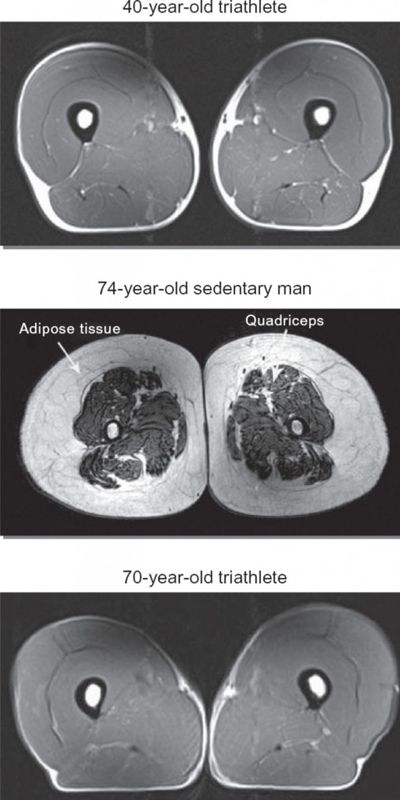
The problem is that the average joe's daily activity is incompatible with an healthy muscle mass. After 30 if you don't actively exercise you lose muscle mass, if you're obese, 50 and starve yourself or take drugs that make you lose more muscles than necessary you won't gain them back ever unless you do some form of serious resistance training

https://hips.hearstapps.com/hmg-prod/images/triathlete-aging...

Re: Weight-loss drug found to shrink muscle in mice, human cells

#316
I was wondering when the other shoe would drop.

These drugs are turning into a band-aid on the fact that it's more profitable to sell addictive, high-calorie foods in the US than foods that promote long-term health.

We'll decay people's heart muscles before we put a tax on unhealthy food to help fund Medicare and Medicaid.

Re: Weight-loss drug found to shrink muscle in mice, human cells

#317

Earlier quoted context omitted.

From the abstract: "Studies suggest muscle loss with these medications (as indicated by decreases in fat-free mass [FFM]) ranges from 25% to 39% of the total weight lost over 36–72 weeks. This substantial muscle loss can be largely attributed to the magnitude of weight loss, rather than by an independent effect of GLP-1 receptor agonists, although this hypothesis must be tested. By comparison, non-pharmacological cal…

FFM isn’t entirely muscle, but what other weight would be shed when losing FFM other than muscle?

[deleted]

Re: Weight-loss drug found to shrink muscle in mice, human cells

#319

Earlier quoted context omitted.

FFM isn’t entirely muscle, but what other weight would be shed when losing FFM other than muscle?

Water weight is a big one, and is part of your FFM. I lost 10lb of water weight in my first 24 hours on tirzepatide. Some of it is likely bone density as well. You can prevent the bone density and muscle loss with proper diet and exercise, though.

Googling it, 70% of FFM is water.

Yeah, I've swung 10lbs in 24 hours just going from well fed to fasted without water. And it certainly wasn't fat I lost, just water and I'm surely any mass in my... various tracts.

Re: Weight-loss drug found to shrink muscle in mice, human cells

#320
post #300

I'm always so baffled by warnings about losing muscle when losing weight. Of course you do! If your body is tens of pounds lighter, then you don't need the extra muscle to lug it around. This paper is about reduction in heart muscle, and of course your heart doesn't need to be as strong because there's less blood to pump and less tissue to fuel. When you gain weight, you also increase the muscles needed to carry that…

From the article: "...explains this rate of muscle decline is significantly higher than what is typically observed with calorie-reduced diets or normal aging and could lead to a host of long-term health issues..." The warning isn't that you're losing muscle during weight-loss with these drugs. It's that the ratio of muscle vs fat loss is much greater with the drugs compared to traditional weight loss methods. It's be…

If I'm reading the study [1] correctly, that conclusion is not warranted.

It appears that they fed the control group and treatment group of mice lots of food to get them fat, then gave them identical normal diets, and gave the treatment group semaglutide.

The semaglutide group lost significantly more weight (fig A.ii) than the control group, and also lost heart muscle.

So it does not seem that they compared to an equivalent amount of weight loss in mice, which is what I'd think you'd need to do to come to the conclusion from the article (actually, not just an equivalent amount of weight loss, but also at the same rate).

[1] https://www.sciencedirect.com/science/article/pii/S2452302X2...

Post reply on HN