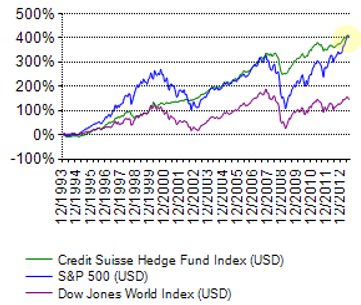
> Sliced democratizes access to hedge funds.
To be clear, Sliced is open only to accredited investors and has a minimum investment of $20,000.
31–40 of 48 posts
To be clear, Sliced is open only to accredited investors and has a minimum investment of $20,000.
> Sliced democratizes access to hedge funds. Even though hedge funds have outperformed S&P 500 over the past decade, very few investors have access to them. Hedge Funds on average do not outperform market indices such as S&P 500. I'm curious as to whether this was TechCrunch's take on the problem, or the startup's?
It's mostly irrelevant. No one is investing in the hedge fund average, they are investing in the hedge funds that they think will do well. It's actually the same if you look at VC funds -- the overall returns of venture funds is poor, but the returns of the top quartile of funds is outstanding. In any case, the S&P 500 is not an appropriate benchmark for the hedge fund industry as a whole, because many hedge funds do…
Earlier quoted context omitted.
It's mostly irrelevant. No one is investing in the hedge fund average, they are investing in the hedge funds that they think will do well. It's actually the same if you look at VC funds -- the overall returns of venture funds is poor, but the returns of the top quartile of funds is outstanding. In any case, the S&P 500 is not an appropriate benchmark for the hedge fund industry as a whole, because many hedge funds do…
I think it is unlikely that hedge fund picking is possible for the following reasons. First, if a fund consistently produces outsized risk-adjusted returns the fund would increase their fees to capture most of those returns (Rentech, formerly Bridgewater). Second, a fund which has outsized risk adjusted returns net of fees would become very popular, receive more investment which creates a drag on returns until either…
Earlier quoted context omitted.
I think it is unlikely that hedge fund picking is possible for the following reasons. First, if a fund consistently produces outsized risk-adjusted returns the fund would increase their fees to capture most of those returns (Rentech, formerly Bridgewater). Second, a fund which has outsized risk adjusted returns net of fees would become very popular, receive more investment which creates a drag on returns until either…
Funds frequently return capital or close to new money in order to stay below their investment capacity. Funds also sometimes charge less than the maximum they can get away with for various reasons. The premise of your argument is simply wrong. Moreover, you are ignoring the very real excess profits that are made on the way to this hypothetical equilibrium. Berkshire Hathaway shares aren't going to make you rich if yo…
The point is they are not open to investment once you have historical evidence that they are "good".
> Funds also sometimes charge less than the maximum they can get away with for various reasons.
The only reason I can think of is to increase investment. But that will happen even for minimal excess return.
> Moreover, you are ignoring the very real excess profits that are made on the way to this hypothetical equilibrium. Berkshire Hathaway shares aren't going to make you rich if you buy them today, but I'm guessing the people who bought them in 1970 don't care.
Obviously there are excess returns the question is if they can be reliably identified before hand and are accessible.
Are you invested in hedge funds? Which ones do you think are good now?
> Sliced democratizes access to hedge funds. Even though hedge funds have outperformed S&P 500 over the past decade, very few investors have access to them. Hedge Funds on average do not outperform market indices such as S&P 500. I'm curious as to whether this was TechCrunch's take on the problem, or the startup's?
Earlier quoted context omitted.
Funds frequently return capital or close to new money in order to stay below their investment capacity. Funds also sometimes charge less than the maximum they can get away with for various reasons. The premise of your argument is simply wrong. Moreover, you are ignoring the very real excess profits that are made on the way to this hypothetical equilibrium. Berkshire Hathaway shares aren't going to make you rich if yo…
> Funds frequently return capital or close to new money in order to stay below their investment capacity. The point is they are not open to investment once you have historical evidence that they are "good". > Funds also sometimes charge less than the maximum they can get away with for various reasons. The only reason I can think of is to increase investment. But that will happen even for minimal excess return. > More…
Couldn't Square or some other "big" player come in and implement payments via bank account and simply put Kash out of business? I know nothing of the domain, but it seems relatively straight forward to do, no? PayPal already let's me send money to any individual with an email address (and maybe a PayPal account?), so couldn't they just change their fees to 1% flat for businesses tomorrow? What am I missing? Thoughts?
Also, it certainly doesn't mean they'll put Kash out of business if they do (and if the Kash team succeeds). For example, I don't expect Amazon Local Register to put Square out of business.
Earlier quoted context omitted.
> Funds frequently return capital or close to new money in order to stay below their investment capacity. The point is they are not open to investment once you have historical evidence that they are "good". > Funds also sometimes charge less than the maximum they can get away with for various reasons. The only reason I can think of is to increase investment. But that will happen even for minimal excess return. > More…
The cliche among hedge fund guys is to be "long term greedy" not "short term greedy", which explains why some funds try to be more investor friendly with fees. You also have flukes like Berkshire that seem to have undercharged simply out of benevolence. I don't really discuss my investments much, but I mostly do not invest in hedge funds for reasons of tax efficiency--a restriction that doesn't apply to many institut…
Helion seems unreal. I am not ready up to date with fusion research, but as far as I know there was not even a demo or prototype in lab producing energy for a few seconds (or minutes), and they claim to have a product in 6 years. Can someone tell me what I've missed ?
You're probably not missing anything. By my (limited) reckoning, even if they can get their design to work in theory, I think they're grossly underestimating the materials requirements for the fusion reactor. From what I recall, one of the big problems that any reactor project has is that the reaction has a tendency to destroy the reaction chamber. Not just the heat, but the neutron radiation can completely screw up…
Couldn't Square or some other "big" player come in and implement payments via bank account and simply put Kash out of business? I know nothing of the domain, but it seems relatively straight forward to do, no? PayPal already let's me send money to any individual with an email address (and maybe a PayPal account?), so couldn't they just change their fees to 1% flat for businesses tomorrow? What am I missing? Thoughts?