Live data from Hacker News

Mapcode – A short address for any location on Earth

mapcode.com

31–40 of 124 posts

Re: Mapcode – A short address for any location on Earth

#31
post #26

" A short address for any location on Earth" It doesn't check out: Surface Area of Earth: 510.1 * 10^6 km^2 Distinct map codes: 36^5 = 60.466176 * 10 ^6 Area of 1 map code = 8.4 km^2 Oh! It's narrowed by country... so it doesn't address any location on Earth. Only populated areas. If you want to actually refer to ANY location on Earth, there's another system, Ham Radio grids. It uses four to six digits and refers to…

It is actually every area, and the length of the codes varies. I'm guessing that the most popular/populated places get the shortest codes and those further away get the longer codes.

For example a location somewhere in the Atlantic off the coast of Gran Canaria is International QFLQV.29KM while some place in the el Poble Sec district in Barcelona is Spain SG.YB.
Re: Mapcode – A short address for any location on Earth

#36
post #23

It's hard to get an understanding of the precise algorithm that's being used to generate the code. If it were a competitor of the postcode it would have to be possible to identify whether two places are close to eachother just by looking at the code right? From the patent I get the feeling that it's a bit like a C-ary space partitioning, where C is 36 (alphabet+numbers). So the first character divides the earth in 36…

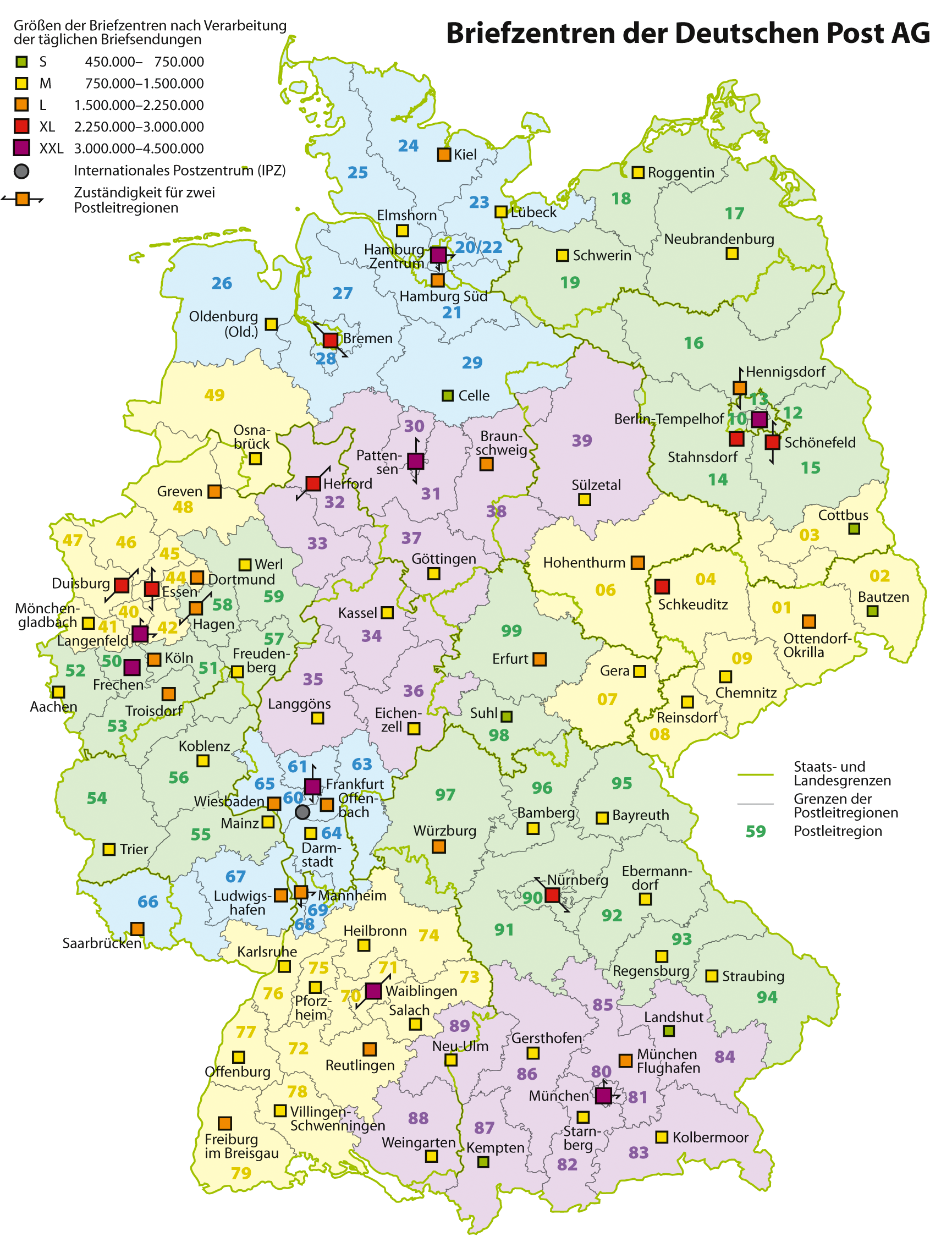
I think that postcodes divide a country not evenly but are chosen by population density and the distribution structure of the post provider. Look at http://upload.wikimedia.org/wikipedia/commons/8/8e/Karte_Bri... for example, each distribution center is responsible for one or two double digit prefixes, the first digit roughly indicates the region. Areas with high population density have a much finer coverage. I don't think there would be any benefit from switching to Map Codes, as they have to be mapped to something like post codes anyways and they are not precise enough to serve as residential addresses.

Re: Mapcode – A short address for any location on Earth

#37

Wouldn't this change the entire address and number? The problem is, you can't find a place without a GPS (or another digital device) :-(

You are correct. This is the real problem. (They even use an Indian business card as an example...)

Re: Mapcode – A short address for any location on Earth

#38
post #21

It gave me a map code that was longer than my postcode. I'm not sure how postcodes work everywere else in the world, but in the uk they point to a specific road, so it's pretty good for navigating to a place with. I do know that in belgium they point to an area, so they're not as good as a navigation aid.

ISTR that UK postcodes narrow things down to around 15 properties.

Re: Mapcode – A short address for any location on Earth

#39
The TomTom founders definitely didn't "just kill the postcode."

> Mapcodes were developed in 2001 by Pieter Geelen and Harold Goddijn, soon after the GPS satellite signals were opened up for civilian use. It was decided to donate the mapcode system to the public domain in 2008.

Can we get an update to the click-baity title?

Post reply on HN