I have some personal experience with the related problem. At age 60 a gradually increasing "murmur" led to a diagnosis of Aortic Ectasia[0], a stretching of the ring of muscle that is the base for the aortic valve. As the valve widens, the three leaflets overlap less and the valve doesn't seal properly, making the heart less efficient. In addition my ascending aorta, the big arched tube that is the subject of the abo…
In a word, No. It wouldnt fix the false lumen. This is me: http://aorticdissection.com/2011/12/06/jim-thompson-47/
The engineer who fixed his own heart
31–40 of 43 posts
Re: The engineer who fixed his own heart
#32I have some personal experience with the related problem. At age 60 a gradually increasing "murmur" led to a diagnosis of Aortic Ectasia[0], a stretching of the ring of muscle that is the base for the aortic valve. As the valve widens, the three leaflets overlap less and the valve doesn't seal properly, making the heart less efficient. In addition my ascending aorta, the big arched tube that is the subject of the abo…
Tangent: why have humans (animals in general I guess) evolved pain receptors inside their bodies?
Re: The engineer who fixed his own heart
#33Re: The engineer who fixed his own heart
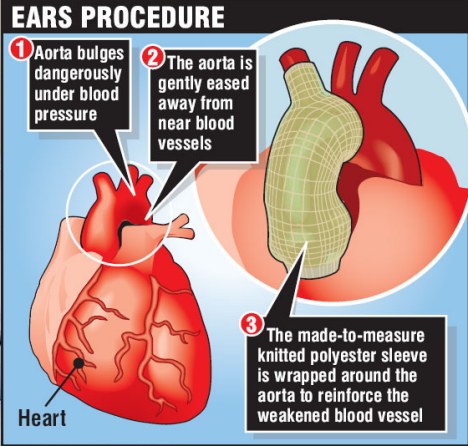
#34I wish they went more into detail about the devise itself. I was hoping to see a picture.
Re: The engineer who fixed his own heart
#35Sounds incredibly obvious.
However, IIRC, Tal's version is based on one that is custom-built to fit the patient, and of course uses more advanced materials.
Re: The engineer who fixed his own heart
#36I have some personal experience with the related problem. At age 60 a gradually increasing "murmur" led to a diagnosis of Aortic Ectasia[0], a stretching of the ring of muscle that is the base for the aortic valve. As the valve widens, the three leaflets overlap less and the valve doesn't seal properly, making the heart less efficient. In addition my ascending aorta, the big arched tube that is the subject of the abo…
Even if it could measurably reduce the chances for known risk groups, would it really be prudent to perform open-heart surgery on a patient without a current condition?
Re: The engineer who fixed his own heart
#37Earlier quoted context omitted.
In a word, No. It wouldnt fix the false lumen. This is me: http://aorticdissection.com/2011/12/06/jim-thompson-47/
If it has already dissected it's obviously too late. The parent comment asked if it would prevent dissection in those aneurysms that haven't yet dissected which is probably a more complicated question. It would probably depend on the elasticity of the vessel since we don't see dissection exclusively on absurdly dilated aortas. At the very least we can guess that it would help to extend the life of the native artery.…
Re: The engineer who fixed his own heart
#38Aorta wrapping was actually pioneered in the 1950's, before the graft replacements that the article mentions, but generally the wrapping had a poor result and was abandonded as a technique. (see http://www.ncbi.nlm.nih.gov/pmc/articles/PMC1802172/pdf/anns... ) Generally the trend in vascular surgery these days is to less invasive procedures such as a stent graft.
Sorry but when you use the term "generally" in a medical context you can be sure the following statement is incorrect. This article is referring to the aortic root which cannot be stinted due to its proximity to the heart.
I am not that familiar with Marfan's or this case, so I don't know if this device is useful in this case (http://www.medtronic.com/patients/heart-valve-disease/about-...), but there are stent-grafts that also replace the aortic value so that the stent-graft can be used close to the heart, and you can be sure that medical device companies are looking at ways of using stent-grafts in close proximity to the aortic valve without requiring its replacement.
Re: The engineer who fixed his own heart
#39Re: The engineer who fixed his own heart
#40I have some personal experience with the related problem. At age 60 a gradually increasing "murmur" led to a diagnosis of Aortic Ectasia[0], a stretching of the ring of muscle that is the base for the aortic valve. As the valve widens, the three leaflets overlap less and the valve doesn't seal properly, making the heart less efficient. In addition my ascending aorta, the big arched tube that is the subject of the abo…
(It's reputed to be one of the most painful experiences possible.) Tangent: why have humans (animals in general I guess) evolved pain receptors inside their bodies?