Earlier quoted context omitted.
Wow... the inequity seems to be concentrated in the deep south. Something else is concentrated in the deep south too.
"Something else is concentrated in the deep south too." What are you referring to? It could be republicans, Black people (yes, look at a map), poverty, etc.
California poised to raise minimum wage to $10
31–40 of 65 posts
Re: California poised to raise minimum wage to $10
#32I'm going to head off all the armchair economists, including the two* who have already replied as of 15 minutes after the article was posted. http://www.igmchicago.org/igm-economic-experts-panel/poll-re... Here's a real survey of actual economists, who largely agree, weighted by confidence, that "The distortionary costs of raising the federal minimum wage to $9 per hour and indexing it to inflation are sufficiently s…
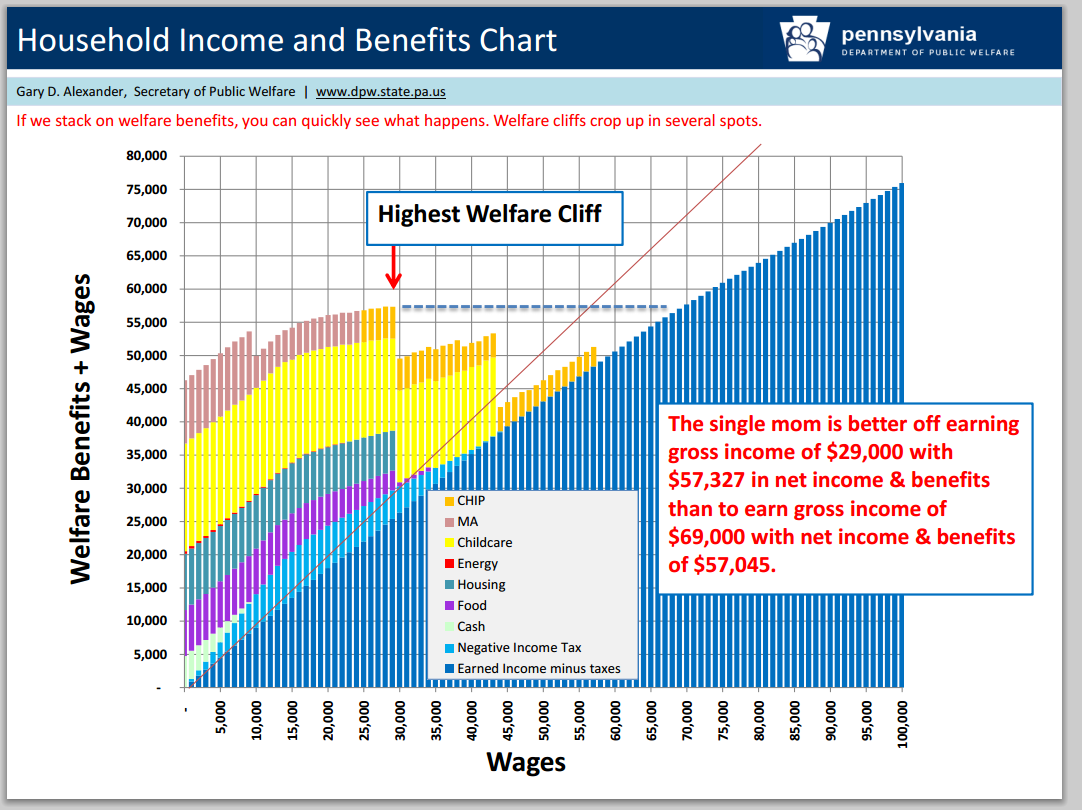
1) There is a welfare trap, and it is real. The more needy you are, the more your welfare programs are robbed with each wage increase. The marginal rate is very high and in some situations can exceed 100%.
Here's what the welfare trap looks like for low-wage families, in one graph: https://lh3.ggpht.com/-_-6Fsycanmw/ULO_5kk3fxI/AAAAAAAAAU4/y...
taken from: http://johnhcochrane.blogspot.com/2012/11/taxes-and-cliffs.h...
If you follow economics there is an astonishing difference in the quality of discourse between the two sides--the pro minimum-wage crowd does not seem aware of the data working against them.
2) There is furthermore research suggesting employers respond to minimum wage by scaling back future employment plans and by causing workers to work harder. Part of the reason minimum wage jobs are so awful is if they weren't, they would not be worth the money.
3) People think of minimum wage as a redistribution of wealth from evil corporate employers and rich consumers to the poor and needy. Notwithstanding who is evil and who is good, that is basically the effect. You can accomplish the same thing in a much simpler, market-friendly fashion: pay the poor for working. A minor version of this program exists--the earned income tax credit. It does the same thing as minimum wage--redistribution of wealth--without the overhead, without reducing workers' negotiating power, and without pricing new low-skill workers out. It can be done in a fashion that greatly reduces the welfare trap. For a while, this idea had broad bipartisan support, from Milton Friedman and Paul Krugman among others.
But now economists argue about minimum wage because it's an attractive political issue. Famously, Paul Krugman's opinion on minimum wage changes depending on who is president.
Bleh. Imagine if climate scientists or evolutionary biologists made political compromises. Worse yet, imagine if they started believing their own compromises.
4) Surveys are not of particularly high interest when it comes to discussing economics. Talking about theory, data, and consequences is a better use of time. Surveys are only social proof--backup evidence--when there is not a confident consensus.
Re: California poised to raise minimum wage to $10
#33Earlier quoted context omitted.
I don't get this.. Is the theory here that companies have $X in a bucket to pay staff, Employees each make $Y, so X/Y is the number of employees? Because that's not how it happens at all. Companies don't hire more staff than they require. If McDonalds needs 10 employees per shift to operate, they're going to hire 10 per shift no matter if they cost $8/hr or $16/hr. The amount of work determines the number of employee…
The general principle is that an employee has to cost less than the money they bring in. The best HN-related example is that if you work for a software development firm, and if they bill you out to clients at $100 an hour, your total cost to them (your hourly wage + taxes + healthcare + benefits + extra) has to be less than $100. To properly phrase your example, yes it is depend on "work", but work is dependent on re…
That's not strictly true. If you have two programmers, one produces $80 in value per hour and the other only $40 in value per hour you can still afford to pay both $60/hr each. This happens all the time because worker productivity is uneven and some jobs are more important/impactful than others. The requirement that revenue exceed costs is only true in aggregate, so the effect of increasing low-wage employee cost is to reduce profits.
Re: California poised to raise minimum wage to $10
#34Now watch teen unemployment jump, and prepare for a future generation of people who couldn't get early work experience, and so become less employable in the long-run.
Re: California poised to raise minimum wage to $10
#35I'd really like to see an experiment conducted that can put the whole debate to rest: raise the minimum wage in half of the states, lower it in the other half. Run this experiment for three years and compare the results, and apply the strategy with the best outcome to the rest of the country.
However, if all states have a 10$ minimum wage then there's no easy substitute, except for going to another country, but that's much more complex.
Re: California poised to raise minimum wage to $10
#36I'm going to head off all the armchair economists, including the two* who have already replied as of 15 minutes after the article was posted. http://www.igmchicago.org/igm-economic-experts-panel/poll-re... Here's a real survey of actual economists, who largely agree, weighted by confidence, that "The distortionary costs of raising the federal minimum wage to $9 per hour and indexing it to inflation are sufficiently s…
The question "The distortionary costs of raising the federal minimum wage to $9 per hour and indexing it to inflation are sufficiently small compared with the benefits to low-skilled workers who can find employment that this would be a desirable policy." contains asssumptions that are very objectionable to someone trained in economics. To most economists, it is wrong to think of the minimum wage as a tradeoff between…
Maybe because they need the money?
Re: California poised to raise minimum wage to $10
#37Earlier quoted context omitted.
The question "The distortionary costs of raising the federal minimum wage to $9 per hour and indexing it to inflation are sufficiently small compared with the benefits to low-skilled workers who can find employment that this would be a desirable policy." contains asssumptions that are very objectionable to someone trained in economics. To most economists, it is wrong to think of the minimum wage as a tradeoff between…
In particular, why do we want to benefit workers on the minimum wage? Maybe because they need the money?
Re: California poised to raise minimum wage to $10
#38Now watch teen unemployment jump, and prepare for a future generation of people who couldn't get early work experience, and so become less employable in the long-run.
Not even an iota.
Businesses need those employees anyway. And the impact of an increased minimum wages is minimal. They pay them less not because paying them more would drive them out of business or really eat into their margins, but just because they can.
And it's not just teens. TONS of people work on minimum wage jobs that are older, including over fifty.
Re: California poised to raise minimum wage to $10
#39Earlier quoted context omitted.
I don't get this.. Is the theory here that companies have $X in a bucket to pay staff, Employees each make $Y, so X/Y is the number of employees? Because that's not how it happens at all. Companies don't hire more staff than they require. If McDonalds needs 10 employees per shift to operate, they're going to hire 10 per shift no matter if they cost $8/hr or $16/hr. The amount of work determines the number of employee…
The general principle is that an employee has to cost less than the money they bring in. The best HN-related example is that if you work for a software development firm, and if they bill you out to clients at $100 an hour, your total cost to them (your hourly wage + taxes + healthcare + benefits + extra) has to be less than $100. To properly phrase your example, yes it is depend on "work", but work is dependent on re…
This is a simplistic example and assumes unlimited supply of labor, but it illustrates the point.
The result is that the unskilled end of the spectrum are too expensive in relation to their productivity. These are the ones who end up unemployed.
I am not an economist, but that is how I understand it.
Re: California poised to raise minimum wage to $10
#40Rather than paying people more to flip burgers, I think it's better policy to top them off with cash and incentivize them to earn more money by getting better jobs.
The EIC is a form of Negative Income Tax that was originated by Milton Friedman. http://www.econlib.org/library/Enc1/NegativeIncomeTax.html