Reproducibly through measurements has a lot of value if you do not have a coach like the author for his mother. Yes a lot of recipes can be handed down but the space of recipes is so much larger. We don‘t need books as we can tell stories and this bring out the feel so much better is true but where would we be without the encyclopedia.
The anxiety of the perfect loaf: the illusion of culinary precision
31–40 of 41 posts
Re: The anxiety of the perfect loaf: the illusion of culinary precision
#32> Viewed through this lens, the modern illusion of control shatters, but something much more liberating takes its place. The recipe is a suggestion. The rules of baking — baker’s percentages, hydration levels, the established ratio of flour-to-water-to-fat — are the underlying framework. This is the scaffolding. Look, the author isn't technically wrong. But also, I have to point out that the reason for all the contro…
It's more than just reproducing the standard flavor. By not measuring sometimes you'll get something very good, but because you didn't measure anything you won't know what you did that caused it to be good and won't be able to do it again.
Measuring doesn't preclude experimentation. You should copy your recipe, mark what changes you plan to make, then try it. If it works, you have a record. If it doesn't work, you can add a memo to know not to try that again.
Re: The anxiety of the perfect loaf: the illusion of culinary precision
#33Earlier quoted context omitted.
Eh, I found the Seattle artisanal bakeries (Fremont, Grand Central) to be better than all but the best I’ve found in Europe.
Yeah there are a lot of great bakeries in the US; you just need to know where they are.
And there are a lot of middling bakeries in Europe.
Haven't spent much time in Belgium, but I was disappointed in the average quality of the bread in small bakeries in France. There was one awesome organic bakery in Paris near the catacombs tour, and one hypermarche (forget where) that somehow had an absolutely incredible rustic baguette. But the little shops in towns, eh. And most of the hypermarches. Germany is also kind of average, the Reve bakeries are reliably on the good side of middling, but nothing that I'd consider incredible.
Re: The anxiety of the perfect loaf: the illusion of culinary precision
#34“In the end, if I’m successful, I’ll have this one bread recipe adapted/developed, and if written out comprehensively for someone else (even future me), it will likely be >4 pages.”
https://garrickvanburen.com/only-finding-the-non-obvious-mat...
Re: The anxiety of the perfect loaf: the illusion of culinary precision
#35Earlier quoted context omitted.
Reproducibility requires more than just measuring ingredients , however, as other characteristics can greatly change results. Leaven viability, flour moisture content, relative humidity, ambient temperature, and accidents of a home-baker's process (did you get interrupted by a child / work / partner / household exigency during your dough prep or bake) all have pretty sharp impacts on results. Precise reproducibility…
Also, elevation: lower air pressure creates shorter rise times. Us high altitude bakers have to constantly take this into account (more for things like bread, less for "chemical rises" based on baking soda etc. etc.)
We're discussing variation by a single cook. Obviously elevation matters, but noting the correction just once ensures consistent product for a lifetime.
Re: The anxiety of the perfect loaf: the illusion of culinary precision
#36> Viewed through this lens, the modern illusion of control shatters, but something much more liberating takes its place. The recipe is a suggestion. The rules of baking — baker’s percentages, hydration levels, the established ratio of flour-to-water-to-fat — are the underlying framework. This is the scaffolding. Look, the author isn't technically wrong. But also, I have to point out that the reason for all the contro…
I worked at a culinary school for a while. In the bread kitchen they taught you the formula stuff, but also, to recognize what the dough would feel like, look like, even taste like, when it was right. They taught you how to adapt if the flour was a little drier today than yesterday, if the kitchen was a little more humid.
Yes, 95-99% of bread's mass is a strongly hydrophilic raw material, and the percentage of water in the precooked product is vital to the outcome. It's obvious the best one can do is to get the dough into the general vicinity of "good enough", and then adjust by other indicators.
Re: The anxiety of the perfect loaf: the illusion of culinary precision
#37> Viewed through this lens, the modern illusion of control shatters, but something much more liberating takes its place. The recipe is a suggestion. The rules of baking — baker’s percentages, hydration levels, the established ratio of flour-to-water-to-fat — are the underlying framework. This is the scaffolding. Look, the author isn't technically wrong. But also, I have to point out that the reason for all the contro…
> You'll even get better at it till you usually get something good. This is the crux. Sure, if I bake a loaf of odd bread every couple of days, I will EVENTUALLY get good enough to produce something good rather than just edible. After how long? A week? A month? A YEAR? So, in the interim, I am WASTING those ingredients and my time. I liken this to knife sharpening. Sure, EVENTUALLY you will get the feel for sharpenin…
Off-topic: what finally allowed me to gain the ability for high sharpening on a whetstone was watching a YT video of a master at the craft who worked slowly [0].
He wasn't one of those chefs doing the whoosh-whoosh-whoosh and it's sharp off a hone, nor even on the stone. He stared and concentrated and carefully made each pass.
That leads to a lot of idiocy out there. I've twice handed knives to (amateur) others only to find them duller after "sharpening" than before. One had a hone; the other had a diamond-grit stone.
The muscle memory to keep your edge at the same angle through the draw along a curved knife face takes a looooong time to perfect. He didn't trust in it; he always watched and moved with care.
Once I accepted that as the end goal, I too could get knives that routinely shaved paper.
[0]: OUTDOORS55 https://www.youtube.com/watch?v=pagPuiuA9cY
Re: The anxiety of the perfect loaf: the illusion of culinary precision
#38Speaking of loafs and culinary precision, from my father's side they always used single cut even to get half of loaf, I used 2 cuts when I wanted half loaf and that annoyed them because when they wanted full loaf after me, they first had to remove my remaining half loaf. How do you cut your bread, single cut (wedge) or double cut?
What??? Can someone translate this?
Re: The anxiety of the perfect loaf: the illusion of culinary precision
#39Earlier quoted context omitted.
Also, elevation: lower air pressure creates shorter rise times. Us high altitude bakers have to constantly take this into account (more for things like bread, less for "chemical rises" based on baking soda etc. etc.)
We're discussing variation by a single cook. Obviously elevation matters, but noting the correction just once ensures consistent product for a lifetime.
This might conceivably vary according to local geology, though other considerations might tend to dominate in that case.
Or if your kitchen is installed in one of the elevators of the Burj Khalifa.
;-)
Re: The anxiety of the perfect loaf: the illusion of culinary precision
#40Speaking of loafs and culinary precision, from my father's side they always used single cut even to get half of loaf, I used 2 cuts when I wanted half loaf and that annoyed them because when they wanted full loaf after me, they first had to remove my remaining half loaf. How do you cut your bread, single cut (wedge) or double cut?
What??? Can someone translate this?
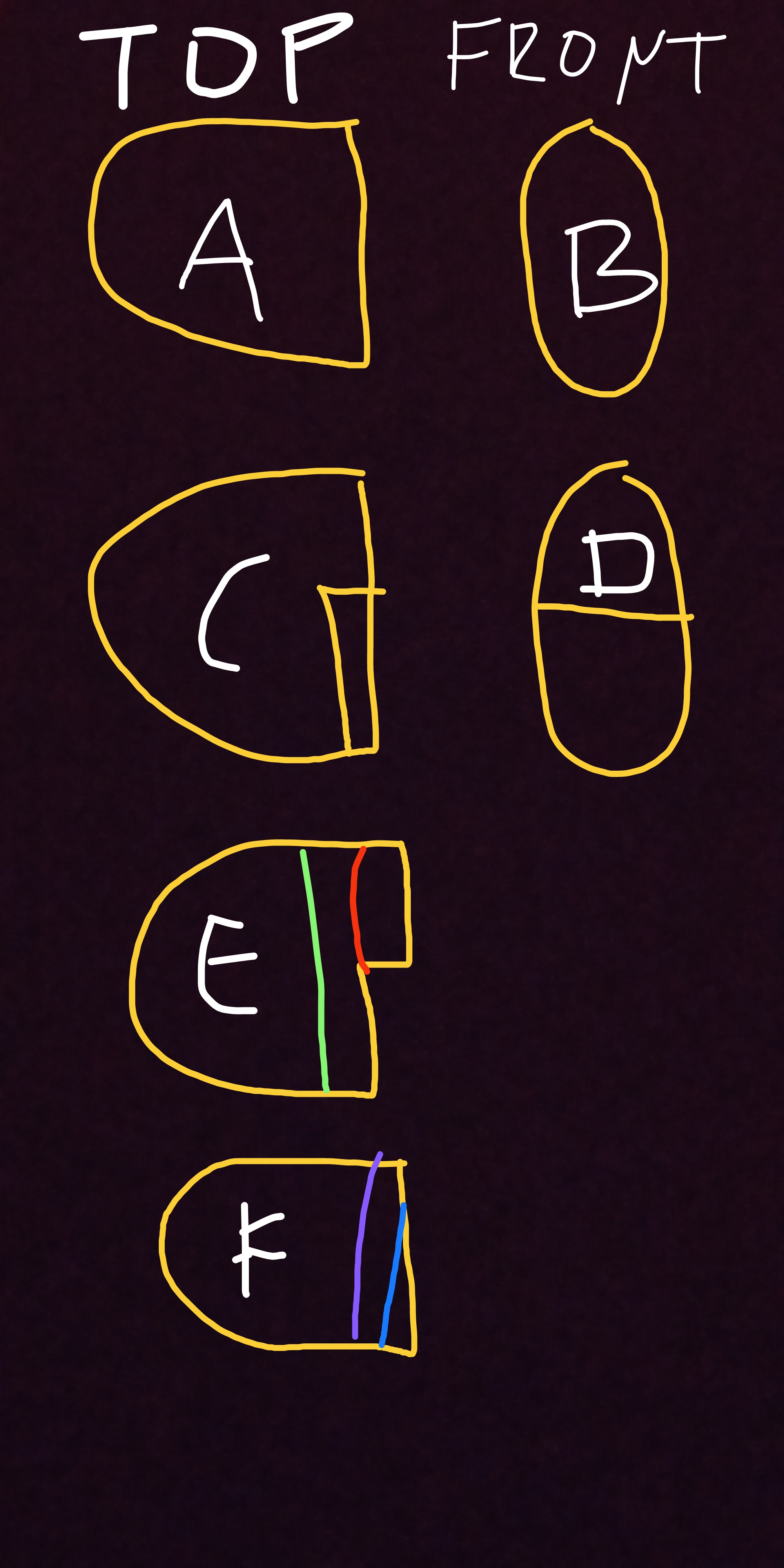
I drawn simple diagram. On the left side are top views of the bread, right side are front cut side. A is half of entire bread, like half eaten. Let's say I want half loaf, I cut half of the bread width and then one short perpendicular cut to separate half loaf. That is C view.
Now if someone goes after me and they want half loaf, no problem, in E they make red cut and they have they half loaf. But if they want full loaf, they still have to cut half loaf first and then they make green cut to get their full loaf.
This annoys them because they use wedge cut F. If you want half you make blue cut, if you want full loaf you make purple cut. Face of the bread is always flat so you can always make half bread or full bread with single cut.