Live data from Hacker News

'Backrooms' and the Rise of the Institutional Gothic

thereader.mitpress.mit.edu

31–40 of 119 posts

Re: 'Backrooms' and the Rise of the Institutional Gothic

#31
post #8

I don’t really get the nostalgia angle as it seems as many of those who are into this kind of thing are too young to have ever been in such a space, let alone worked in one. I’ve worked in a place like this that was well past its prime and though uncanny, it’s certainly not creepy. The illusion of infinitely twisting, identical corridors simply doesn’t hold up when you’re actually in a space like this, but only works…

> The illusion of infinitely twisting, identical corridors simply doesn’t hold up when you’re actually in a space like this, but only works if you’ve only ever seen these kinds of spaces from a still photograph on the internet (which is why the audience for this sort of thing is too young to have ever experienced it themselves).

I'm not sure if that's true. I've definitely been to places that feel intentionally confusing; the basement of my college, several hospitals, etc. Where you walk between two buildings, and suddenly go from Floor 4 to Floor 6, or where you're sure you entered facing north, but after making three right-hand turns, you exit a building facing south.

Re: 'Backrooms' and the Rise of the Institutional Gothic

#32

The article has a screenshot of the Stanley Parable, but misses an opportunity to reference Control (2019) which is much more directly influenced by the "liminal space" concept, and imagines a non-euclidian space called The Oldest House at 34 Thomas Street (a reference to the brutalist, windowless AT&T Long Lines skyscraper at 33 Thomas Street, New York City). https://www.youtube.com/watch?v=F74LLDhAhhI It also very…

The Stanley Parable definitely plays with non-euclidean and liminal spaces - the room in the screenshot being one such example.

It does, but its main focus is ludonarrative dissonance, which is why Control would be a better example (along with games that specifically invoke Backrooms lore, like POOLS)

Re: 'Backrooms' and the Rise of the Institutional Gothic

#33
post #21

Earlier quoted context omitted.

The concept did not originate in videogames. The whole thing started from a 4chan post where someone posted a photo of a yellow interior. Then, in 2022, Kane Parsons created a viral YouTube video based on that post. You can see it here: https://youtube.com/watch?v=H4dGpz6cnHo . The video game adaptations all came later. Wikipedia has a good writeup here: https://en.wikipedia.org/wiki/The_Backrooms

I've had dreams like this - I think a lot of people have - where you find yourself trapped in a space, an office or a mall or wherever, one common version seems to be a public bathroom - and you keep moving through an endless maze of doors that lead nowhere. The article has it wrong, this was a archetype of the human collective unconscious well before 4chan turned it into a meme.

Which article is wrongm Both the article and Wikipedia entry focus on The Backrooms which are a type of liminal space. Yes, liminal spaces have existed in fiction, dreams, etc. However, here the discussion is on The Backrooms and how that idea and aesthetic became very popular very quickly.

Re: 'Backrooms' and the Rise of the Institutional Gothic

#34

While the Backrooms movie trailer does make it look interesting, "Backrooms" / liminal horror / Skinamarink all have the same effect on me: nothing. I figure the split of people who find it scary vs those that don't is people who can "unscare" themselves. Like when I go into my basement at night, I can give myself the scare of "what if someone's watching ..." then go "nah" and I'm fine.

I'm not sure if it's even meant to be scary. I think of the Backrooms as closer to the world of Piranesi, or the project that took a bunch of virtual-tours of apartments for rent, and aggregrated them all into a single mega-building.

The Backrooms and Skinamarink are both classified as horror.

Re: 'Backrooms' and the Rise of the Institutional Gothic

#35

The Backrooms have always reminded me of House of Leaves and the Navidson Record within specifically. (I think maybe that's a deliberate influence in the lore?) So I like how the movie's plot seems to be similar as well.

I think there's a bit of a convergent evolution House Of Leaves is similiar to Backrooms in a way - they represent the same kinds of horror but it's more like how Weird Fiction converged and inspired in the same way. There's a level of early slenderman there as well (in terms of a lot of the early slenderman horror being more about the horror of dreaming this entity into the real) I'd argue SCP Foundation is probably…

> I'm not really smart enough to know what it means - probably something about modern society dissassociating people from the space, but don't know much more.

I think it has something to do with the controlled comfort of modern life. And how even a small disruption can become unsettling.

Like in HoL, the most chilling scene isn't anything that happens beyond the door imo. It's when the book falls because the house changed size ever so slightly. I think the classic haunted house trope is at play there too - home is comfort but those stories frequently involve a move, which is inherently stressful. I remember when I bought my house..every new noise or small change was disturbing. Potentially a hidden horror lurking in the house (like a water leak).

Re: 'Backrooms' and the Rise of the Institutional Gothic

#36
Dreams I've had (since a late teenager) have often taken place in some kind of architecture with infinite rooms, hallways…

I wrote a computer game where a paper airplane flies room to room… It occurred to me that I was not indirectly surfacing this "endlessly scrolling building" that has recurred so often in what I suppose are nightmares(?).

At the same time, memory being what it is, I worry that the reverse is true—that the game I write inspired the nightmares (and that I now miss-remember when they began, misattribute them to my teenage years).

There is at times a feeling of infinite possibility when I find myself in these places while dreaming. I always enjoy exploring new places and so a place with infinite rooms, hallways, floors is going to keep me busy.

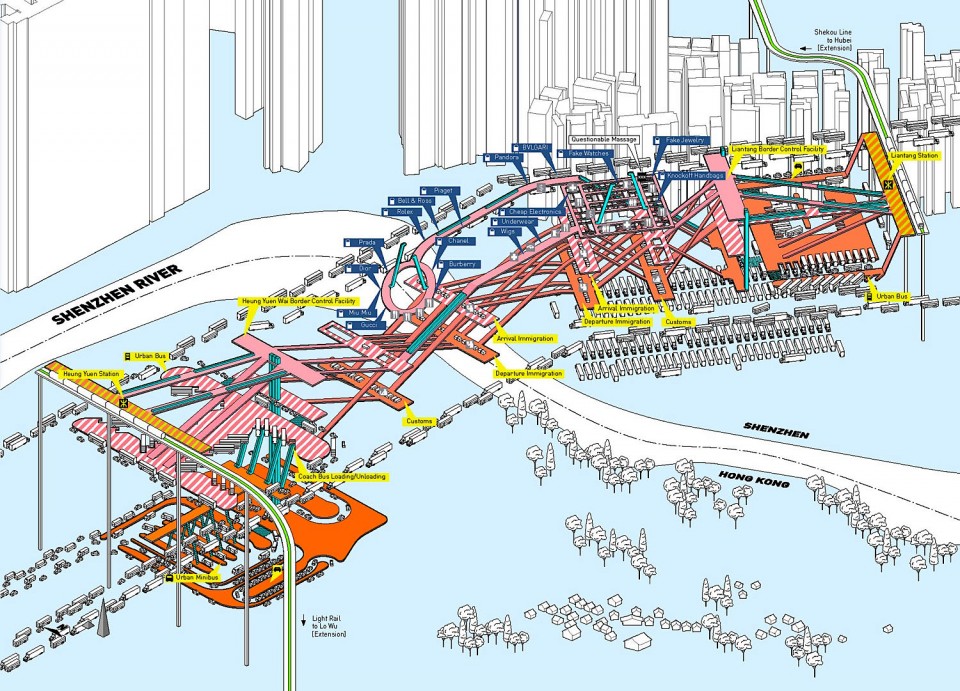
When I learned of Kowloon Walled City [1][2], that caught my attention. I've seen too descriptions of the underground portions of Hong Kong [3] that let you move from place to place without every stepping outside. The movie "Chungking Express" gives off that vibe [4]. The imaginary prisons of Giovanni Battista Piranesi [5].

[1] https://www.visualcapitalist.com/wp-content/uploads/2017/09/...

[2] http://lh5.googleusercontent.com/-xI_c78etYDc/T61_qAwHWFI/AA...

[3] https://weburbanist.com/wp-content/uploads/2014/05/hong-kong...

[4] https://youtu.be/0uMekCFDnkI

[5] https://en.wikipedia.org/wiki/Carceri_d%27invenzione

Re: 'Backrooms' and the Rise of the Institutional Gothic

#37

Earlier quoted context omitted.

The Stanley Parable definitely plays with non-euclidean and liminal spaces - the room in the screenshot being one such example.

It does, but its main focus is ludonarrative dissonance, which is why Control would be a better example (along with games that specifically invoke Backrooms lore, like POOLS)

I was actually a little surprised there was no mention of Escape the Backrooms, although I suppose The Stanley Parable is a better-known game.

Re: 'Backrooms' and the Rise of the Institutional Gothic

#38

Earlier quoted context omitted.

>"Backrooms" don't just come from videogames It's where the concept originated.

The concept did not originate in videogames. The whole thing started from a 4chan post where someone posted a photo of a yellow interior. Then, in 2022, Kane Parsons created a viral YouTube video based on that post. You can see it here: https://youtube.com/watch?v=H4dGpz6cnHo . The video game adaptations all came later. Wikipedia has a good writeup here: https://en.wikipedia.org/wiki/The_Backrooms

>The concept did not originate in videogames.

Yes it did. "noclipping out of reality" is a metaphor that is nonsense outside the context of videogame worlds. The 4chan copypasta that popularized the Backrooms meme doesn't mention video games but that particular post is not the origin of the backrooms concept.

There are literal backrooms you can noclip into existing in games that that predate that 4chan post by several years

Re: 'Backrooms' and the Rise of the Institutional Gothic

#39

The Backrooms have always reminded me of House of Leaves and the Navidson Record within specifically. (I think maybe that's a deliberate influence in the lore?) So I like how the movie's plot seems to be similar as well.

I think there's a bit of a convergent evolution House Of Leaves is similiar to Backrooms in a way - they represent the same kinds of horror but it's more like how Weird Fiction converged and inspired in the same way. There's a level of early slenderman there as well (in terms of a lot of the early slenderman horror being more about the horror of dreaming this entity into the real) I'd argue SCP Foundation is probably…

House Of Leaves was published in 2000 and Backrooms originates (as far as I can tell) from like 2011? Not that it's impossible that the ideas developed independently, but given how big a cult hit House of Leaves was I'd be very surprised if there wasn't some direct lineage. Not trying to gatekeep, it's just that the Backroom trailer was giving me _really distinct_ HoL vibes. I wonder if that's just the film mixing in ideas that weren't necessarily present in the original copypasta.

edit: Another thing I will say is that I've noticed both HoL and Backrooms seem to act like a kind of shibboleth for a particular demographic (not even really the same demographic) and you often see this in how people write/talk about both. I think it maybe stems from how dense/unapproachable the two works are, how innocuous they seem on the surface such that you really have to sink some effort to get at them.

Post reply on HN