Live data from Hacker News

Trinity large: An open 400B sparse MoE model

arcee.ai

31–40 of 83 posts

Re: Trinity large: An open 400B sparse MoE model

#31
post #3

They trained it in 33 days for ~20m (that includes apparently not only the infrastructure but also the salaries over a 6 month period). And the model is coming close to QWEN and Deepseek. Pretty impressive

They didn't do something stupid like Llama 4 "one active expert", but 4 of 256 is very sparse. It's not going to get close to Deepseek or GLM level performance unless they trained on the benchmarks.

I don't think that was a good move. No other models do this.

Re: Trinity large: An open 400B sparse MoE model

#33

Given that it's a 400B-parameter model, but it's a sparse MoE model with 13B active parameters per token, would it run well on an NVIDIA DGX Spark with 128 GB of unified RAM, or do you practically need to hold the full model in RAM even with sparse MoE?

No.

128GB vram gets you enough space for 256B sized models. But 400B is too big for the DGX Spark, unless you connect 2 of them together and use tensor parallel.

Re: Trinity large: An open 400B sparse MoE model

#34

Earlier quoted context omitted.

It'd certainly be odd if people were recommending old LLMs which score worse, even if marginally. That said, 4o is really a lot more usable than you're making it out to be. The particular benchmark in the example is fungible but you have to pick something to make a representative example. No matter which you pick someone always has a reason "oh, it's not THAT benchmark you should look at". The benchmarks from the cha…

Frankly, this reads as a lot of words that amount to an excuse for using only LMArena, and the rationale is quite clear: it’s for an unrelated argument that isn’t going to ring true to people, especially an audience of programmers who just spent the last year watching the AI go from being able to make coherent file edits to multi hour work. LMArena is, de facto, a sycophancy and Markdown usage detector. Two others yo…

I've always found LiveBench a bit confusing to try to compare over time as the dataset isn't meant to be compared over time. It also currently claims GPT-5 Mini High from last summer is within ~15% of Claude 4.5 Opus Thinking High Effort in the average, but I'll wait with bated breath for the millions of amazing apps which couldn't be coded before to start showing up (or, more likely, be told in 6 months how these 2 benchmarks weren't the ones that should matter either). Artificial Analysis at least has the same at 20% from the top, so maybe that's the one we all agree to use for now since it implies faster growth.

> FWIW GPT 5.2 unofficial marketing includes the Erdos thing you say isn’t happening.

Certainly not, unless you're about to tell me I can pop into ChatGPT and pop out Erdos proofs regularly since #728 was massaged out with multiple prompts and external tooling a few weeks ago - which is what I was writing about. It was great, it was exciting, but it's exactly the slow growth I'm talking about.

I like using LLMs, I use them regularly, and I'm hoping they continue to get better for a long time... but this is in no way the GPT 3 -> 3.5 -> 4 era of mind boggling growth of frontier models anymore. At best, people are finding out how to attach various tooling to the models to eek more out as the models themselves very slowly improve.

Re: Trinity large: An open 400B sparse MoE model

#35
post #8

The only thing I question is the use of Maverick in their comparison charts. That's like comparing a pile of rocks to an LLM.

It's because they're doing 4 of 256 sparsity, which was a bad decision caused by financial limitations.

Training cost (FLOPs) = 6 * active params * total tokens. By keeping the MoE experts param count low, it reduces total training costs.

I don't think this was a good move. They should have just trained way past chinchilla like the other major labs, and keep sparsity above 2%. Even Kimi K2 is above 2%. GLM is at 5%, which makes it very expensive (and high performing) for its small size.

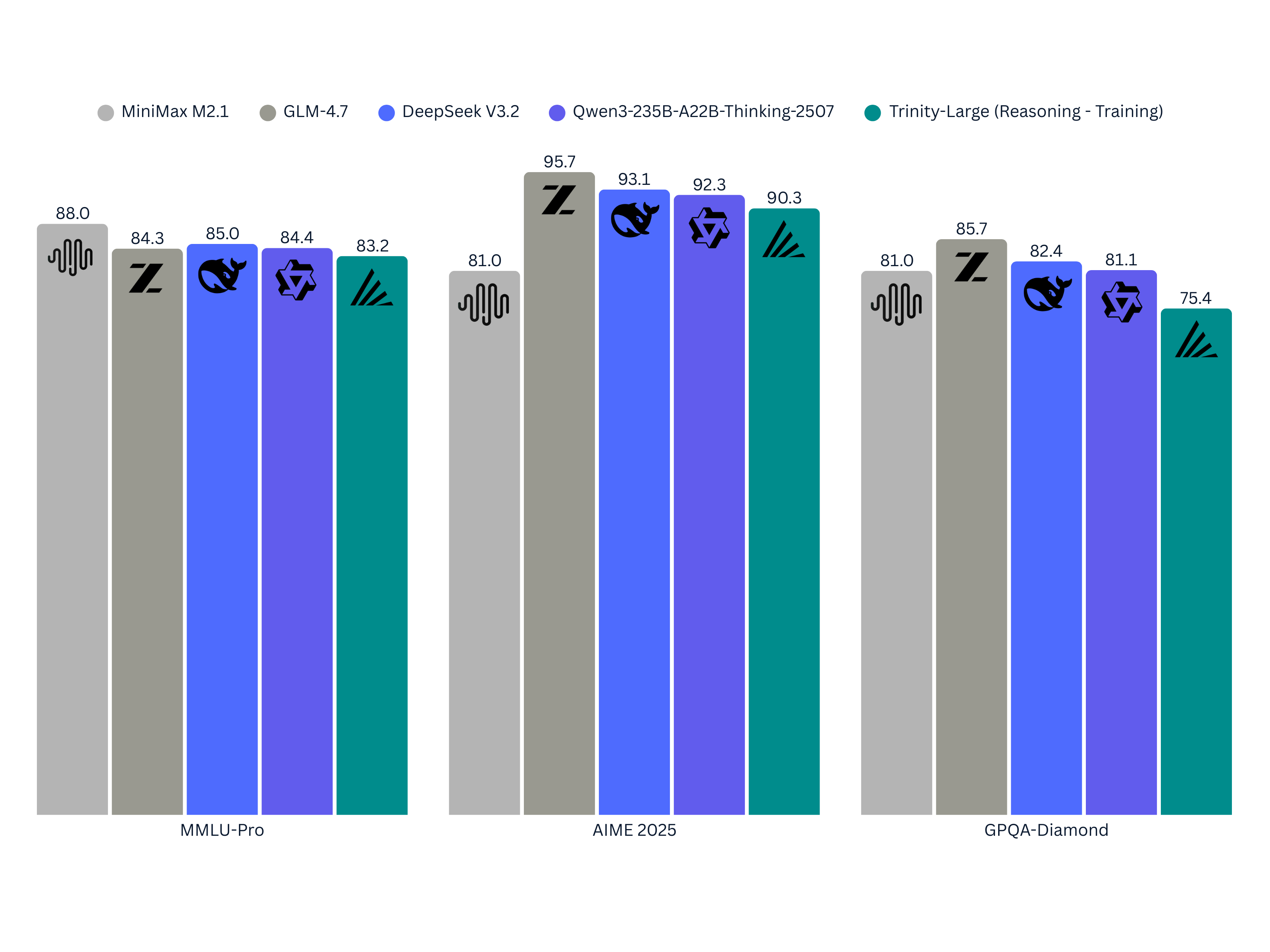
Arcee went the other way. They trained a massive 400b model (bigger than GLM-4.5/4.6/4.7, bigger than Qwen3 235b A23b), but only have 17b active params, which is smaller than Qwen and GLM. It's also only trained on 17T tokens, vs 20-30T+ tokens for the other models. It's just undertrained and undersized (in terms of active parameters), and they got much worse performance than those models:

https://45777467.fs1.hubspotusercontent-na1.net/hubfs/457774...

It's not a bad showing considering the limitations they were working with, but yeah they definitely need double the active experts (8 out of 256 instead of 4 out of 256) to be competitive. That would roughly double the compute cost for them, though.

Their market strategy right now is to have less active params so it's cheaper for inference, more total params so it's smarter for the amount of active params they have, but not too big to fit into a H200 cluster. I... guess this is a valid niche strategy? The target audience is basically "people who don't need all the intelligence of GLM/Qwen/Deepseek, but want to serve more customers on the H200 cluster they already have sitting around". It's a valid niche, but a pretty small one.
Re: Trinity large: An open 400B sparse MoE model

#38
post #20

Earlier quoted context omitted.

> E.g. gemini-3-pro tops the lmarena text chart today at 1488 vs 1346 for gpt-4o-2024-05-13. That's a win rate of 70% (where 50% is equal chance of winning) over 1.5 years. Meanwhile, even the open weights stuff OpenAI gave away last summer scores between the two. Why do you care about LM Arena? It has so many problems, and the fact that no one would suggest using GPT-4o for doing math or coding right now, or much of…

It'd certainly be odd if people were recommending old LLMs which score worse, even if marginally. That said, 4o is really a lot more usable than you're making it out to be. The particular benchmark in the example is fungible but you have to pick something to make a representative example. No matter which you pick someone always has a reason "oh, it's not THAT benchmark you should look at". The benchmarks from the cha…

Progress has not become linear. We've just hit the limits of what we can measure and explain easily.

One year ago coding agents could barely do decent auto-complete.

Now they can write whole applications.

That's much more difficult to show than an ELO score based on how people like emjois and bold text in their chat responses.

Don't forget Llama4 led Lmarena and turned out to be very weak.

Re: Trinity large: An open 400B sparse MoE model

#39

Earlier quoted context omitted.

Frankly, this reads as a lot of words that amount to an excuse for using only LMArena, and the rationale is quite clear: it’s for an unrelated argument that isn’t going to ring true to people, especially an audience of programmers who just spent the last year watching the AI go from being able to make coherent file edits to multi hour work. LMArena is, de facto, a sycophancy and Markdown usage detector. Two others yo…

I've always found LiveBench a bit confusing to try to compare over time as the dataset isn't meant to be compared over time. It also currently claims GPT-5 Mini High from last summer is within ~15% of Claude 4.5 Opus Thinking High Effort in the average, but I'll wait with bated breath for the millions of amazing apps which couldn't be coded before to start showing up (or, more likely, be told in 6 months how these 2…

> I'll wait with bated breath for the millions of amazing apps which couldn't be coded before to start showing up

Appstore releases were roughly linear until July 25 and are up 60% since then:

https://www.coatue.com/c/takes/chart-of-the-day-2026-01-22

Re: Trinity large: An open 400B sparse MoE model

#40
post #3

They trained it in 33 days for ~20m (that includes apparently not only the infrastructure but also the salaries over a 6 month period). And the model is coming close to QWEN and Deepseek. Pretty impressive

I'll straight up accuse them of on purpose muddying the waters. To get to the point of executing a successful training run like that, you have to count every failed experiment and experiment that gets you to the final training run. They spent well over 100 Million to train this model by that definition, and all definitions which don't include the failed runs up to the successful one at the end are at best disingenuous and at worst outright lies designed to trick investors into dumping Nvidia.

No, deepseek did not spend only 5.5 million for Deepseek V3. No Gemini was not "entirely trained on TPUs". They did hundreds of experiments on GPUs to get to the final training run done entirely on TPUs. GCP literally has millions of GPUs and you bet your ass that the gemini team has access to them and uses them daily. Deepseek total cost to make Deepseek V3 is also in the 100-400 million range when you count all of what's needed to get to the final training run.

Edit: (Can't post cus this site's "posting too fast" thing is really stupid/bad)

The only way I can get reliable information out of folks like you is to loudly proclaim something wrong on the internet. I'm just going to even more aggressively do that from now on to goad people like you to set the record straight.

Even if they only used TPUs, they sure as shit spent orders of magnitude more than they claim due to "count the failed runs too"

Post reply on HN