Live data from Hacker News

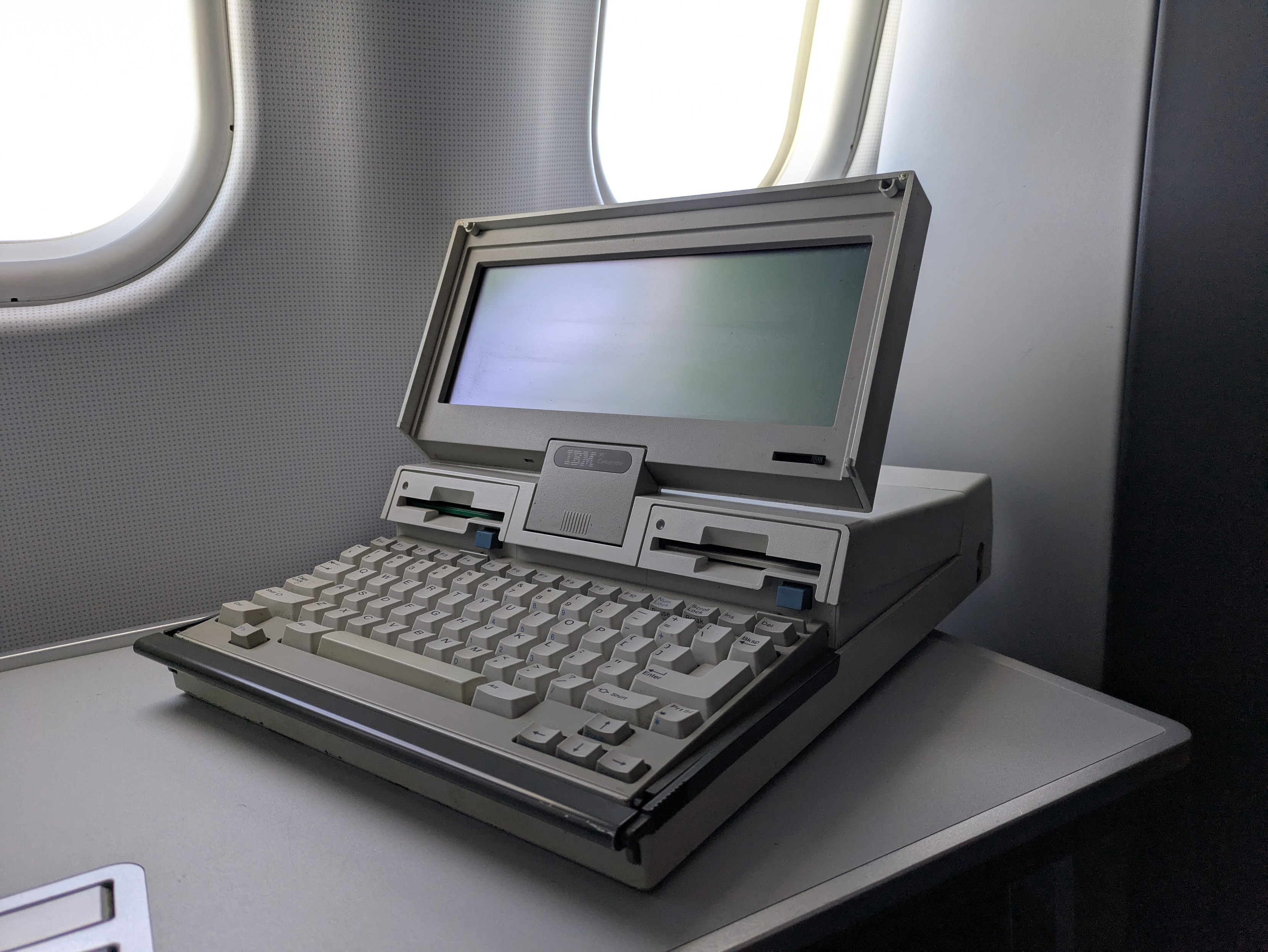
Mod. 5140 - IBM's First Laptop Computer

richardsapperdesign.com

31–40 of 45 posts

Re: Mod. 5140 - IBM's First Laptop Computer

#31
post #5

I used to have NEC MobilePro 900 like here: https://live.staticflickr.com/213/481422006_92cdaeb6ee_b.jpg I miss that form factor really. And BTW, I regret that WindowsCE is not the thing anymore. IMO it has the best development infrastructure out there backed with MSVC IDE. I classify OSes into two major groups: "writer OS" (all desktop OSes primarily) and "reader OS" (all mobiles). But there is a void in between for…

You may like this: https://kingjim.us/products/pomera-full-suite-typewriter-for...

Or a reMarkable with the addon keyboard!
Re: Mod. 5140 - IBM's First Laptop Computer

#32

When I was a co-op student employee at IBM in the late 80s, I was given a desk in what was otherwise a storage room piled with stuff that had been used and then set aside. One box contained a 5140 convertible laptop with one of each peripheral "slice" -- printer, modem, expansion ports -- and the full set of technical manuals. I was allowed to take that beast home with me. I learned so much tinkering with that machin…

Any details to share re. specs, operating system?

I had one. Great little system. Built like a tank, and just as heavy.

Incredibly forward-thinking modular architecture. Keyboard, memory, drives, serial port, parallel port, even the screen could be replaced just by the turn of a lever or a push of a button.

Fantastic keyboard, even by today's laptops standards.

Ate batteries like M&Ms. I almost always kept it plugged in.

At the time, running it off the pair of 720k floppies was fine. I believe there was a hard drive option, but I never saw it.

Its biggest weakness was the screen. There were backlit and CRT options, which were better and you could just pop off and in.

The screen was grayscale CGA, but there was a TSR called SimCGA which would translate, so you could run EGA programs.

Re: Mod. 5140 - IBM's First Laptop Computer

#33

Earlier quoted context omitted.

Maybe you can answer this then. Back in the early 80’s, Radio Shack made the TRS-80 Model 100 laptop. It ran for 20+ hours on 4 AA batteries. A few years later, Psion came out with a series of small devices that ran on 2 AA batteries and got 30+ hours of runtime. With modern electronics and displays, could something like a model 100 be made that could run for hundreds or even thousands of hours on 4 AA batteries?

> With modern electronics and displays Wouldn’t the second part work against the first? There’s a lot of pixels you need to push to refresh a good modern display. I guess you could use a bad (as in low-res) modern display, but I wouldn’t expect those to be particularly concerned with energy efficiency either, just cheap.

Yeah, the above referenced TRS-80 Model 100 had a 240x64 monochrome display with no backlight. No surprise it didnt use much power.

Re: Mod. 5140 - IBM's First Laptop Computer

#34

Earlier quoted context omitted.

Maybe you can answer this then. Back in the early 80’s, Radio Shack made the TRS-80 Model 100 laptop. It ran for 20+ hours on 4 AA batteries. A few years later, Psion came out with a series of small devices that ran on 2 AA batteries and got 30+ hours of runtime. With modern electronics and displays, could something like a model 100 be made that could run for hundreds or even thousands of hours on 4 AA batteries?

> With modern electronics and displays Wouldn’t the second part work against the first? There’s a lot of pixels you need to push to refresh a good modern display. I guess you could use a bad (as in low-res) modern display, but I wouldn’t expect those to be particularly concerned with energy efficiency either, just cheap.

A low-res display would be fine. In fact the same display as the original Model 100 would be great.

A sibling mentioned e-ink and that might be ideal. With a fast enough CPU and race-to-sleep scheduling, the machine would mostly be in a low power idle mode.

I think the temptation for a lot of designers here would be to use Linux and I think that would be a big mistake. A custom, basic OS with a few simple programs like the Model 100 or Psion 5 had would be ideal, at least for me. Or maybe even something like FreeRTOS (like the Flipper uses) if it is low power enough.

Re: Mod. 5140 - IBM's First Laptop Computer

#35

Earlier quoted context omitted.

I'm down. I can design and build it, if there are folks out there who are keen to do the other aspects of a business please feel free to reach out.

Maybe you can answer this then. Back in the early 80’s, Radio Shack made the TRS-80 Model 100 laptop. It ran for 20+ hours on 4 AA batteries. A few years later, Psion came out with a series of small devices that ran on 2 AA batteries and got 30+ hours of runtime. With modern electronics and displays, could something like a model 100 be made that could run for hundreds or even thousands of hours on 4 AA batteries?

With modern electronics and displays, could something like a model 100 be made that could run for hundreds or even thousands of hours on 4 AA batteries?

The biggest problem is the screen. People aren't going to tolerate a 40x8 (320px x 64px) screen with no backlight and limited contrast.

Putting a modern screen on it is going to eat power beyond your budget.

The M100's refresh rate wasn't great, so replacing the LCD with an e-ink display would be comparable, except it would far more expensive.

Re: Mod. 5140 - IBM's First Laptop Computer

#36

Were these truly meant to be “laptops” or just portable computers? I guess if they have a battery is a fairly clear discriminator.

This one has a lead acid battery in it (I’m guessing a sealed one), which I don’t expect to enhance its lap-friendliness. What somewhat puzzles me about these early portables (also including e.g. the Macintosh Portable, sold 1989–1991, in a similar form factor) is the manufacturers’ insistence on putting a (heavy) mains transformer inside the chassis. That could not have helped the weight, so I have to guess they did…

What somewhat puzzles me about these early portables (also including e.g. the Macintosh Portable, sold 1989–1991, in a similar form factor) is the manufacturers’ insistence on putting a (heavy) mains transformer inside the chassis.

The transformer was outboard on this machine, like a modern computer. It had its own Velcro compartment in the carrying bag.

Re: Mod. 5140 - IBM's First Laptop Computer

#37

I'd argue that given the max angle of the screen it cannot be used on your lap comfortably unless your eyes are on your navel. Hence it would be a battery powered portable pc and not a laptop.

I'd argue that given the max angle of the screen it cannot be used on your lap

I'd argue that the two years I spent using it as a laptop, largely on my lap, says it works fine.

I also used it balanced on my knees, curled up in a window nook.

Re: Mod. 5140 - IBM's First Laptop Computer

#38

Earlier quoted context omitted.

> With modern electronics and displays Wouldn’t the second part work against the first? There’s a lot of pixels you need to push to refresh a good modern display. I guess you could use a bad (as in low-res) modern display, but I wouldn’t expect those to be particularly concerned with energy efficiency either, just cheap.

A low-res display would be fine. In fact the same display as the original Model 100 would be great. A sibling mentioned e-ink and that might be ideal. With a fast enough CPU and race-to-sleep scheduling, the machine would mostly be in a low power idle mode. I think the temptation for a lot of designers here would be to use Linux and I think that would be a big mistake. A custom, basic OS with a few simple programs li…

A low-res display would be fine. In fact the same display as the original Model 100 would be great.

Use one for a while before you decide.

I still use mine every couple of weeks for distraction-free writing, and to read the news. The display updates VERY slowly. So slowly that you don't have to be a very strong typist to get way ahead of it.

Re: Mod. 5140 - IBM's First Laptop Computer

#40

Earlier quoted context omitted.

A low-res display would be fine. In fact the same display as the original Model 100 would be great. A sibling mentioned e-ink and that might be ideal. With a fast enough CPU and race-to-sleep scheduling, the machine would mostly be in a low power idle mode. I think the temptation for a lot of designers here would be to use Linux and I think that would be a big mistake. A custom, basic OS with a few simple programs li…

A low-res display would be fine. In fact the same display as the original Model 100 would be great. Use one for a while before you decide. I still use mine every couple of weeks for distraction-free writing, and to read the news. The display updates VERY slowly. So slowly that you don't have to be a very strong typist to get way ahead of it.

The display worked better 40 years ago. They lose contrast and responsiveness with age.

My favorite calculator is an HP-28s and it too has become slow and hard to see.

Post reply on HN