CRT displays are one of those analog technologies that are arguably much cooler than their digital successors. Think – a literan raygun, a particle accelerator, inside your monitor, creating the image you're looking at.
How does a screen work?
31–40 of 111 posts
Re: How does a screen work?
#32I have to take issue with the usage of the terms "pixel" and "subpixel" with regards to CRT. CRTs do not display discrete pixels. They display discrete scanlines, each one made up of a smoothly varying voltage across the line (and thus resolution is a function of both the DAC in the display device in the case of systems that generate a digital signal and then convert it to analog for display, and the hardware inside the CRT monitor). Also, there is no mapping between any "pixels" represented within that varying voltage and the separate color phosphor dots.
Even "digital RGB" isn't digital in terms of the CRT. It's only "digital" because each color channel has a nominal on and off voltage, with no in-between (outside of the separate intensity pin). However, the electron gun still has a rise and fall time that is not instant.
Displays didn't truly become digital for the masses until the LCD era, with DVI and HDMI signals. Even analog HD CRTs could accept these digital signals and display them.
Re: How does a screen work?
#33CRTs are still slightly magical to me. The image doesn't really exist. It's an illusion. If your eyes operated at electronic speeds, you would see a single incredibly bright dot-point drawing the raster pattern over and over. This YouTube video by "The Slow Mo Guys" shows this in action: https://youtu.be/3BJU2drrtCM?t=190
That slo-mo video is somewhat misleading, though. The phosphor glows for a good while, so there is a reasonable chunk of the image that's visible at any given time. The problem in that video is that the exact location the beam is hitting is momentarily very bright, so they calibrated the exposure to that and everything else looks really dark.
And still it was possible as a side attack, with just looking at the reflected brightness of a screen, to get a perfect image back.
Re: How does a screen work?
#34I have to take issue with the usage of the terms "pixel" and "subpixel" with regards to CRT. CRTs do not display discrete pixels . They display discrete scanlines , each one made up of a smoothly varying voltage across the line (and thus resolution is a function of both the DAC in the display device in the case of systems that generate a digital signal and then convert it to analog for display, and the hardware insid…
Years ago I had an LG 32" wide-screen CRT TV. I chose that model because it had a VGA port. It advertised a resolution of 640x480.
I was thrilled when my computer let me choose a resolution of 848x480, and it worked perfectly.
Back in those days, the web was usable at that resolution.
Re: How does a screen work?
#35LCD on paper you see lots of drawbacks, in practice modern state of the art LCD for TV is pretty damn good. We will soon have RGB LED Backlight LCD with WHVA+ Panel that is about as wide angle as IPS, 95%+ REC 2020 colour, and 1-2ms response time. Phosphorescent blue OLEDs should reduce current OLED display energy usage by 20-30%. But it still seems to be way off for phones and mass usage.
None of that really helps LCDs primary downsides of poor contrast ratio and relatively high energy consumption. Backlit displays will always inherently score worse on these metrics vs self emissive displays.
Re: How does a screen work?
#36CRT displays are one of those analog technologies that are arguably much cooler than their digital successors. Think – a literan raygun, a particle accelerator, inside your monitor, creating the image you're looking at.
Active matrix flat panels felt like incredibly cool technology when they became available in the 1990s.
Each individual pixel is driven by a transistor and capacitor that actively maintain the pixel state? Insane manufacturing magic.
Dead pixels used to be a big problem with LCD displays. Haven’t thought about that in at least twenty years.
Re: How does a screen work?
#37Earlier quoted context omitted.
You are moving the goal posts from it being a consumer product to requiring it to be large, good, and uniform. Yes, there was engineering work to make such a consumer product, but it is something I would expect there to have been line of sight for.
I was just giving one example. The first LCD products I remember were things like 7 segment digital watches and calculators where the LCD was passive and the "pixels" were large. I am not super familiar with how that went from lab to consumer product but I imagine even there it was non-trivial. It took a long time to progress to modern LCD displays. It took years to get from small black and white displays, to small c…
I'm not saying that it wasn't nontrivial, but that it wasn't surprising that it was able to happen.
Re: How does a screen work?
#38CRTs are still slightly magical to me. The image doesn't really exist. It's an illusion. If your eyes operated at electronic speeds, you would see a single incredibly bright dot-point drawing the raster pattern over and over. This YouTube video by "The Slow Mo Guys" shows this in action: https://youtu.be/3BJU2drrtCM?t=190
That slo-mo video is somewhat misleading, though. The phosphor glows for a good while, so there is a reasonable chunk of the image that's visible at any given time. The problem in that video is that the exact location the beam is hitting is momentarily very bright, so they calibrated the exposure to that and everything else looks really dark.
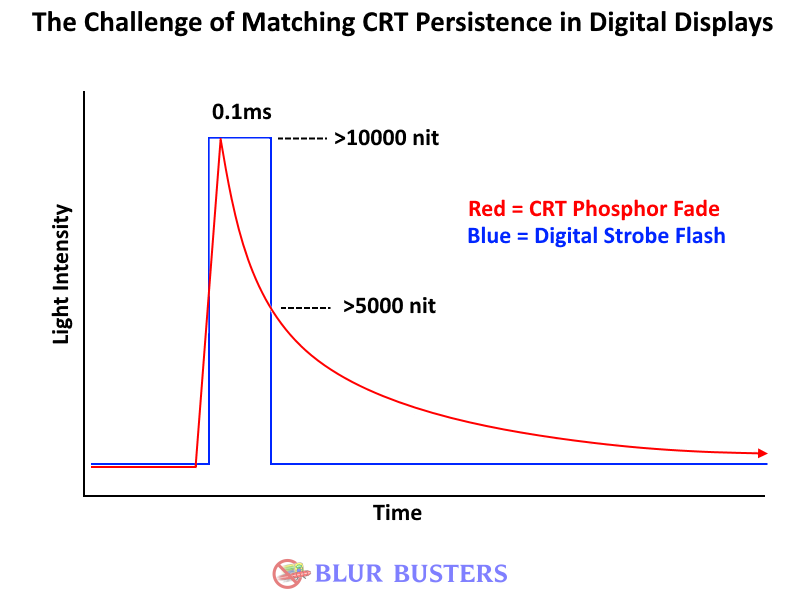
The phosphor still drops off very quickly [0][1][2], roughly within a millisecond. That’s why you would need a 1000 Hz LCD/OLED screen with really high brightness (and strobing logic) to approximate CRT motion clarity. On a traditional NTSC/PAL CRT, 1 ms is just under 16 lines, but the latest line is already much brighter than the rest. The slow-motion recording showing roughly one line at a time therefore seems accurate.
[0] https://blurbusters.com/wp-content/uploads/2018/01/crt-phosp...
[1] https://www.researchgate.net/figure/Phosphor-persistence-of-...
[2] https://www.researchgate.net/figure/Stimulus-succession-on-C...
Re: How does a screen work?
#39Not only was the initial diagram all/explaining, but the "pop"-"pip" on zoom-unzoom of the image was just as nice as playing with a sheet of bubble wrap. Wow, and that ruler on the right side, even with the sound. One of the nicest pages I have been on. And the landing page... https://www.makingsoftware.com/ It just keeps on giving.
Adding my congrats as well. The combination of well-written explanations for the semi-technical layperson combined with clear, intuitive graphics is a powerful instruction platform.
Re: How does a screen work?
#40I can appreciate these articles as they are but I personally don’t like them. They are junk food level of infotainment to me. Something I’d find on a Wikipedia summary section that covers general points. A CRT - to name one - is a device whose actual understanding will challenge people in profound ways. To ask “how does a screen even work?” and to begin to answer this question will require a bit more than a summary f…
[flagged]