Live data from Hacker News

A common urban intersection in the Netherlands (2018)

bicycledutch.wordpress.com

31–40 of 339 posts

Re: A common urban intersection in the Netherlands (2018)

#31
post #20

I moved from the U.S. to the Netherlands nine years ago, and I can attest that the bike infrastructure is amazing and has an outsized impact on your quality of life and general happiness. Being able to bike everywhere — safely, quickly, without any cultural baggage of "being one of those bicycle people" — is a total game-changer. It's one of those things that sounds kooky to people who haven't actually experienced it…

1000% agree. We moved 7 years ago and now have 4 kids. It is so valuable that my preteens can bike to tennis, friends, etc safely, even at night. Or that you can pop a toddler to childcare without a car seat and parking. Last year we finally got a car. I hardly ever use it.

And remember, the bike infrastructure was only built in the past 30-40 years. Before that, the Netherlands had a super car-focused infrastructure. It was only after the “stop murdering our children” political campaigns that the car focus shifted. https://usa.streetsblog.org/2013/02/20/the-origins-of-hollan...
Re: A common urban intersection in the Netherlands (2018)

#32
post #3

It's not that much different from Copenhagen where I live. Bike lanes are everywhere.

Is this intentional bait for the somewhat notorious "Copenhagen is Great ... but it's not Amsterdam" video by the Not Just Bikes channel? ;) (as a Dutchie living in Malmö: I love Copenhagen, and I'm already happy that it's a million times better than 99% of the rest of the world. Still, it's also true that the Netherlands has a head-start of a few decades on everyone else and that it does show if you look closely) [0…

Hahah, I would never! :D It definitely shows that the Netherlands had an early start and still an advantage. Kudos on that!

Re: A common urban intersection in the Netherlands (2018)

#33

I'm not sure how common this type of intersection is. I live and bike daily in Amsterdam and it took me about a minute to fully understand what's going on here. The picture seems to show a special case where the intersecting road is bike only, and instead of the normal painted arrows that show where bikes should queue up when making a left, there's an open area off to the left where one would wait behind the "shark t…

I haven't read the entire article, but this is a very common situation: main road with two cycle paths crosses a minor road (or has two side roads at the same place). All roads are also for cars. I'm not sure why the article makes such a difference between the two side roads: they seem quite similar apart from the one-car waiting space before the cycle path.

Re: A common urban intersection in the Netherlands (2018)

#34

I'm not sure how common this type of intersection is. I live and bike daily in Amsterdam and it took me about a minute to fully understand what's going on here. The picture seems to show a special case where the intersecting road is bike only, and instead of the normal painted arrows that show where bikes should queue up when making a left, there's an open area off to the left where one would wait behind the "shark t…

Yeah there is not really space for these eleborate intersections in central Amsterdam. Most are signal controlled or pure spaghetti with trams coming from four directions with almost absolute priority, like this one https://www.google.com/maps/place/52%C2%B021'49.1%22N+4%C2%B...

Re: A common urban intersection in the Netherlands (2018)

#35
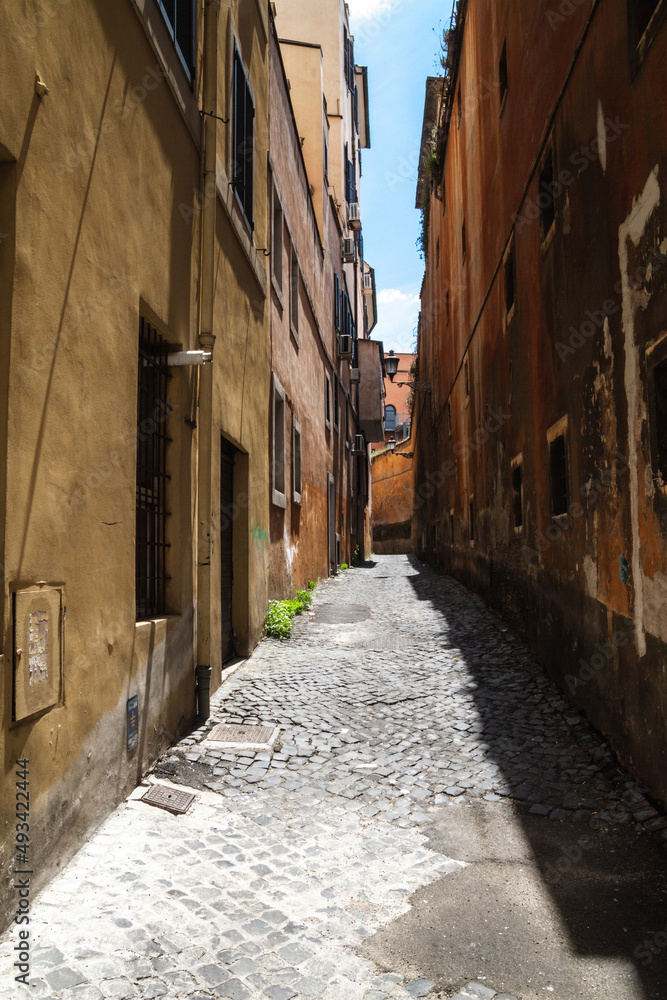
you need space to do that, not many cities in Europe have the luxury of being built from scratch and having so much space to dedicate to a single intersection.

Where i live (in Rome) the streets are like this

https://as1.ftcdn.net/v2/jpg/04/93/42/24/1000_F_493422444_Hw...

edit: anyway the simplest solution is to turn every intersection into a roundabout, no traffic lights needed, clear right of way, cars can't go fast and in the end it also makes it easier for pedestrians to cross the street.

Re: A common urban intersection in the Netherlands (2018)

#36

> Here you can see that a car drivers waiting for people cycling are never in the way of other people in cars. Am I blind or does it only work for just one or maybe two cars?

Correct. That is enough 95% of the time. (I made that number up, but it's not far from the truth.)

Re: A common urban intersection in the Netherlands (2018)

#38
post #3

It's not that much different from Copenhagen where I live. Bike lanes are everywhere.

Is this intentional bait for the somewhat notorious "Copenhagen is Great ... but it's not Amsterdam" video by the Not Just Bikes channel? ;) (as a Dutchie living in Malmö: I love Copenhagen, and I'm already happy that it's a million times better than 99% of the rest of the world. Still, it's also true that the Netherlands has a head-start of a few decades on everyone else and that it does show if you look closely) [0…

In general I try to avoid nationalism - a lot of what one perceives as "my country ABC is the best at XYZ!" is just "I was born in ABC so I am used to XYZ!".

But...for the small niche of cycling infrastructure, the top 10 list is The Netherlands in places 1 to 10, then no country in places 11 to 50, and then Denmark in place 51.

What is important to consider is that cycling infrastructure is all around great in The Netherlands everywhere. Not just in the center of Amsterdam. Industrial estates, villages in the middle of nowhere, roads through forests, popular attractions or theme parks, islands: everything is reachable by bike, usually with bike lanes that are well maintained and physically separated from the main road, and often with bicycles having right of way on roundabouts etc.

Re: A common urban intersection in the Netherlands (2018)

#39
post #29

Isn't it funny how part of the solution is a bit like introducing a one-car buffer into the queue, reducing back pressure? Makes me wonder how much traffic planning and distributed systems could learn from each other (or perhaps already have, I'm not an expert in either).

The article doesn't deal with what happens when the queue gets bigger than one. It looks like a second car would queue on the main road, blocking traffic. To eliminate this you could turn the buffer into a whole extra lane with room for say 5 cars to queue, but this would compromise on the nice feature where the partially turned car gets to completely turn and have great vision of the cycle lanes in both directions.…

At least where I live, such a type of intersection is used when a residential street branches off a large main road. You do not have a high volume of traffic going into this residential street, and "waiting for a crossing cyclist" does only take 1-2 seconds. So a buffer size of 1 is usually enough.

Re: A common urban intersection in the Netherlands (2018)

#40
post #29

Isn't it funny how part of the solution is a bit like introducing a one-car buffer into the queue, reducing back pressure? Makes me wonder how much traffic planning and distributed systems could learn from each other (or perhaps already have, I'm not an expert in either).

The article doesn't deal with what happens when the queue gets bigger than one. It looks like a second car would queue on the main road, blocking traffic. To eliminate this you could turn the buffer into a whole extra lane with room for say 5 cars to queue, but this would compromise on the nice feature where the partially turned car gets to completely turn and have great vision of the cycle lanes in both directions.…

Build more bike lanes.

To an extent, it's a self-solving problem. If you have great non-car transport options and an increase in traffic makes car driving less appealing, then more people will use those non-car transport options rather than joining the queue.

Post reply on HN