Live data from Hacker News

Polychromatic Pixels

compoundsemiconductor.net

31–40 of 149 posts

Re: Polychromatic Pixels

#31
post #16

My ultimate hope is that this will allow us to store and display color data as Fourier series. Right now we only represent colour as combinations of red, green, and blue, when a colour signal itself is really a combination of multiple "spectral" (pure) colour waves, which can be anything in the rainbow. Individually controllable microLEDs would change this entirely. We could visualize any color at will by combining t…

What would be the purpose of this?

The human eye can't distinguish light spectra producing identical tristimulus values. Thus for display purposes [1], color can be perfectly represented by 3 scalars.

[1] lighting is where the exact spectrum matters, c.f. color rendering index
Re: Polychromatic Pixels

#32
post #16

My ultimate hope is that this will allow us to store and display color data as Fourier series. Right now we only represent colour as combinations of red, green, and blue, when a colour signal itself is really a combination of multiple "spectral" (pure) colour waves, which can be anything in the rainbow. Individually controllable microLEDs would change this entirely. We could visualize any color at will by combining t…

Color data has three components for the simple reason that the human eye has three different color receptors. You can change the coordinate system of that color space, but three components will remain the most parsimonious representation.

Re: Polychromatic Pixels

#33
post #20

Earlier quoted context omitted.

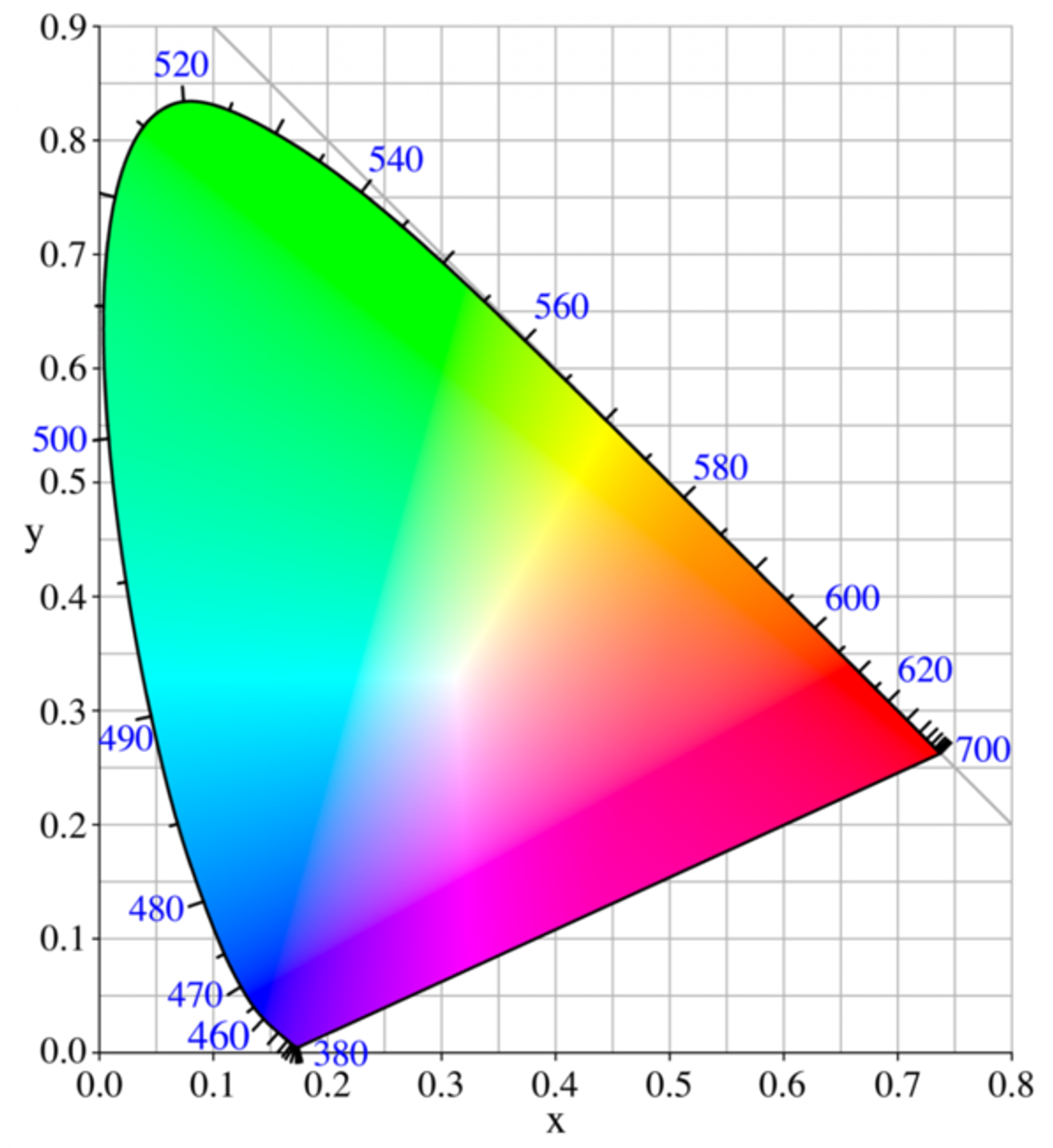
With two wavelength-tunable LEDs you should be able to cover the entire CIE colorspace. That's because the points on outer edge of CIE are pure wavelengths and you can get to any point inside by interpolating between two of them.

How do you make white?

E.g. mix 480nm cyan and 590nm orange.

Re: Polychromatic Pixels

#34
post #20

Earlier quoted context omitted.

With two wavelength-tunable LEDs you should be able to cover the entire CIE colorspace. That's because the points on outer edge of CIE are pure wavelengths and you can get to any point inside by interpolating between two of them.

How do you make white?

By mixing two complementary colors.

Re: Polychromatic Pixels

#35
post #4

These still produce a single [adjustable] wavelength, which means some colors that are displayable on displays of today are not representable using just one of these, and multiples will be required.

Yes, it’d be two subpixels instead of the current three. It’s not clear that that’s worth the added complexity of having to control each subpixel across two dimensions (brightness and wavelength) instead of just one (brightness).

Re: Polychromatic Pixels

#36
post #4

These still produce a single [adjustable] wavelength, which means some colors that are displayable on displays of today are not representable using just one of these, and multiples will be required.

If the refresh rate is high enough, a single LED could flip between multiple wavelengths to dither to non spectral colors.

Higher refresh/modulation rates imply higher power consumption. It’s already a trade-off in current display tech for mobile.

Re: Polychromatic Pixels

#37
post #35
post #4

These still produce a single [adjustable] wavelength, which means some colors that are displayable on displays of today are not representable using just one of these, and multiples will be required.

Yes, it’d be two subpixels instead of the current three. It’s not clear that that’s worth the added complexity of having to control each subpixel across two dimensions (brightness and wavelength) instead of just one (brightness).

Can you produce "white" with just two wavelengths?

Re: Polychromatic Pixels

#38
post #18

Hm, thinking about this further, this would need dithering to work properly (which probably works fine, but the perceived quality difference would mean pixel density comparisons aren't apples-to-apples) Presumably, you get to control hue and brightness per-pixel. But that only gives you access to a thin slice of the sRGB gamut (i.e. the parts of HSL where saturation is maxed out), but dithering can solve that. Coming…

Dithering is at worst equivalent to subpixels, which we already use.

If you take the "no subpixels" claim out of the article, this technology still seems useful for higher DPI and easier manufacture.

Re: Polychromatic Pixels

#39
post #18

Hm, thinking about this further, this would need dithering to work properly (which probably works fine, but the perceived quality difference would mean pixel density comparisons aren't apples-to-apples) Presumably, you get to control hue and brightness per-pixel. But that only gives you access to a thin slice of the sRGB gamut (i.e. the parts of HSL where saturation is maxed out), but dithering can solve that. Coming…

You really can't think about single wavelength tunable pixels as something except at the edge HSL.

I think about it from the CIE "triangle" where wavelength traces the outer edge, or even the Lab (Luminance a-green/red b-yellow/blue) color space since it's more uniform in perceivable SDR color difference (dE).

https://luminusdevices.zendesk.com/hc/article_attachments/44...

One key realization is that although 1 sub-pixel can't cover the gamut of sRGB (or Rec2020), but only 2 with wavelength and brightness control rather than 3 RGB. Realistically, this allows something like super-resolution because your blue (and red) visual resolution is much less than your green (eg 10-30pix/deg rather than ~60ppd). However, your eye's sensitivity off their XYZ peaks are less and perceived brightness would fall.

I guess what I'm saying is that a lot of the assumptions baked into displays have to be questioned and worked out for these kinds of pixels to get their full benefit.

Re: Polychromatic Pixels

#40
post #37
post #35

Earlier quoted context omitted.

Yes, it’d be two subpixels instead of the current three. It’s not clear that that’s worth the added complexity of having to control each subpixel across two dimensions (brightness and wavelength) instead of just one (brightness).

Can you produce "white" with just two wavelengths?

[deleted]
Post reply on HN