Live data from Hacker News

Casio-F-91W die-shot

zeptobars.com

31–40 of 167 posts

Re: Casio-F-91W die-shot

#31

I'm a big fan of the F105W which is basically the same watch with a vastly improved backlight that lights up the whole LCD. It makes a great watch extremely usable at night. I'd also recommend the Casio G-Shock GWM5610 which admittedly is about 5 times more expensive at $111 but it has UTC time and is absolutely bulletproof, along with radio sync and solar with solar charge indicator. It's currently my favorite among…

I love my GWM5610, the only thing I dislike is how hard to press the buttons are and the bad display angles. But other than that it's a damn brick. And the radio sync is magic.

Re: Casio-F-91W die-shot

#33
post #12

I bought one of those recently and I was surprised by how inaccurate it was. It drifted like 15 seconds every month. From what I've been reading, that is normal, but I was surprised - with all the technological advances that we have it is odd to think that cheap timekeeping is not a solved problem yet! Also: how is the software of these watches without a CPU designed? Is it something like Verilog or whatever?

> all the technological advances that we have This is 34 years old technology. You can get GPS watches relatively cheap and they'd sync with satellites automatically and always remain accurate.

Yes. I ended up buying a GWM5610 which synchronises through radio. It's cool. But still I would have hoped there would be a better "local" (i.e. self-reliant) solution.

Re: Casio-F-91W die-shot

#34
post #28

This is a remarkably interesting image. How do these guys even get these shots? I'd love to do this on all kinds of things at home..

I really like this one Defcon talk on chip decapping [1]. It's a pretty nasty process but absolutely one you can do on your driveway (poor man's fume hood, don't tell the EPA) at home. You can then just use a standard front lit microscope to take die shots.

[1] https://youtu.be/0Z4aF-qiziM

Re: Casio-F-91W die-shot

#35

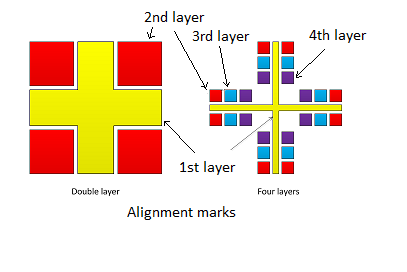
Is that a Swiss flag on the lower-left corner, or some kind of pads?

Maybe an alignment marker for layer stacking.

Yup! These sorts of crosses are used to align photolithography masks. Here's a similar example: https://www.seas.upenn.edu/~nanosop/images/alignmentmarks2.p...

There are a lot of other structures used to characterize the alignment and other fancy structures which support machine alignment for newer (than like the 90s) processes.

Re: Casio-F-91W die-shot

#36
post #12

I bought one of those recently and I was surprised by how inaccurate it was. It drifted like 15 seconds every month. From what I've been reading, that is normal, but I was surprised - with all the technological advances that we have it is odd to think that cheap timekeeping is not a solved problem yet! Also: how is the software of these watches without a CPU designed? Is it something like Verilog or whatever?

Almost all quartz watches have a similiar movement, running of a 32kHz crystal. Those give you about 15s/month accuracy, which is an oder of magnitude better than most mechanical watches and that for a very few bucks. More precise quartz watches exists, but they require quite a bit more effort, which of course translates into costs.

Actually one of the earliest quartz watches on the market from Omega used a 2MHz crystal and was very accurate. Personally I own a Seiko with a 200kHz system, which is good for about 20s/year. Then there are the thermo stabilized systems, which are even more accuarate. The problem is, that the frequency of the crystal depends on its temperature which is the main source of time inaccuracy (there are some watch enthusiasts which do get egg breeding cupboards which have constant temperatures up to tenths of degrees, they make for very accurate watches).

Currently, the best movements on the market are accurate to about 5s/year, which is pretty amazing considering the watches are worn on your wrist in varying conditions. With my precise Seiko watch I could even notice a slight change in speed when I moved quite a distance to a different town with slightly different weather. That shows how big a challenge a really accuarate wrist watch is.

Then there are the market concerns. The most basic and cheap quartz are already accurate enough for most non-enthusiasts. Then, after almost being killed by quartz watches in the 80ies, the luxury watch industry managed to establish a mechanical movement as the desirable item. So there are few expensive quartz watches left on the market, which would feature more sophisticated movements with higher accuracy. And finally, there is a range of higher value watches which receives time signals, be it official time signals in several regions or just GPS signals.

Cornered like this in the market, unfortunately not much money went into high-precisions movements. There are still a few on the market from Seiko, Breitling, Omega and Citizen (there might be more, but those come to my mind). And of course there is the Apple Watch, which is rather affordable and just uses NTP to get absolute precise timing.
Re: Casio-F-91W die-shot

#37
post #30

Earlier quoted context omitted.

> F105W which is basically the same watch with a vastly improved backlight Can’t stress this enough. The F-91W is useless at night because the backlight brightness is terrible. The F105W has an indiglo-style “EL” light that is very effective. The two watches are nearly identical from an aesthetic perspective. The functions are identical as are the buttons.

Indiglo has good looks and function. What I dislike is that it requires a high-voltage driver. As tiny and low-current as that may be, it is electrically and even slightly acoustically noisy, and not something that belongs in a low-voltage wristwatch.

Considering I might turn it on once per night for a second or less, I’m not concerned. Is the risk that it affects the timekeeping?

Re: Casio-F-91W die-shot

#38
post #23
post #10

Earlier quoted context omitted.

I think it's one blob of standard-cell logic on the left with power routing through the middle. I don't think there is any visible partitioning into functionality in this logic. The large amount of analog circuitry in the right half is a bit of a puzzle. It looks like some large capacitors, maybe a charge pump for something?

This is outside my wheelhouse, but I assumed that the large capacitor area was a (trimmable) capacitor bank that could be put in parallel with the load capacitor on the (external) quartz oscillator, allowing calibration to counter some unit-to-unit variant in crystal frequency.

That's a possibility, but I don't see any laser-trimming marks on the big capacitor. Another option would be selecting capacitors with fuses, but I don't see any fuses or capacitors with powers-of-two sizing. With the complexity of the circuitry in the right hand side, I think there are a bunch of analog things going on.

Re: Casio-F-91W die-shot

#39
post #28

This is a remarkably interesting image. How do these guys even get these shots? I'd love to do this on all kinds of things at home..

For die photos, you want a metallurgical microscope, one that shines light down through the lens. A typical microscope shines the light from underneath, which works well for biological samples, but not so well for chips.

The tricky part is decapping the chip. The easy way is to get a ceramic package, which you can decap with a chisel. Or a metal can, which you can open with a hacksaw. With a standard epoxy package, you can heat it with a hot air gun and twist it, and you have maybe 50% chance of the die separating from a package. The best way for epoxy packages is boiling sulfuric and/or nitric acid, which has obvious issues.

The other aspect is that you need to stitch together a bunch of images to get a high-resolution photo. I use Hugin, which lets just say that it has a learning curve.

Re: Casio-F-91W die-shot

#40
post #39
post #28

This is a remarkably interesting image. How do these guys even get these shots? I'd love to do this on all kinds of things at home..

For die photos, you want a metallurgical microscope, one that shines light down through the lens. A typical microscope shines the light from underneath, which works well for biological samples, but not so well for chips. The tricky part is decapping the chip. The easy way is to get a ceramic package, which you can decap with a chisel. Or a metal can, which you can open with a hacksaw. With a standard epoxy package, y…

[deleted]
Post reply on HN