Live data from Hacker News

A near 100% renewables grid is well within reach, and with little storage

reneweconomy.com.au

31–40 of 365 posts

Re: A near 100% renewables grid is well within reach, and with little storage

#31
post #29

One thing I would love to see addressed in these kinds of analyses: the efficacy of strategic placement of solar. Electrical demand tends to peak slightly after sundown for much of the year. However, the sun obviously doesn't set at the same time everywhere. Darwin's sunset is currently an hour and a half later than Sydney/Brisbane. Could building more equatorial/western solar installations together with transmission…

Transmission losses would eat any benefit, unfortunately. Of course, the author didn't model this at all. This is the problem with 99% of "actually we could totally rip out our entire infrastructure right now" posts - it's usually justified with crappy modeling that falls apart under slightly more scrutinizing consideration. Solar-only with low storage overhead might become more viable if we get room-temperature supe…

Losses wouldn’t be bad with HVDC, with the added benefit of HVDC ties not needing to be frequency synced across the entire grid, so you have some opportunity to increase resiliency.

I don’t think it’s a one-sized fits all solution. There will be places where storage will make sense, and other where longer distance transmission makes sense. I think the reality is it will be a mix of both, along with a nice diverse mix of generation methods.
Re: A near 100% renewables grid is well within reach, and with little storage

#32
post #10

The averages don’t tell me much. We need to look at percentiles with intermittent sources of energy. 99% still means 3 full days of blackout every year. So it needs to be sufficient to cover an even higher percentile (in fact I don’t even think there is an acceptable number of hours of blackout in a year). I would be curious how they get to that with energies that pretty much go to zero the week there is no wind.

That's what is different about this new study. It uses real time supply/demand figures instead of annualized averages. It meets 98.8% of demand with renewables and fills in with fossil power the rest of the time. To quote from the article: Key results from the 52 weeks of simulations are summarised as follows: - Renewables met 98.8% of demand over the year, with the remaining 1.2% met by ‘Other’ (fossils) - ‘Other’ g…

> 82% of demand was directly powered by wind and solar without having to pass through storage or be curtailed.

This is amazing. As an EE I wonder about transportation losses, but wind and solar should be pretty easy to decentralize, so maybe this is a non-issue. Wind might be a little harder to decentralize, but I don't know how the regional differences are in Australia. I'd suspect the coasts (or even offshore) would be windiest, which is also where most people tend to live.

Re: A near 100% renewables grid is well within reach, and with little storage

#34
post #10

The averages don’t tell me much. We need to look at percentiles with intermittent sources of energy. 99% still means 3 full days of blackout every year. So it needs to be sufficient to cover an even higher percentile (in fact I don’t even think there is an acceptable number of hours of blackout in a year). I would be curious how they get to that with energies that pretty much go to zero the week there is no wind.

> 99% still means 3 full days of blackout every year. Presumably the entire grid isn't going down. Brown outs in small parts of the country is what I'd expect. This sounds like the current state of California.

No post body was provided.

Re: A near 100% renewables grid is well within reach, and with little storage

#35
post #29

Earlier quoted context omitted.

Transmission losses would eat any benefit, unfortunately. Of course, the author didn't model this at all. This is the problem with 99% of "actually we could totally rip out our entire infrastructure right now" posts - it's usually justified with crappy modeling that falls apart under slightly more scrutinizing consideration. Solar-only with low storage overhead might become more viable if we get room-temperature supe…

Losses wouldn’t be bad with HVDC, with the added benefit of HVDC ties not needing to be frequency synced across the entire grid, so you have some opportunity to increase resiliency. I don’t think it’s a one-sized fits all solution. There will be places where storage will make sense, and other where longer distance transmission makes sense. I think the reality is it will be a mix of both, along with a nice diverse mix…

Australia seems especially well suited for long-distance transmission because development is so heavily weighted to the coasts; there's not a lot of existing built-up interior areas to route around. At 800 kilovolts HVDC line losses are only 5% per 2000 km:

https://publications.jrc.ec.europa.eu/repository/bitstream/J...

(See page 11)

Re: A near 100% renewables grid is well within reach, and with little storage

#36
Great analysis. I’m not so familiar with the AU energy market, so I don’t know how much of an update this result is vs. a reasonable prior.

The bigger simulation mentioned in the OP is the ISP: https://aemo.com.au/energy-systems/major-publications/integr.... Anyone know what that plan proposes in terms of energy mix?

> It is interesting to note that the ISP is predicting that approximately 9GW of peaking gas or liquids will need to be retained in the NEM’s generation mix out to 2050. This is more than the 6.6GW required so far in this study.

Though the OP notes that ISP is doing demand modeling too, instead of simulating a new supply mix for the present demand & supply conditions.

Re: A near 100% renewables grid is well within reach, and with little storage

#37

Earlier quoted context omitted.

The "Victorian Big Battery" cost about 100 million to build and provides 450MWh, so at those prices the 120GWh they calculate for 5 hours would cost about 25 billion. Not outrageous in the scale of nation building projects.

They won't use batteries for grid scale storage, that's a bit too expensive. They'll probably use hydro, some sort of heated mass or compressed air. Or gas, it's much better than coal at least.

I think in this model it is actually batteries. They pair pretty economically with solar to smooth output on the daily cycle.

They also include existing Hydro in their model, plus 'other' which is what mostly covers the storage on longer scales.

But there's easy answers for the rest too. It's just not modelled in this very simple model because most of the heavy lifting is always going to be solar and wind and that's probably the point they're trying to make.

Re: A near 100% renewables grid is well within reach, and with little storage

#38

5 hours of grid-scale storage seems like a lot.

It also doesn't sound like actually enough. They never have outages longer than 5 hours? And even with fully renewable sources they would never have periods longer than 5 hours without much generation?

Looks like they used Gas peaker plants (labeled "Other") to make up the difference during the times that was necessary.

Re: A near 100% renewables grid is well within reach, and with little storage

#39
post #29

One thing I would love to see addressed in these kinds of analyses: the efficacy of strategic placement of solar. Electrical demand tends to peak slightly after sundown for much of the year. However, the sun obviously doesn't set at the same time everywhere. Darwin's sunset is currently an hour and a half later than Sydney/Brisbane. Could building more equatorial/western solar installations together with transmission…

Transmission losses would eat any benefit, unfortunately. Of course, the author didn't model this at all. This is the problem with 99% of "actually we could totally rip out our entire infrastructure right now" posts - it's usually justified with crappy modeling that falls apart under slightly more scrutinizing consideration. Solar-only with low storage overhead might become more viable if we get room-temperature supe…

This is pretty outdated.. HVDC has solved most of the transmission problem. Even the typical "3.5% per 1,000km" assumption that shows up on Wikipedia is pretty out of date. Modern projects are built with much lower losses (since they're running much higher voltage) and central Australia with massive solar potential is no more than 2,000KM from anywhere else in the country so generation transmission losses would be more like 5% total...

Re: A near 100% renewables grid is well within reach, and with little storage

#40
post #32

Earlier quoted context omitted.

That's what is different about this new study. It uses real time supply/demand figures instead of annualized averages. It meets 98.8% of demand with renewables and fills in with fossil power the rest of the time. To quote from the article: Key results from the 52 weeks of simulations are summarised as follows: - Renewables met 98.8% of demand over the year, with the remaining 1.2% met by ‘Other’ (fossils) - ‘Other’ g…

> 82% of demand was directly powered by wind and solar without having to pass through storage or be curtailed. This is amazing. As an EE I wonder about transportation losses, but wind and solar should be pretty easy to decentralize, so maybe this is a non-issue. Wind might be a little harder to decentralize, but I don't know how the regional differences are in Australia. I'd suspect the coasts (or even offshore) woul…

Solar can be decentralized, wind less so.

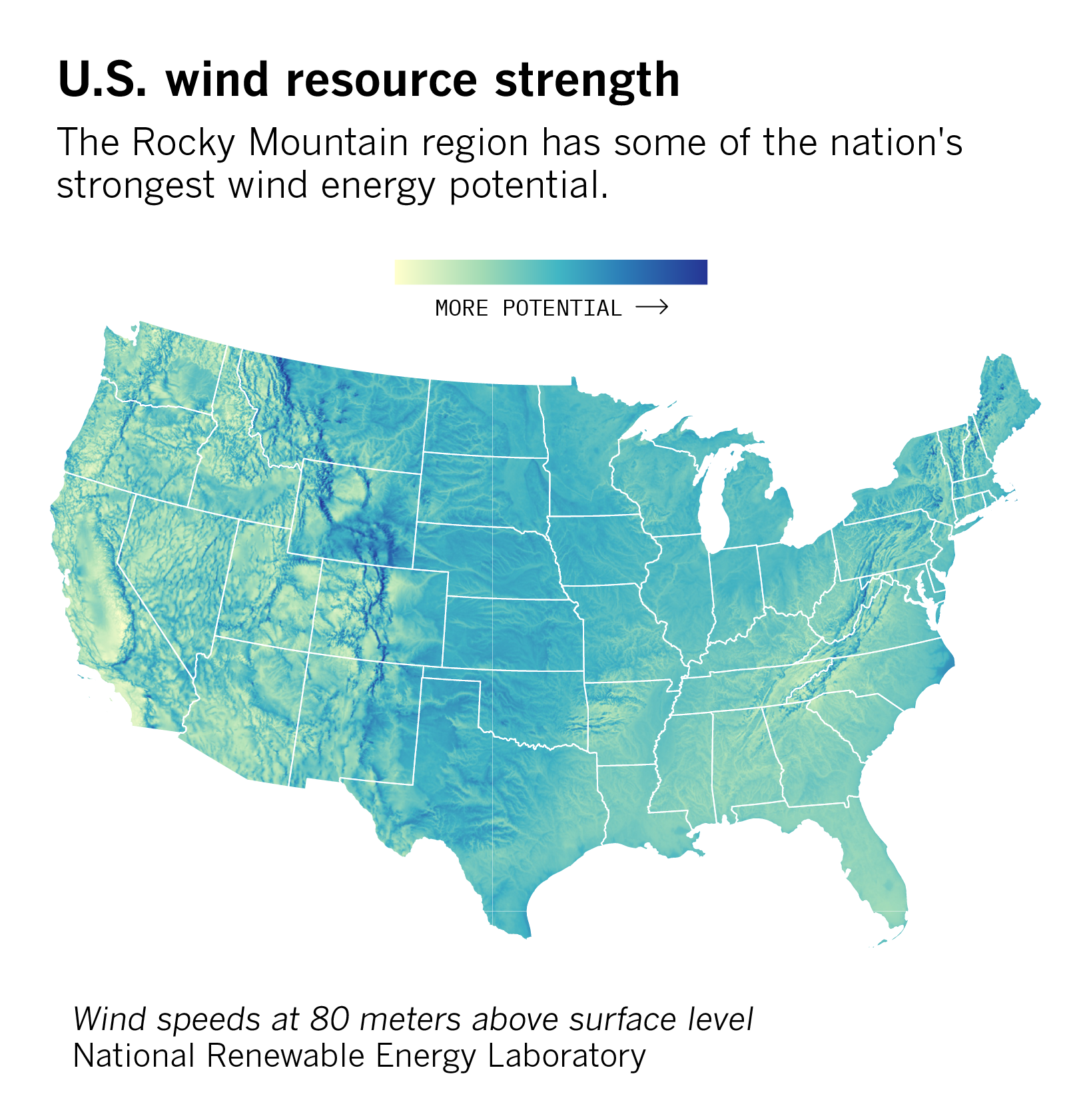
I don't know what wind looks like in Australia but in the US it heavily favors places like the Front Range and the Wyoming Divide: https://california-times-brightspot.s3.amazonaws.com/77/87/8...

EDIT: Looking at the same map for Australia I see that wind power potential tends to be strongest coastally, which matches population density (nice!)

I'll still say that overall you can't expect to decentralize wind like you can with solar.

Post reply on HN