Can anyone clue me in as to why this is on the NIH's website?
It's published in a journal that PubMed[1] indexes. The journal itself is about "research on all aspects of entropy and information theory" [2] which is why the paper is about estimation.
31–40 of 118 posts
Can anyone clue me in as to why this is on the NIH's website?
Earlier quoted context omitted.
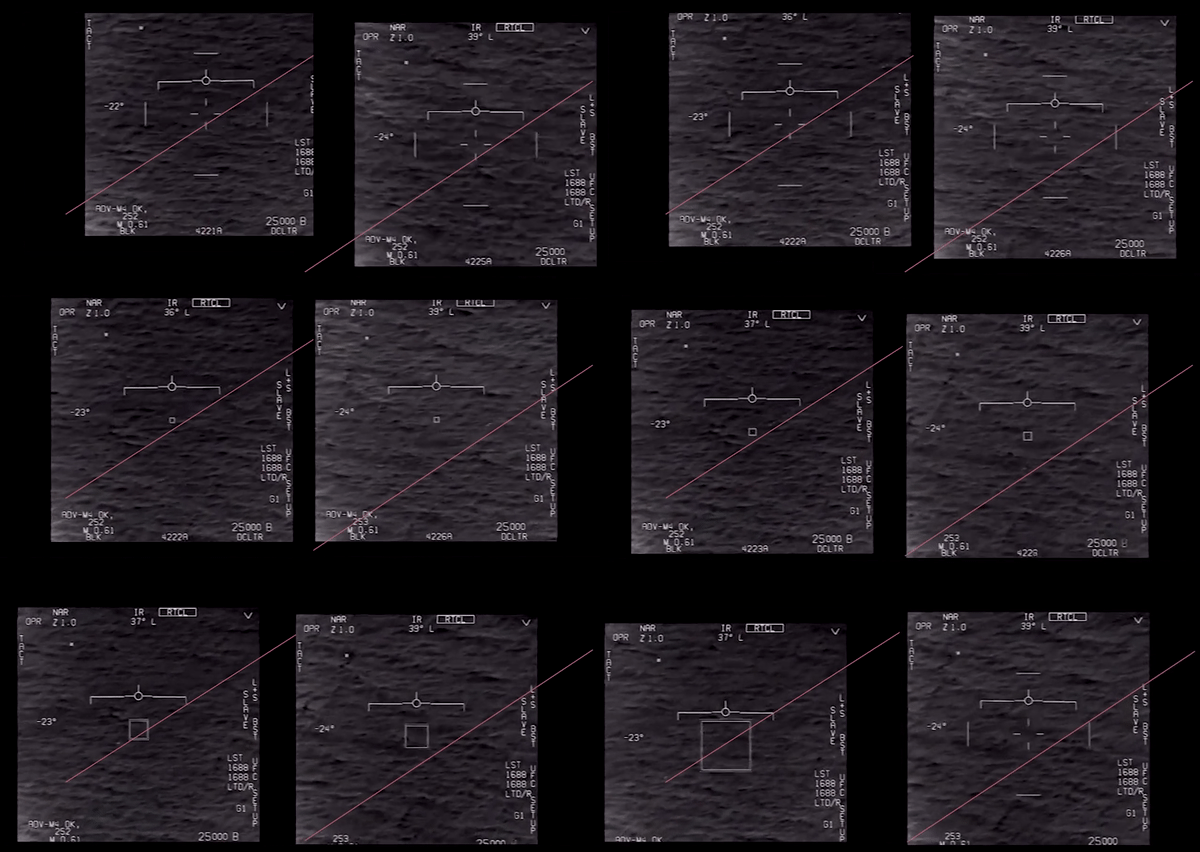
It isn't. The bird is between the sea and the jet and for all practically purposes stationary. When the camera pod on the jet tracks the bird and keeps it in the center of the field of view, what you are seeing is a parallax motion of the sea in the background due to the motion of the jet. This refers to the second clip in the linked video which also also the focus of the linked analysis.
You need to listen to the interview with the pilots who filmed this. They were chasing it, and couldn't catch up.
I’m not saying that’s what this is, I’m pointing out that what the pilots perceive is not to be taken at face value.
Earlier quoted context omitted.
1. They are trained to estimate the sizes of featureless flying tic-tacs?
They are trained in identifying aircraft and grok flight characteristics, and for the lack of better phrasing because I'm eating a taco at lunch, how one's senses can be wrong or skewed.
Here's my most recent thought. Pilots spent years up there and the only thing they see are other planes. If they see something it must be a plane, from the size they can estimate the distance. But when they suddenly see smaller drone, their pilot-brain thinks it's a plane, but because it is much smaller than a plane, they think it must be far away. And when it flys same speed as plane, in "projected" large distance t…
> But when they suddenly see smaller drone, their pilot-brain thinks it's a plane, but because it is much smaller than a plane, they think it must be far away. I think this neglects the training and capability of the pilot to the point of being insulting. You're basically saying that a (let's say) 15 year veteran of the U.S. Air Force can't tell the difference between a small drone and a plane, doesn't understand bas…
https://www.metabunk.org/data/MetaMirrorCache/49d95870dca331...
Some of the other high g-force examples turned out to be an FOV change of the camera footage when toggling IR.
>Collectively, these observations strongly suggest that these UAVs should be carefully studied by scientists [9,10,11,12,13].
>Unfortunately, the attitude that the study of UAVs (UFOs) is “unscientific” pervades the scientific community, including SETI (Search for Extraterrestrial Intelligence) [34], which is surprising, especially since efforts are underway to search for extraterrestrial artifacts in the solar system [35,36,37,38,39], particularly, on the Moon, Mars, asteroids [40], and at Earth-associated Lagrange points. Ironically, such attitudes inhibit scientific study, perpetuating a state of ignorance about these phenomena that has persisted for well over 70 years, which is now especially detrimental, since answers are presently needed [41,42,43,44,45,46].
It was news to me that in the Nimitz event ballistic missile defense radar was actually observing the UAVs in low Earth orbit days before the fighter jet encounter. Truly wild stuff. If I had to hazard a guess, these are unmanned (unaliened?) probes, the same ones that have been here for centuries or more. They may not even know or care what humans are or what we're up to. Maybe they keep dipping to the water to take…
> The main incident occurred on 14 November 2004, but several days earlier, radar operators on the USS Princeton were detecting UAPs appearing on radar at about 80,000+ feet altitude to the north of CSG11 in the vicinity of Santa Catalina and San Clemente Islands. Senior Chief Kevin Day informed us that the Ballistic Missile Defense (BMD) radar systems had detected the UAPs in low Earth orbit before they dropped down to 80,000 feet. The objects would arrive in groups of 10 to 20 and subsequently drop down to 28,000 feet with a several hundred foot variation, and track south at a speed of about 100 knots.
Can anyone clue me in as to why this is on the NIH's website?
It's published in a journal that PubMed[1] indexes. The journal itself is about "research on all aspects of entropy and information theory" [2] which is why the paper is about estimation . [1] https://www.ncbi.nlm.nih.gov/pmc/ [2] https://en.wikipedia.org/wiki/Entropy_(journal)
Now I have to go back and re-read that paper with an eye toward the statistical techniques used.
Earlier quoted context omitted.
The durations are expressed in ‘ship time’, ie the perceived duration from the pov of the ship. This is explicited further in the document.
Off topic comment: I'm pretty sure "explicited" is not a real word, but you've convinced me that it ought to be. Perfectly clear what you meant. Can somebody add this to the dictionary, please?
explicate — to give a detailed explanation of
https://www.merriam-webster.com/dictionary/explicate
It seems like a relatively newer word in its usage: https://books.google.com/ngrams/graph?year_start=1800&year_e...