Live data from Hacker News

Royal Society cautions against censorship of scientific misinformation online

royalsociety.org

31–40 of 970 posts

Re: Royal Society cautions against censorship of scientific misinformation online

#31

The issue that plagues us is a lack of trust in long-standing societal authorities. We can't follow the entire scientific proof chain for every piece of information we encounter, because we don't have time. So we rely on authority to some extent, whether that be peer review, government, independent bodies, etc. We need to be able to trust that these bodies are telling us the truth and aren't seeking to mislead us. Be…

The CDC recently dropped to 50% public trust, after repeated failures, mixed messages and outright lies in some cases.

They lie and then act incensed when the public stops believing them. Given the massive damage they've done, I'd consider it justified.

The CDC is an incompetent, bloated and fundamentally dishonest organization that was perfectly comfortable throwing grandma to the wolves via lies (masks don't work!) if it meant their unpreparedness wasn't exposed.

Via anti-masking lies, CDC irreparably damaged their reputation and also likely got people killed who believed them. The damage is deserved.

Re: Royal Society cautions against censorship of scientific misinformation online

#32

The issue that plagues us is a lack of trust in long-standing societal authorities. We can't follow the entire scientific proof chain for every piece of information we encounter, because we don't have time. So we rely on authority to some extent, whether that be peer review, government, independent bodies, etc. We need to be able to trust that these bodies are telling us the truth and aren't seeking to mislead us. Be…

>The issue that plagues us is a lack of trust in long-standing societal authorities.

What caused that trust to be lost? Is it something they did?

Re: Royal Society cautions against censorship of scientific misinformation online

#33
post #12

So many "misinformation censorship" proponents seem to have quickly forgotten just how much literally everyone in public health has spread misinformation this pandemic. It's unavoidable being wrong and often the cost of making claims without unimpeachable evidence is higher than the cost of being wrong. Name me a public health official who regularly made recommendations this pandemic and I'll show you misinformation.…

There is a difference between "malice" and "intentional misinformation".

Authority figures are not accurately representing risks and rewards of different actions and have deliberately shaped their messaging to achieve outcomes.

Direct from the horse's mouth: https://twitter.com/cdcgov/status/1233134710638825473 "CDC does not currently recommend the use of facemasks to help prevent novel #coronavirus. Take everyday preventive actions, like staying home when you are sick and washing hands with soap and water, to help slow the spread of respiratory illness." from 27 Feb 2020.

They weren't saying this because they thought face masks were ineffective, they said this because they were worried about supplies for healthcare workers. (obvious by reading subtext)

This is a repeated pattern. Making recommendations and sharing "facts" omitting important details in order to push for an unshared outcome.

Nobody is properly sharing how risks have changed, nobody is making premeditated decisions about which risks will be associated with which mitigating actions. The goalposts are constantly shifting to match present feelings instead of setting limits based on reason and sticking to them.

The censorship problem comes in when publishers are half-way committing to a narrative which changes by the week, failing to shut down people who are just saying things a subset wants to hear in order to get money and actively shutting down others who are actively trying to engage in reasonable debate.

The fundamental problem is this:

People have different risk tolerance and different priorities when it comes to personal risk, and individual actions affecting the community. These differences in this case are ultimately fairly small but getting blown out of proportion because it's profitable to get people upset.

It is all a moot point now and nobody seems to be able to articulate or admit it yet.

There is very little community protection left available by vaccinating. Vaccinated people can carry and spread the disease, the new variants are a lot less deadly, and a sizable proportion of the population already has natural immunity from getting the actual virus (~75M confirmed cases in the US for ~330M population, with estimates that there may have been as many as 4x as many cases which went uncounted)

It's over, we lost, the outcome we have is what we got and there is very little leverage to change it at this point because the vast majority of what was going to happen has already happened and the prevention tools we have are mostly ineffective at curbing spread.
Re: Royal Society cautions against censorship of scientific misinformation online

#34

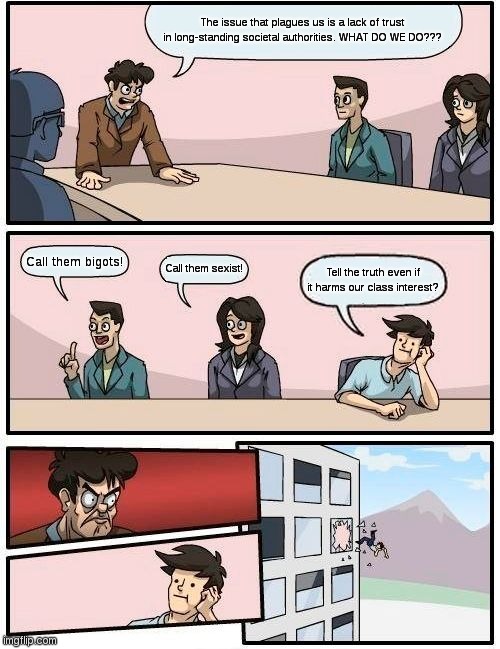
The issue that plagues us is a lack of trust in long-standing societal authorities. We can't follow the entire scientific proof chain for every piece of information we encounter, because we don't have time. So we rely on authority to some extent, whether that be peer review, government, independent bodies, etc. We need to be able to trust that these bodies are telling us the truth and aren't seeking to mislead us. Be…

> The issue that plagues us is a lack of trust in long-standing societal authorities.

Hmm. I wonder how we got there...[1]

[1] https://i.imgflip.com/63b63m.jpg

Re: Royal Society cautions against censorship of scientific misinformation online

#35
post #12

So many "misinformation censorship" proponents seem to have quickly forgotten just how much literally everyone in public health has spread misinformation this pandemic. It's unavoidable being wrong and often the cost of making claims without unimpeachable evidence is higher than the cost of being wrong. Name me a public health official who regularly made recommendations this pandemic and I'll show you misinformation.…

The anti mask, anti N95 masks with exhalation valve stuff has been the worst here I think. If you would let folks wear N95 with exhalation valves (highly comfortable) it just makes it easier for folks to protect themselves (and indirectly others). And for those who don't care, let's distinguish slightly between making sure those who want to protect themselves as much as possible can, and the need to force people down…

I don't get it.

Exhalation valves are great if you're using the mask to filter external dust.

Here you're trying to filter outgoing and ingoing droplets. Filtering is still going to be most effective at the source, even if you are wearing N.95.

Adding a valve is going to reduce the utility of the mask a lot for this application.

Re: Royal Society cautions against censorship of scientific misinformation online

#36

The issue that plagues us is a lack of trust in long-standing societal authorities. We can't follow the entire scientific proof chain for every piece of information we encounter, because we don't have time. So we rely on authority to some extent, whether that be peer review, government, independent bodies, etc. We need to be able to trust that these bodies are telling us the truth and aren't seeking to mislead us. Be…

For long term scientific correctness, what the hacker news crowd could help with tremendously is reproducibility and that means versioning and continuous integration with data, for research software. In context of a paper or doing research, you have to write software anyway.

The other one that pops to mind is probably statistical calculation helping services.

Maybe there are lots of other things as well - I haven't been involved with scientific research in a long time.

Re: Royal Society cautions against censorship of scientific misinformation online

#37
post #20

Earlier quoted context omitted.

The anti mask, anti N95 masks with exhalation valve stuff has been the worst here I think. If you would let folks wear N95 with exhalation valves (highly comfortable) it just makes it easier for folks to protect themselves (and indirectly others). And for those who don't care, let's distinguish slightly between making sure those who want to protect themselves as much as possible can, and the need to force people down…

This is a bit of a tangent, but I don't understand generalized masking. At best they flatten the curve, which I think at this point I believe flattening the curve is dangerous. We have pretty well defined risk demographics and if we could have covid seasons come and go quickly I think it gives the high risk demographics the best chance of applying multi-layered defenses against a shorter season of risk. There is of c…

The issue for me is I have elderly parents one of which does have a health condition (serious) that makes some breathing and other issues hard. They wanted to fly out to visit me. The absolute best way to avoid covid for yourself in my view is an N95 masks with a vent, because you can actually wear that thing for hours comfortably.

I have friends who treated folks with covid wearing N95's and did not get covid.

So I really wish we could let folks make the personal health decisions here a bit more. If you want to wear a bubble helmet with filters in it - go for it. The full respirator (almost always with an exhalation valve)? Go for it. The N95 with an exhalation valve? Go for it.

Instead, delta airlines says no full cover, no N95 with exhalation etc. So now you have people who don't want to wear masks forced to wear them, and they are preventing folks who really DO want to be protected (while on a flight) from fully protecting themselves. This is all in the name of "science" which really is not science but "public health" mumbo jumbo.

It goes back to this issue of basically not realizing folks have different risk profiles / tolerances. If I'm allowed to wear my N95 with an exhalation valve for 4 hours, I frankly don't care if the guy 2 rows back has his mask off his nose.

This mistake is lecturing everyone (often with bad info) and then blocking folks from solving their own problems. remember when the anti-body rapid tests had to have a chip, an iphone app and a medical professional in the mix?

And no, I don't believe in those cloth masks, and surgical masks on a plane for 5 hours? Hard to imagine that being highly effective.

Re: Royal Society cautions against censorship of scientific misinformation online

#38

The issue that plagues us is a lack of trust in long-standing societal authorities. We can't follow the entire scientific proof chain for every piece of information we encounter, because we don't have time. So we rely on authority to some extent, whether that be peer review, government, independent bodies, etc. We need to be able to trust that these bodies are telling us the truth and aren't seeking to mislead us. Be…

I wasn't social media that eroded the trust in research and science, it was the introduction of politics.

We need to separate research from politics. It needs to be a separate pillar of the state. You don't want reseachers chasing funds continously and doing short-term research for local sponsors. You want sizeable investments in long-term research projects, high autonomy and following of the scientific method. This way people would trust the results.

Re: Royal Society cautions against censorship of scientific misinformation online

#39
post #22

I always think about this. If you can't trust people with the ability to see or hear certain information, how can you even trust them to vote?

That question is the type of thing that a backdoored voting machine or corrupt election board could solve.

Luckily, so far there is no evidence of widespread voter fraud.

Re: Royal Society cautions against censorship of scientific misinformation online

#40

The issue that plagues us is a lack of trust in long-standing societal authorities. We can't follow the entire scientific proof chain for every piece of information we encounter, because we don't have time. So we rely on authority to some extent, whether that be peer review, government, independent bodies, etc. We need to be able to trust that these bodies are telling us the truth and aren't seeking to mislead us. Be…

The interesting thing about trust is it takes much longer to build than to spend.

Given the level scientific institutions have been spending trust over the past few years I'm not sure how this problem can be alleviated within our current framework.

Post reply on HN