"Between 2012 and 2013, McDonald’s reached agreement with the Kentucky Labor Cabinet to pay $29,000 in back wages to 203 affected workers" So basically you steal the money, and if you're caught (unlikely), you just have to give it back. Maybe I should try that next time I'm in a restaurant.
> Maybe I should try that next time I'm in a restaurant. Perhaps ironically, people frequently place orders at restaurant and then decline to come to pick them up & pay. They restaurant still ends up providing the service they promise, and the customer declines to make the payment they promise. It's terrible, but my understanding is it's similarly quite commonplace and hardly ever prosecuted.
An Epidemic of Wage Theft Is Costing Workers Hundreds of Millions a Year (2014)
31–40 of 126 posts
Re: An Epidemic of Wage Theft Is Costing Workers Hundreds of Millions a Year (2014)
#32https://www.tcworkerscenter.org/wp-content/uploads/2018/09/W...
Re: An Epidemic of Wage Theft Is Costing Workers Hundreds of Millions a Year (2014)
#33> This failure to pay what workers are legally entitled to can be called wage theft; in essence, it involves employers taking money that belongs to their employees and keeping it for themselves. Shouldn't it be called fraud rather than theft? I thought theft is depriving someone of something they own... but you don't own the money yet before the payment is made. My understanding was, if you intended to pay a debt, bu…
It's a term of art. In practice, I don't believe failure to pay a debt is ever prosecuted as theft, but it's not economically distinguishable from it even if a legal distinction is made. This is effectively the basis of accrual accounting whereby firms claim payments as an inflow on their income statements when a good or service is delivered, not when payment is received. Possibly worth noting if you reversed somethi…
This is the right answer. We aren't in danger of eroding the semantic foundations of law by using "theft" instead of "fraud", because "wage theft" is a term with a specific definition.
Re: An Epidemic of Wage Theft Is Costing Workers Hundreds of Millions a Year (2014)
#34Earlier quoted context omitted.
> Maybe I should try that next time I'm in a restaurant. Perhaps ironically, people frequently place orders at restaurant and then decline to come to pick them up & pay. They restaurant still ends up providing the service they promise, and the customer declines to make the payment they promise. It's terrible, but my understanding is it's similarly quite commonplace and hardly ever prosecuted.
Not quite the same, since McDonalds actually enjoyed the benefit of the labor without paying. So it's as if the customers sat down and ate the meal, then declined to pay. If the cops get called the consequence is probably worse than merely having to pay what was already agreed.
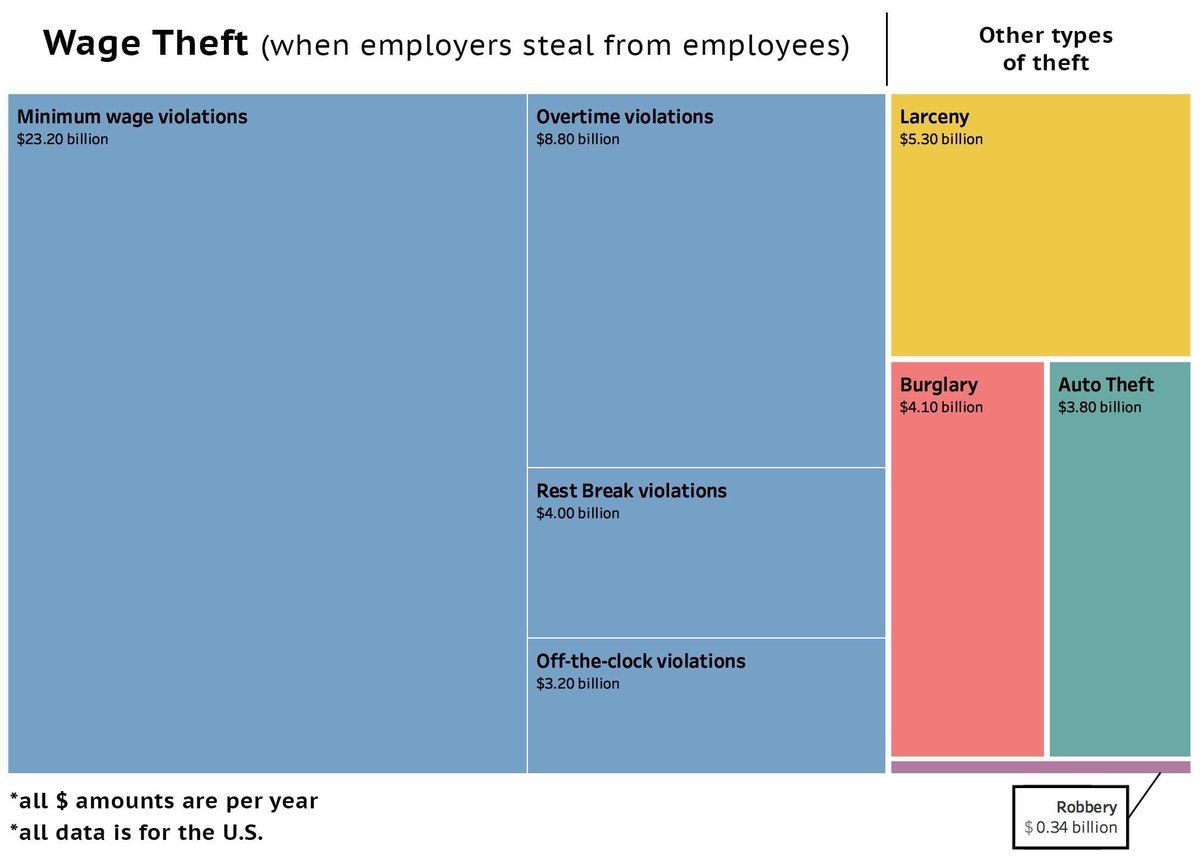
Re: An Epidemic of Wage Theft Is Costing Workers Hundreds of Millions a Year (2014)
#35> This failure to pay what workers are legally entitled to can be called wage theft; in essence, it involves employers taking money that belongs to their employees and keeping it for themselves. Shouldn't it be called fraud rather than theft? I thought theft is depriving someone of something they own... but you don't own the money yet before the payment is made. My understanding was, if you intended to pay a debt, bu…
"Wage theft" is an established term with clear meaning, is it really helpful in any way to try and cherry-pick it from first principles despite that? Nobody is using "wage theft" to suggest treating all unpaid debts as "theft".
If you go with your friends to restaurant, with the understanding that you’ll pay the bill everyone will pay you their part, but one of them refuses to do so afterwards, would anyone call this “meal theft”? No. Your friend is still morally in the wrong, of course, it’s just not what “theft” is.
Re: An Epidemic of Wage Theft Is Costing Workers Hundreds of Millions a Year (2014)
#36Earlier quoted context omitted.
> You don't own your employer's money until it's paid to you. I think you’re conflating wages earned and wages paid. You most definitely do “own” the funds you’ve earned even if your employer has not yet paid them out to you.
> I think you’re conflating wages earned and wages paid. You most definitely do “own” the funds you’ve earned even if your employer has not yet paid them out to you. "Own"... in what sense? Legally? If I went to withdraw that money from my employer's bank account, would they let me, or would they tell me that's not my money, even though it was supposed to be paid to me?
Your private employer doesn't have the ability to define ownership. Governments, and by extension the judiciary, however typically are granted that.
Re: An Epidemic of Wage Theft Is Costing Workers Hundreds of Millions a Year (2014)
#37"Between 2012 and 2013, McDonald’s reached agreement with the Kentucky Labor Cabinet to pay $29,000 in back wages to 203 affected workers" So basically you steal the money, and if you're caught (unlikely), you just have to give it back. Maybe I should try that next time I'm in a restaurant.
> Maybe I should try that next time I'm in a restaurant. Perhaps ironically, people frequently place orders at restaurant and then decline to come to pick them up & pay. They restaurant still ends up providing the service they promise, and the customer declines to make the payment they promise. It's terrible, but my understanding is it's similarly quite commonplace and hardly ever prosecuted.
You can order whatever you want unless a payment is made and product accepted a legal transaction hasn't occured. Missed items, uncooked food, poor quality are common reasons not to accept and send back. You can decide to decline the transaction at any point.
What businesses do is make the person pay first. Rarely does a fastfood worker take my order.. stop.. makes my food and then asks me to pay. They take my money serve the next person, I wait to get called.
A drive through is different and they get very low rates of drivers ordering only to drive away.
Businesses have found a way to deal with this issue.
Re: An Epidemic of Wage Theft Is Costing Workers Hundreds of Millions a Year (2014)
#38Earlier quoted context omitted.
> You don't own your employer's money until it's paid to you. I think you’re conflating wages earned and wages paid. You most definitely do “own” the funds you’ve earned even if your employer has not yet paid them out to you.
> I think you’re conflating wages earned and wages paid. You most definitely do “own” the funds you’ve earned even if your employer has not yet paid them out to you. "Own"... in what sense? Legally? If I went to withdraw that money from my employer's bank account, would they let me, or would they tell me that's not my money, even though it was supposed to be paid to me?
Re: An Epidemic of Wage Theft Is Costing Workers Hundreds of Millions a Year (2014)
#39Earlier quoted context omitted.
> You don't own your employer's money until it's paid to you. I think you’re conflating wages earned and wages paid. You most definitely do “own” the funds you’ve earned even if your employer has not yet paid them out to you.
> I think you’re conflating wages earned and wages paid. You most definitely do “own” the funds you’ve earned even if your employer has not yet paid them out to you. "Own"... in what sense? Legally? If I went to withdraw that money from my employer's bank account, would they let me, or would they tell me that's not my money, even though it was supposed to be paid to me?
Re: An Epidemic of Wage Theft Is Costing Workers Hundreds of Millions a Year (2014)
#40If USPS can get away with wage theft easily without consequences, I’m guessing it’s even easier for private employers. https://www.npr.org/2021/09/02/1033727651/investigation-show...